Radioactivity — Syllabus
ICSE · Class 10 · Physics
What Radioactivity covers in ICSE Class 10 Physics: 4 topics, for the 2026-27 session. Part of the ICSE Class 10 Physics syllabus.
Interactive on Super Tutor
Studying Radioactivity? Get the full interactive chapter.
Quizzes, flashcards, AI doubt-solver and a step-by-step study plan — built for syllabus and more.
Free trial, no card needed.
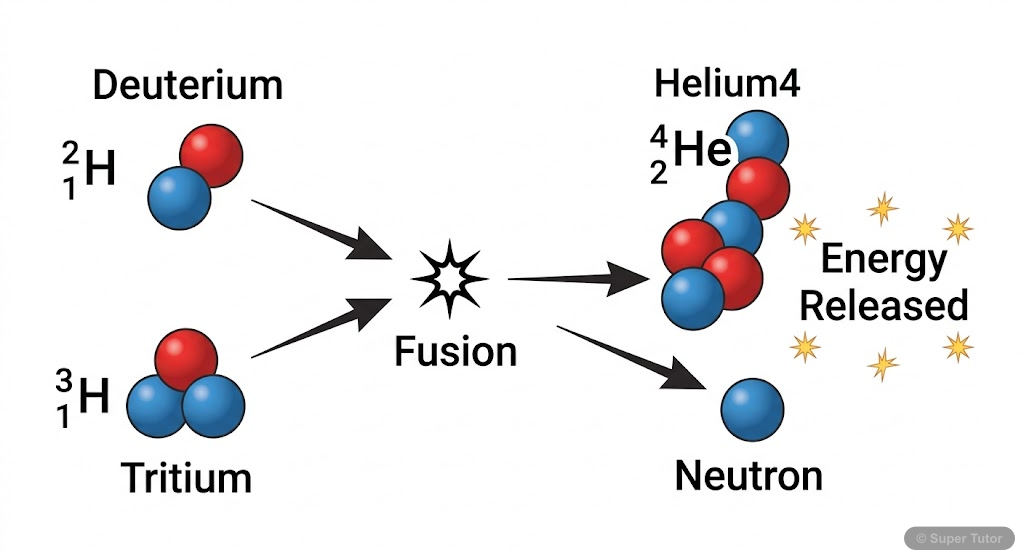
Learn better with visuals Super Tutor pairs illustrations like this with notes and quizzes for Radioactivity.
Get startedTopics in Radioactivity
Structure of Atom and Nucleus
- An atom is made of three particles: proton, neutron, and electron.
- Protons and neutrons are concentrated in the nucleus, while electrons revolve around the nucleus in orbits.
- The nucleus is extremely small, with size between 10^-15 m and 10^-14 m.
Isotopes, Isobars and Isotones
- Elements having the same atomic number but different mass number are called isotopes.
- Atoms of different elements having the same mass number but different atomic number are called isobars.
- Atoms having different number of protons but same number of neutrons are called isotones.
Discovery and Nature of Radioactivity
- Henry Becquerel discovered radioactivity after observing that uranium and its salts emit radiations called Becquerel rays.
- Becquerel rays are of three types: alpha, beta, and gamma.
- Radioactivity is the spontaneous emission of alpha, beta, and gamma radiations from a natural radioactive element.
Alpha, Beta and Gamma Radiations
- Alpha particles are positively charged and are doubly ionised helium nuclei.
- Alpha particle mass is approximately four times the mass of proton, and its charge is double that of proton.
- Alpha particles move at about 1/10 of the speed of light, or 3×10^7 m/s.
Key Concepts
Central concept: Radioactivity and nuclear changes
Work through every topic in Radioactivity with notes and quizzes
Start This ChapterFrequently Asked Questions
What are the important topics in Radioactivity for ICSE Class 10 Physics?
How should I revise Radioactivity for the ICSE Class 10 board exam?
Sources & Official References
Content is aligned to the official syllabus. Refer to the board website for the latest curriculum.
More resources for Radioactivity
Practice Quiz
Test yourself with a quick quiz
Important Questions
Exam-style questions with answers
Revision Notes
Key points for last-minute revision
Formula Sheet
The chapter's formulas in one place
Chapter Summary
Understand the chapter at a glance
Concept Maps
See how topics connect
Study Plan
Step-by-step plan for this chapter
Flashcards
Quick-fire cards for active recall
For serious students
Get the full Radioactivity chapter — start free.
Quizzes, flashcards, an AI doubt solver and a study plan for ICSE Class 10 Physics. Free to start, no card needed.