Excretory Products and Their Elimination — Revision Notes
ICSE · Class 11 · Biology
Excretory Products and Their Elimination revision notes for ICSE Class 11 Biology: 4 topics in quick points. Part of the ICSE Class 11 Biology syllabus.
Interactive on Super Tutor
Studying Excretory Products and Their Elimination? Get the full interactive chapter.
Quizzes, flashcards, AI doubt-solver and a step-by-step study plan — built for revision notes and more.
Free trial, no card needed.
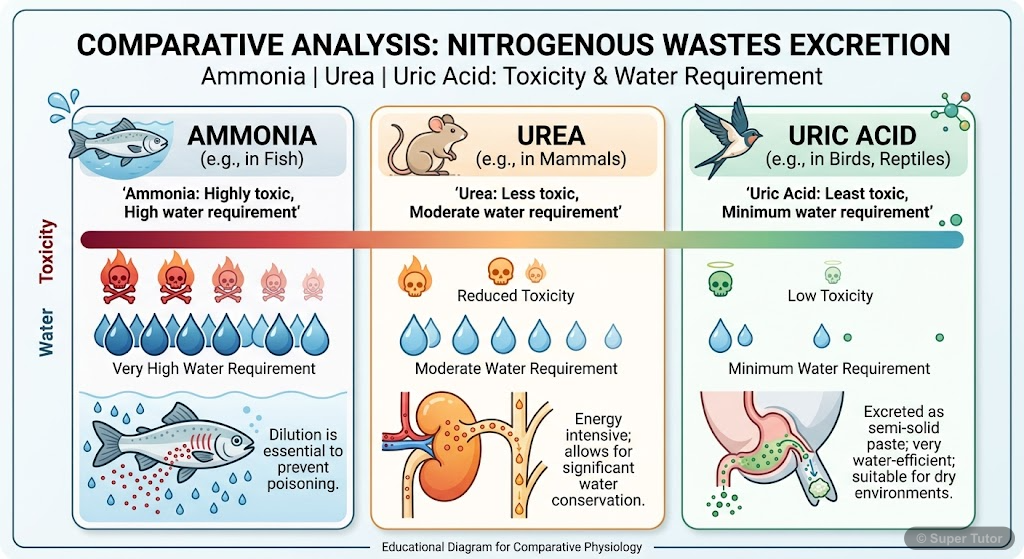
One of 14 illustrations for Excretory Products and Their Elimination in Super Tutor — alongside flashcards, concept maps and practice questions.
Key Topics to Revise
1. Nitrogenous Waste and Modes of Excretion
- Major nitrogenous excretory products are ammonia, urea, uric acid, creatine, creatinine, trimethylamine oxide, and guanine.
- Ammonia is highly toxic, highly soluble, and needs much water for elimination.
- Urea is less toxic than ammonia but still needs to be diluted for elimination from the body.
2. Human Excretory System: Kidney, Ureter, Bladder, Urethra
- The human excretory system consists of two kidneys, two ureters, a urinary bladder, and a urethra.
- The two kidneys each weigh about 150 g in an adult human.
- Each kidney measures about 10-12 cm long, 5-7 cm broad, and 2-3 cm thick.
3. Nephron and Renal Corpuscle
- There are about 1.2 million nephrons in a human kidney.
- The nephron is the functional and excretory unit of the kidney.
- A nephron has two main parts: the renal corpuscle and the renal tubule.
4. Urine Formation: Filtration, Reabsorption, Secretion
- Urine formation occurs in three steps: glomerular filtration, tubular reabsorption, and tubular secretion.
- Glomerular filtration is the filtration of blood in the glomerulus to form a protein-free filtrate.
- About 1100-1200 ml of blood is filtered by the kidneys per minute.
Get complete notes with diagrams and examples
Full NotesKey Concepts
Frequently Asked Questions
What are the important topics in Excretory Products and Their Elimination for ICSE Class 11 Biology?
How should I revise Excretory Products and Their Elimination for Class 11 exams?
Sources & Official References
Content is aligned to the official syllabus. Refer to the board website for the latest curriculum.
More resources for Excretory Products and Their Elimination
For serious students
Get the full Excretory Products and Their Elimination chapter — start free.
Quizzes, flashcards, an AI doubt solver and a study plan for ICSE Class 11 Biology. Free to start, no card needed.