Excretory Products and Their Elimination — Chapter Summary
ICSE · Class 11 · Biology
Summary of Excretory Products and Their Elimination for ICSE Class 11 Biology. Part of the ICSE Class 11 Biology syllabus.
Interactive on Super Tutor
Studying Excretory Products and Their Elimination? Get the full interactive chapter.
Quizzes, flashcards, AI doubt-solver and a step-by-step study plan — built for chapter summary and more.
Free trial, no card needed.
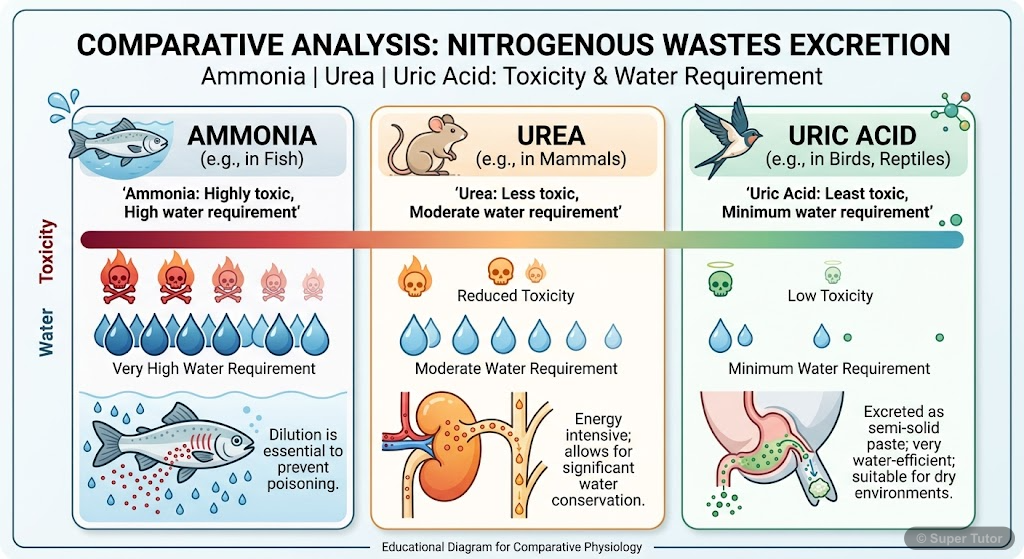
One of 14 illustrations for Excretory Products and Their Elimination in Super Tutor — alongside flashcards, concept maps and practice questions.
Overview
Excretion is the removal of waste products from the body. Carbon dioxide, water, nitrogenous wastes, excess salts, and some other substances must be removed because they become harmful if they accumulate. In humans, the urinary system is the main excretory system, and the kidneys play the central ro
Key Concepts
Excretion is the removal of waste
Excretion is the removal of waste products, mainly nitrogenous wastes, from the body. It also helps remove excess water, salts, vitamins, hormones, an
Ammonotelism uses ammonia
Ammonotelism uses ammonia, ureotelism uses urea, and uricotelism uses uric acid as the main nitrogenous waste. Ammonia is most toxic, urea is less tox
The human urinary system includes two
The human urinary system includes two kidneys, two ureters, urinary bladder, and urethra. Kidneys lie retroperitoneally on either side of the vertebra
Each kidney is dark red
Each kidney is dark red, bean-shaped, and has cortex and medulla. The medulla contains renal pyramids, and the hilus is the region where the ureter, r
A nephron is the functional unit
A nephron is the functional unit of the kidney. It has a renal corpuscle and a renal tubule. Two types occur: cortical nephrons with short loops of He
Learning Objectives
- Define excretion and explain its importance in maintaining homeostasis.
- Distinguish between ammonotelism, ureotelism, and uricotelism.
- Describe the human excretory system and the structure of kidney and nephron.
- Explain the steps of urine formation: filtration, reabsorption, and secretion.
- Understand the counter current mechanism and its role in concentrating urine.
Frequently Asked Questions
What are the important topics in Excretory Products and Their Elimination for ICSE Class 11 Biology?
How should I revise Excretory Products and Their Elimination for Class 11 exams?
Sources & Official References
Content is aligned to the official syllabus. Refer to the board website for the latest curriculum.
More resources for Excretory Products and Their Elimination
For serious students
Get the full Excretory Products and Their Elimination chapter — start free.
Quizzes, flashcards, an AI doubt solver and a study plan for ICSE Class 11 Biology. Free to start, no card needed.