Complex Numbers — Chapter Summary
ICSE · Class 11 · Mathematics
Summary of Complex Numbers for ICSE Class 11 Mathematics. Part of the ICSE Class 11 Mathematics syllabus. Complex numbers extend real numbers by.
Interactive on Super Tutor
Studying Complex Numbers? Get the full interactive chapter.
Quizzes, flashcards, AI doubt-solver and a step-by-step study plan — built for chapter summary and more.
Free trial, no card needed.
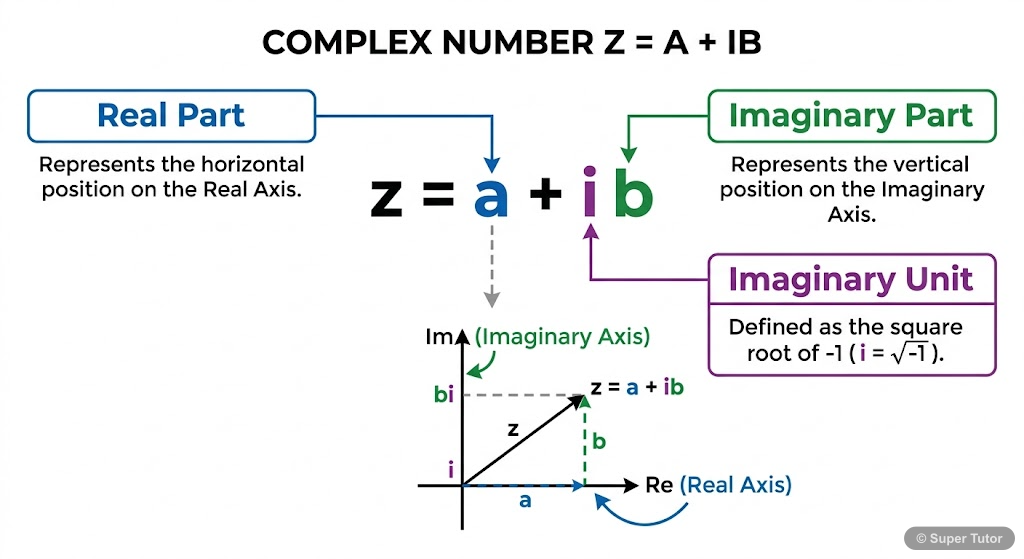
Learn better with visuals Super Tutor pairs illustrations like this with notes and quizzes for Complex Numbers.
Overview
Complex numbers extend real numbers by introducing the imaginary unit i, where i = sqrt(-1). They make it possible to work with square roots of negative numbers, simplify powers of i, and represent numbers geometrically on the Argand plane. The chapter develops the basic form a + ib, shows how to co
Key Concepts
The imaginary unit is defined by
The imaginary unit is defined by i = sqrt(-1), so i^2 = -1. It is a solution of x^2 + 1 = 0. Powers of i repeat in the cycle i, -1, -i, 1.
An imaginary number is a number
An imaginary number is a number whose square is less than zero. For every real number b, ib is an imaginary number. For any non-negative a, sqrt(-a) =
A complex number has the form
A complex number has the form a + ib, where a and b are real numbers. The set of all complex numbers is C. Here, a is the real part and b is the imagi
Two complex numbers a1 + ib1
Two complex numbers a1 + ib1 and a2 + ib2 are equal exactly when a1 = a2 and b1 = b2. If Im z = 0, the number is purely real. If Re z = 0, it is purel
If z1 = a1 + ib1
If z1 = a1 + ib1 and z2 = a2 + ib2, then z1 + z2 = (a1 + a2) + i(b1 + b2), z1 - z2 = (a1 - a2) + i(b1 - b2), and z1 z2 = (a1a2 - b1b2) + i(a1b2 + a2b1
Learning Objectives
- Understand the meaning of the imaginary unit i and why it is needed
- Write complex numbers in Cartesian form a + ib
- Identify real part, imaginary part, purely real and purely imaginary complex numbers
- Perform addition, subtraction, multiplication, division, and find multiplicative inverse of complex numbers
- Use conjugate and modulus to simplify calculations
Frequently Asked Questions
What are the important topics in Complex Numbers for ICSE Class 11 Mathematics?
How should I revise Complex Numbers for Class 11 exams?
Sources & Official References
Content is aligned to the official syllabus. Refer to the board website for the latest curriculum.
More resources for Complex Numbers
Practice Quiz
Test yourself with a quick quiz
Important Questions
Exam-style questions with answers
Revision Notes
Key points for last-minute revision
Formula Sheet
The chapter's formulas in one place
Concept Maps
See how topics connect
Study Plan
Step-by-step plan for this chapter
Flashcards
Quick-fire cards for active recall
Syllabus
What topics to cover
For serious students
Get the full Complex Numbers chapter — start free.
Quizzes, flashcards, an AI doubt solver and a study plan for ICSE Class 11 Mathematics. Free to start, no card needed.