Permutations and Combinations — Chapter Summary
ICSE · Class 11 · Mathematics
Summary of Permutations and Combinations for ICSE Class 11 Mathematics. Part of the ICSE Class 11 Mathematics syllabus.
Interactive on Super Tutor
Studying Permutations and Combinations? Get the full interactive chapter.
Quizzes, flashcards, AI doubt-solver and a step-by-step study plan — built for chapter summary and more.
Free trial, no card needed.
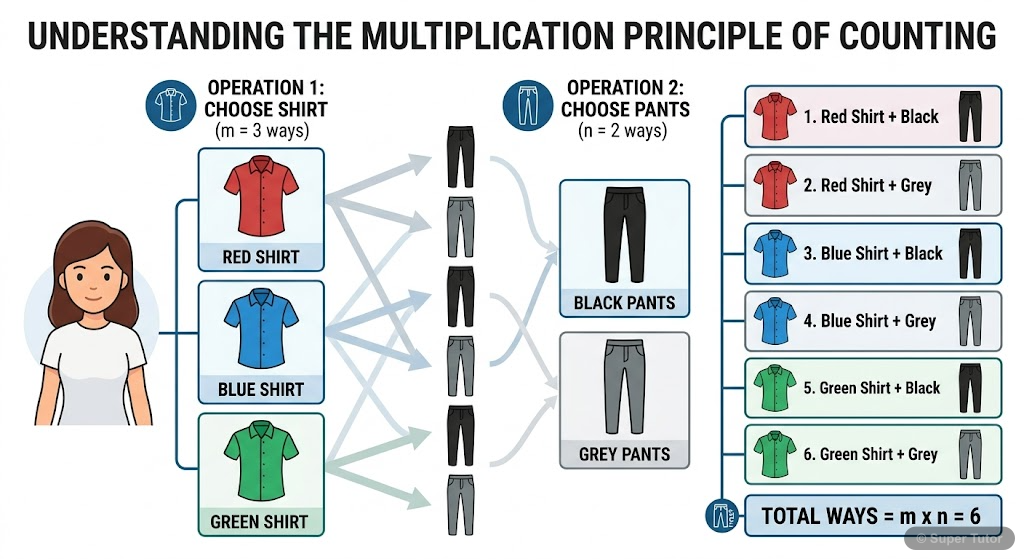
One of 11 illustrations for Permutations and Combinations in Super Tutor — alongside flashcards, concept maps and practice questions.
Overview
Permutations and combinations study counting methods used to find how many arrangements or selections are possible. Factorial gives the basic counting tool, the multiplication principle counts successive choices, and the addition principle counts disjoint alternatives. Permutations count ordered arr
Key Concepts
The factorial of a positive integer
The factorial of a positive integer n is n! = n × (n - 1) × (n - 2) × ... × 2 × 1. Also, 1! = 1 and 0! = 1 by convention. Factorial is not defined for
If one event can happen
If one event can happen in m ways and a second event can happen in n ways after it, then the two events in succession can happen in m × n ways. It is
If two disjoint events can happen
If two disjoint events can happen in m ways and n ways respectively, then the event A or B can happen in m + n ways. It applies only when the events h
A permutation is an arrangement
A permutation is an arrangement of objects in a definite order. For n different objects taken r at a time without repetition, nPr = n!/(n-r)!. Order m
A combination is an unordered selection
A combination is an unordered selection of objects. For n different objects taken r at a time, nCr = n!/[r!(n-r)!]. Order does not matter, so AB and B
Learning Objectives
- Understand factorial notation and its basic properties.
- Use the multiplication principle and addition principle correctly.
- Distinguish between permutations and combinations.
- Apply the formula for permutations of distinct and non-distinct objects.
- Solve circular permutation problems for round-table and necklace arrangements.
Frequently Asked Questions
What are the important topics in Permutations and Combinations for ICSE Class 11 Mathematics?
How should I revise Permutations and Combinations for Class 11 exams?
Sources & Official References
Content is aligned to the official syllabus. Refer to the board website for the latest curriculum.
More resources for Permutations and Combinations
Practice Quiz
Test yourself with a quick quiz
Important Questions
Exam-style questions with answers
Revision Notes
Key points for last-minute revision
Formula Sheet
The chapter's formulas in one place
Concept Maps
See how topics connect
Study Plan
Step-by-step plan for this chapter
Flashcards
Quick-fire cards for active recall
Syllabus
What topics to cover
For serious students
Get the full Permutations and Combinations chapter — start free.
Quizzes, flashcards, an AI doubt solver and a study plan for ICSE Class 11 Mathematics. Free to start, no card needed.