Limits — Chapter Summary
ICSE · Class 11 · Mathematics
Summary of Limits for ICSE Class 11 Mathematics. Key concepts: The limit of a function f, If limits of two functions and If a lies in the domain.
Interactive on Super Tutor
Studying Limits? Get the full interactive chapter.
Quizzes, flashcards, AI doubt-solver and a step-by-step study plan — built for chapter summary and more.
Free trial, no card needed.
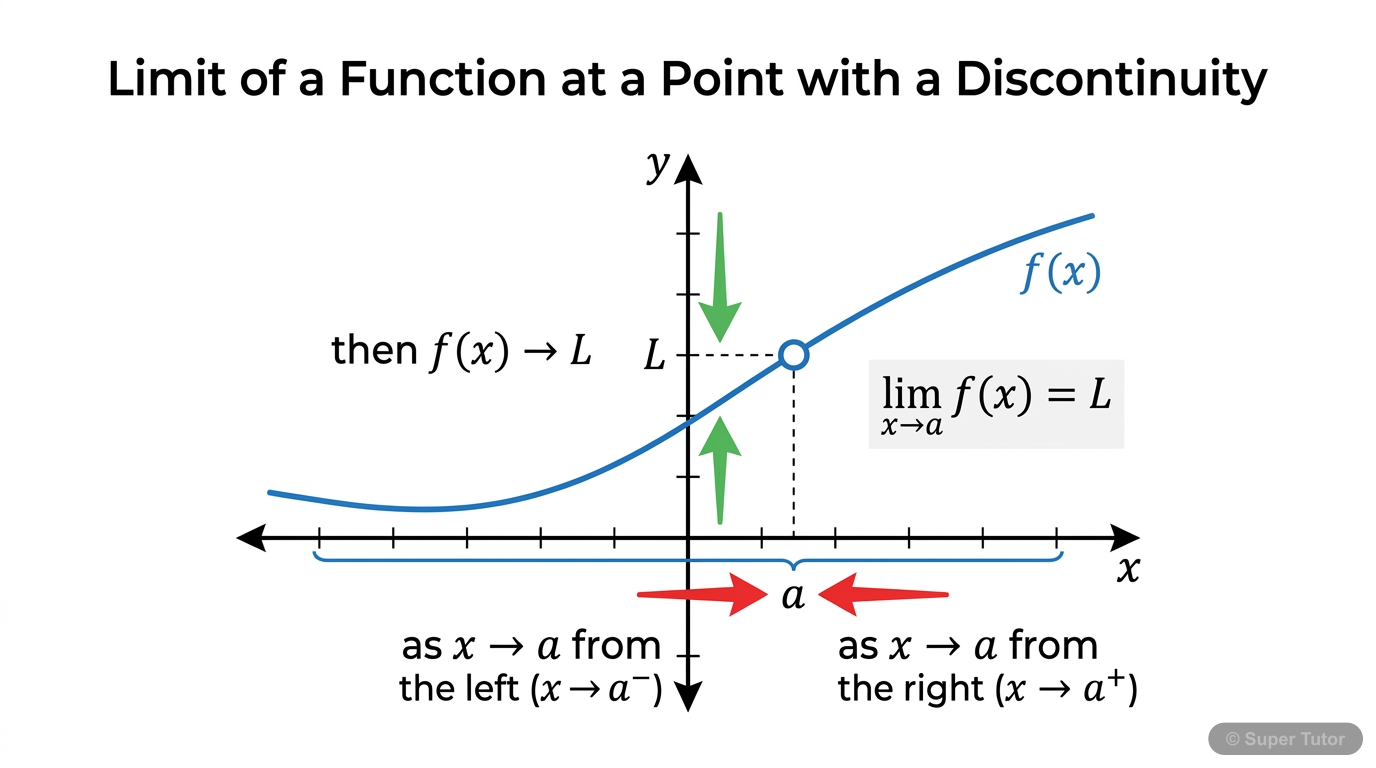
Learn better with visuals Super Tutor pairs illustrations like this with notes and quizzes for Limits.
Overview
Limits describe the value a function approaches as the input approaches a given number. This idea is the base of calculus. A limit can be studied by direct substitution when the function is defined at the point, or by algebraic methods when direct substitution gives an indeterminate form such as 0/0
Key Concepts
The limit of a function f
The limit of a function f is a real number l as x tends to c if the value of f(x) approaches l as x approaches c. It is written as lim_{x→c} f(x).
If limits of two functions exist
If limits of two functions exist at the same point, then the limit of their sum, difference, product, and quotient can be found using the standard lim
If a lies in the domain
If a lies in the domain of f, then lim_{x→a} f(x) = f(a). This is the easiest method when the function is defined at the point of approach.
When direct substitution gives 0/0
When direct substitution gives 0/0, factorise numerator and denominator, cancel the common factor, and then substitute again. The common factor is oft
For expressions containing square roots
For expressions containing square roots, multiply numerator and denominator by the conjugate to remove the root. This often changes an indeterminate f
Learning Objectives
- Understand the meaning of a limit and its notation.
- Use the algebra of limits for sums, differences, products, and quotients.
- Evaluate algebraic limits by direct substitution, factorisation, rationalisation, standard limits, and limits at infinity.
- Apply standard trigonometric limits and prove the key limit sin x / x = 1.
- Work with right-hand limits and left-hand limits to decide whether a two-sided limit exists.
Frequently Asked Questions
What are the important topics in Limits for ICSE Class 11 Mathematics?
How should I revise Limits for Class 11 exams?
Sources & Official References
Content is aligned to the official syllabus. Refer to the board website for the latest curriculum.
More resources for Limits
Practice Quiz
Test yourself with a quick quiz
Important Questions
Exam-style questions with answers
Revision Notes
Key points for last-minute revision
Formula Sheet
The chapter's formulas in one place
Concept Maps
See how topics connect
Study Plan
Step-by-step plan for this chapter
Flashcards
Quick-fire cards for active recall
Syllabus
What topics to cover
For serious students
Get the full Limits chapter — start free.
Quizzes, flashcards, an AI doubt solver and a study plan for ICSE Class 11 Mathematics. Free to start, no card needed.