Sequences and Series — Chapter Summary
ICSE · Class 11 · Mathematics
Summary of Sequences and Series for ICSE Class 11 Mathematics. Part of the ICSE Class 11 Mathematics syllabus.
Interactive on Super Tutor
Studying Sequences and Series? Get the full interactive chapter.
Quizzes, flashcards, AI doubt-solver and a step-by-step study plan — built for chapter summary and more.
Free trial, no card needed.
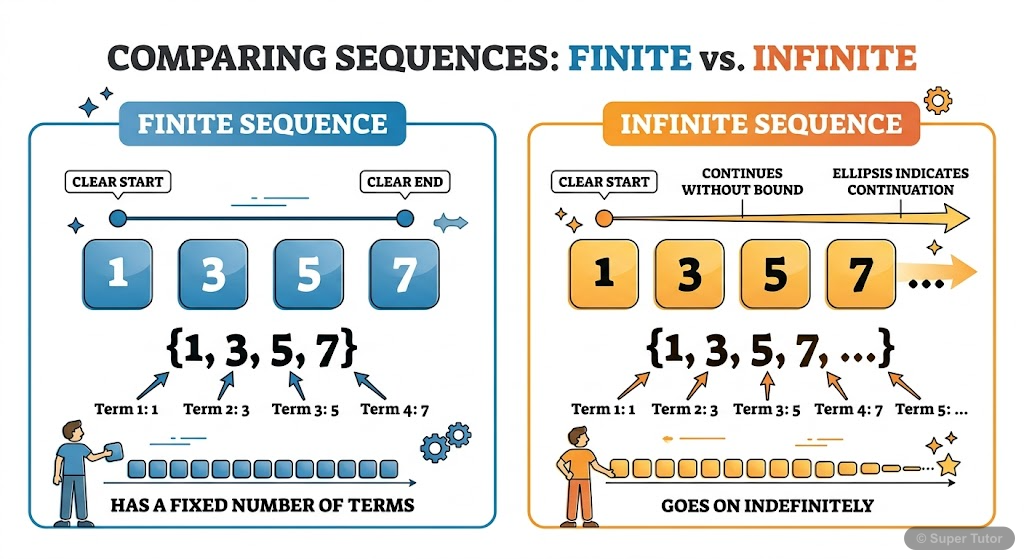
One of 10 illustrations for Sequences and Series in Super Tutor — alongside flashcards, concept maps and practice questions.
Overview
Sequences and series form the basis of many patterns in mathematics. A sequence is an ordered list of numbers, while a series is the sum of the terms of a sequence. Some sequences follow an explicit formula and are called progressions. The two most important progressions are arithmetic progression a
Key Concepts
A sequence is an ordered list
A sequence is an ordered list of numbers. Formally, it is a function whose domain is a subset of natural numbers and whose range is a subset of real n
A sequence is called a progression
A sequence is called a progression if its terms can be written using an explicit formula. The sequences 2,4,6,8,... and -1,1,-1,1,... are progressions
A finite sequence has a fixed
A finite sequence has a fixed number of terms, such as 2,4,6,8. An infinite sequence continues without end, such as 2,4,6,8,...
A series is the sum representation
A series is the sum representation of the terms of a sequence, written as a1+a2+a3+.... It may be finite or infinite according to the sequence.
An arithmetic progression is a progression
An arithmetic progression is a progression in which the difference between any term and the previous term is constant. If the first term is a and the
Learning Objectives
- Understand the meaning of sequence, progression, and series
- Distinguish between finite and infinite sequences
- Identify arithmetic progression and geometric progression
- Find the nth term and sum of terms of an A.P. and G.P.
- Use recursive relations such as the Fibonacci sequence
Frequently Asked Questions
What are the important topics in Sequences and Series for ICSE Class 11 Mathematics?
How should I revise Sequences and Series for Class 11 exams?
Sources & Official References
Content is aligned to the official syllabus. Refer to the board website for the latest curriculum.
More resources for Sequences and Series
Practice Quiz
Test yourself with a quick quiz
Important Questions
Exam-style questions with answers
Revision Notes
Key points for last-minute revision
Formula Sheet
The chapter's formulas in one place
Concept Maps
See how topics connect
Study Plan
Step-by-step plan for this chapter
Flashcards
Quick-fire cards for active recall
Syllabus
What topics to cover
For serious students
Get the full Sequences and Series chapter — start free.
Quizzes, flashcards, an AI doubt solver and a study plan for ICSE Class 11 Mathematics. Free to start, no card needed.