Thermal Properties of Matter — Important Questions
ICSE · Class 11 · Physics
43 important questions from Thermal Properties of Matter for ICSE Class 11 Physics, with answers. Includes multiple choice questions.
Interactive on Super Tutor
Studying Thermal Properties of Matter? Get the full interactive chapter.
Quizzes, flashcards, AI doubt-solver and a step-by-step study plan — built for important questions and more.
Free trial, no card needed.
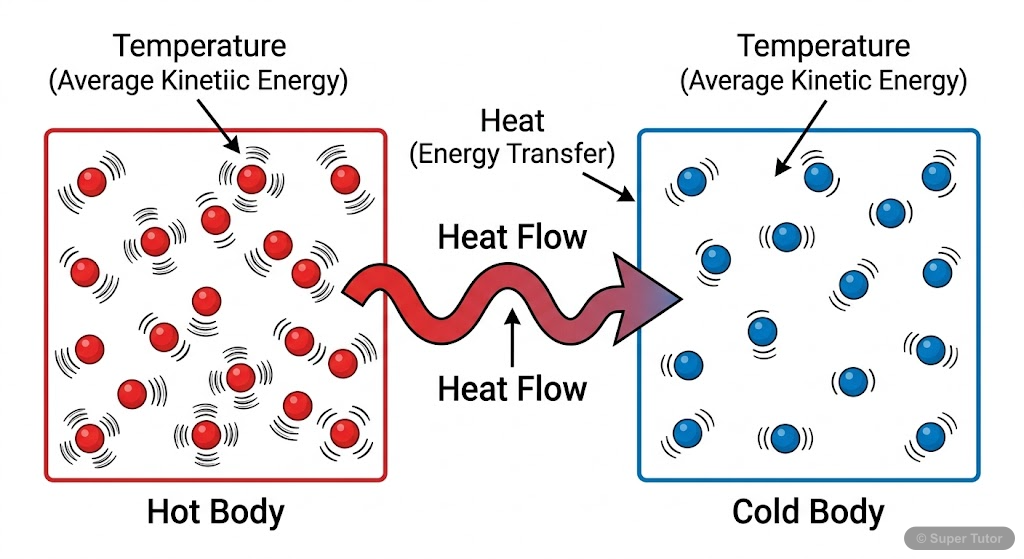
Learn better with visuals Super Tutor pairs illustrations like this with notes and quizzes for Thermal Properties of Matter.
Important Questions from Thermal Properties of Matter
100 g of ice at 0°C is mixed with 100 g of steam at 100°C. What is the final temperature and composition of the mixture? (Latent heat of ice = 80 cal/g, Latent heat of steam = 540 cal/g, specific heat of water = 1 cal/g°C)
Show answer
100°C; mixture contains only water
Step 1: Heat required to convert 100 g ice at 0°C to water at 100°C = 100×80 + 100×1×100 = 8000 + 10000 = 18000 cal. Step 2: Heat available from condensing 100 g steam at 100°C = 100 × 540 = 54000 cal. Step 3: Since heat available (54000 cal) > heat required (18000 cal), all ice converts to water at 100°C. Remaining heat = 54000 − 18000 = 36000 cal after condensing some steam. Let x g of steam condense: x × 540 = 18000, x = 33.3 g. So 33.3 g steam condenses and all ice melts to water at 100°C. Final state: 100°C, all water. Step 4: All steam (100 g) gives 54000 cal but only 18000 cal is needed
A copper calorimeter of mass 100 g contains 200 g of water at 20°C. A piece of metal of mass 150 g at 80°C is dropped into the calorimeter. The final temperature is 25°C. If specific heat of copper = 0.1 cal/g°C and water = 1 cal/g°C, find the specific heat of the metal.
Show answer
0.1273 cal/g°C
Step 1: Heat gained by water = 200 × 1 × (25 − 20) = 1000 cal. Step 2: Heat gained by calorimeter = 100 × 0.1 × (25 − 20) = 50 cal. Step 3: Total heat gained = 1000 + 50 = 1050 cal. Step 4: By principle of calorimetry, heat lost by metal = heat gained. 150 × c × (80 − 25) = 1050. 150 × c × 55 = 1050. c = 1050 / 8250 = 0.1273 cal/g°C. Option B doubles the answer by using ΔT = 27.5 for metal. Option C halves the answer. Always account for calorimeter's heat gain.
In an experiment, 10 g of a solid at 100°C is dropped into a calorimeter containing 50 g of water at 20°C. The water equivalent of the calorimeter is 5 g. The final temperature is 30°C. What is the specific heat of the solid?
Show answer
0.786 cal/g°C
Step 1: Heat gained = (mass of water + water equivalent of calorimeter) × specific heat of water × rise in temp = (50 + 5) × 1 × (30 − 20) = 55 × 10 = 550 cal. Step 2: Heat lost by solid = m × c × ΔT = 10 × c × (100 − 30) = 700c. Step 3: By principle of calorimetry: 700c = 550. c = 550/700 = 0.786 cal/g°C. Option B forgets the water equivalent. Option C uses (100−20) instead of (100−30) for solid's temperature drop. Option D uses ΔT = 140 instead of 70.
The coefficient of volume expansion of an ideal gas at constant pressure is γ_P and at constant volume is γ_V. Which of the following statements is correct regarding an ideal gas at room temperature (300 K)?
Show answer
γ_P = γ_V = 1/T = 3.33 × 10⁻³ K⁻¹
Step 1: From ideal gas equation PV = μRT. At constant pressure: ΔV/V = ΔT/T, so γ_P = ΔV/(VΔT) = 1/T. Step 2: At constant volume: ΔP/P = ΔT/T, so γ_V = ΔP/(PΔT) = 1/T. Step 3: Both are equal to 1/T. At T = 300 K: γ_P = γ_V = 1/300 = 3.33 × 10⁻³ K⁻¹. Step 4: This shows that for ideal gases, both expansion coefficients are equal and DEPEND on temperature (they decrease as T increases). Option B is wrong — there is no reason for γ_P > γ_V. Option D is wrong because γ depends on T.
+39 more questions on Thermal Properties of Matter (ICSE Class 11 Physics)
Practise AllFrequently Asked Questions
What are the important topics in Thermal Properties of Matter for ICSE Class 11 Physics?
How many important questions are there in Thermal Properties of Matter?
Sources & Official References
Content is aligned to the official syllabus. Refer to the board website for the latest curriculum.
More resources for Thermal Properties of Matter
Practice Quiz
Test yourself with a quick quiz
Revision Notes
Key points for last-minute revision
Formula Sheet
The chapter's formulas in one place
Chapter Summary
Understand the chapter at a glance
Concept Maps
See how topics connect
Study Plan
Step-by-step plan for this chapter
Flashcards
Quick-fire cards for active recall
Syllabus
What topics to cover
For serious students
Get the full Thermal Properties of Matter chapter — start free.
Quizzes, flashcards, an AI doubt solver and a study plan for ICSE Class 11 Physics. Free to start, no card needed.