Fluid Pressure — Important Questions
ICSE · Class 11 · Physics
44 important questions from Fluid Pressure for ICSE Class 11 Physics, with answers. Includes multiple choice questions.
Interactive on Super Tutor
Studying Fluid Pressure? Get the full interactive chapter.
Quizzes, flashcards, AI doubt-solver and a step-by-step study plan — built for important questions and more.
Free trial, no card needed.
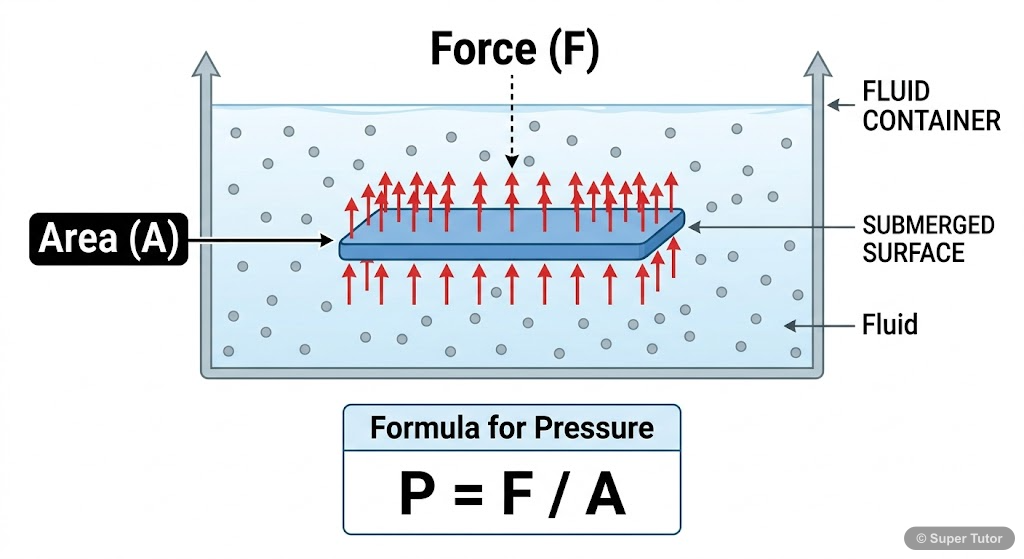
Learn better with visuals Super Tutor pairs illustrations like this with notes and quizzes for Fluid Pressure.
Important Questions from Fluid Pressure
Pascal's Law states that pressure applied to an enclosed fluid is:
Show answer
Transmitted undiminished to every part of the fluid
Step 1: Pascal's Law is a fundamental principle about enclosed fluids. Step 2: When pressure is applied to any part of an enclosed fluid, it is transmitted equally and undiminished to all other parts of the fluid. Step 3: This means every part of the fluid — top, bottom, sides — experiences the same change in pressure. Step 4: This is why when you squeeze one end of a filled water bottle, every side bulges out equally. The other options describe incorrect transmission of pressure.
In a hydraulic lift, a force of 20 N is applied on a piston of area 2 cm². What is the force exerted on a larger piston of area 100 cm²?
Show answer
1000 N
Step 1: By Pascal's Law, pressure is transmitted equally. So pressure at small piston = pressure at large piston. Step 2: Pressure at small piston = F₁/A₁ = 20 N / 2 cm² = 10 N/cm². Step 3: Force on large piston F₂ = Pressure × A₂ = 10 N/cm² × 100 cm² = 1000 N. Step 4: This shows the power of hydraulic systems — a small force of 20 N produces a large force of 1000 N. Option 500 N would result from using half the area (50 cm²). Option 20 N ignores the area multiplication.
The force exerted by a fluid at rest on a surface in contact with it is always:
Show answer
Perpendicular to the surface (normal)
Step 1: Consider a fluid at rest in contact with a surface. Step 2: If there were any tangential (parallel) component of force on the surface, by Newton's 3rd law the surface would exert a tangential force back on the fluid. Step 3: A tangential force would cause the fluid to flow, which contradicts our assumption that the fluid is at rest. Step 4: Therefore, the force exerted by a fluid at rest must be purely perpendicular (normal) to the surface. This is a fundamental property of fluids at rest.
Which of the following is the dimensional formula for pressure?
Show answer
[M L⁻¹ T⁻²]
Step 1: Pressure = Force / Area. Step 2: Dimension of Force = [M L T⁻²] (from F = ma). Step 3: Dimension of Area = [L²]. Step 4: Dimension of Pressure = [M L T⁻²] / [L²] = [M L⁻¹ T⁻²]. The negative exponent on L shows pressure decreases with increasing area. Option [M L T⁻²] is force, [M L² T⁻²] is energy/work, and [M L T⁻¹] is momentum.
+40 more questions on Fluid Pressure (ICSE Class 11 Physics)
Practise AllFrequently Asked Questions
What are the important topics in Fluid Pressure for ICSE Class 11 Physics?
How many important questions are there in Fluid Pressure?
Sources & Official References
Content is aligned to the official syllabus. Refer to the board website for the latest curriculum.
More resources for Fluid Pressure
Practice Quiz
Test yourself with a quick quiz
Revision Notes
Key points for last-minute revision
Formula Sheet
The chapter's formulas in one place
Chapter Summary
Understand the chapter at a glance
Concept Maps
See how topics connect
Study Plan
Step-by-step plan for this chapter
Flashcards
Quick-fire cards for active recall
Syllabus
What topics to cover
For serious students
Get the full Fluid Pressure chapter — start free.
Quizzes, flashcards, an AI doubt solver and a study plan for ICSE Class 11 Physics. Free to start, no card needed.