Gravitation : Planets and Satellites — Important Questions
ICSE · Class 11 · Physics
72 important questions from Gravitation : Planets and Satellites for ICSE Class 11 Physics, with answers. Part of the ICSE Class 11 Physics syllabus.
Interactive on Super Tutor
Studying Gravitation : Planets and Satellites? Get the full interactive chapter.
Quizzes, flashcards, AI doubt-solver and a step-by-step study plan — built for important questions and more.
Free trial, no card needed.
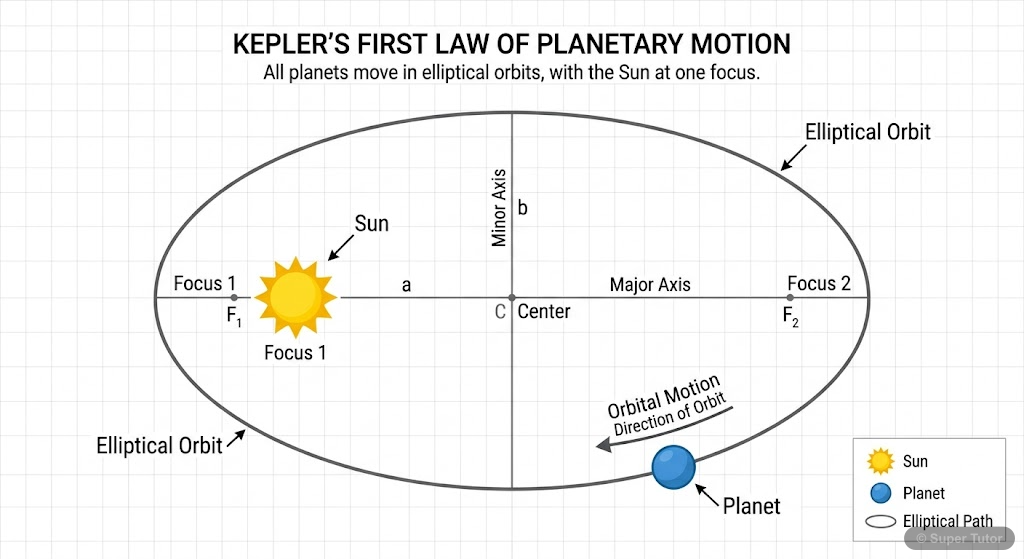
Learn better with visuals Super Tutor pairs illustrations like this with notes and quizzes for Gravitation : Planets and Satellites.
Important Questions from Gravitation : Planets and Satellites
A geostationary satellite has orbital radius 42200 km and period 24 h. Find its orbital speed.
Show answer
3.1 km/s
Use v = 2πr/T. With r = 42200 km and T = 24 h, v ≈ 2 × 3.14 × 42200 / 24 ≈ 11042 km/h = 3.1 km/s.
At Earth’s surface, g = 9.8 m/s^2 and R_e = 6.37 × 10^6 m. Find the escape velocity using v_e = √(2gR_e).
Show answer
11.2 km/s
v_e = √(2gR_e) = √(2 × 9.8 × 6.37 × 10^6) ≈ √1.248 × 10^8 ≈ 1.12 × 10^4 m/s = 11.2 km/s.
A satellite of mass m moves in a circular orbit of radius r around Earth. If its orbital speed is v_o, find the total energy in terms of G, Me, m and r.
Show answer
-1/2 GMe m / r
For a circular orbit, K = GMe m /(2r) and U = -GMe m / r. So E = U + K = -GMe m/r + GMe m/(2r) = -1/2 GMe m/r.
A satellite orbits Earth in a circle of radius 2R_e. Find its orbital speed in terms of the orbital speed close to Earth’s surface, v_0.
Show answer
v_0/√2
Orbital speed varies as 1/√r. If r becomes 2R_e, speed becomes √(R_e/2R_e) = 1/√2 times the close-orbit speed v_0.
+68 more questions on Gravitation : Planets and Satellites (ICSE Class 11 Physics)
Practise AllFrequently Asked Questions
What are the important topics in Gravitation : Planets and Satellites for ICSE Class 11 Physics?
How many important questions are there in Gravitation : Planets and Satellites?
Sources & Official References
Content is aligned to the official syllabus. Refer to the board website for the latest curriculum.
More resources for Gravitation : Planets and Satellites
Practice Quiz
Test yourself with a quick quiz
Revision Notes
Key points for last-minute revision
Formula Sheet
The chapter's formulas in one place
Chapter Summary
Understand the chapter at a glance
Concept Maps
See how topics connect
Study Plan
Step-by-step plan for this chapter
Flashcards
Quick-fire cards for active recall
Syllabus
What topics to cover
For serious students
Get the full Gravitation : Planets and Satellites chapter — start free.
Quizzes, flashcards, an AI doubt solver and a study plan for ICSE Class 11 Physics. Free to start, no card needed.