Elasticity — Important Questions
ICSE · Class 11 · Physics
41 important questions from Elasticity for ICSE Class 11 Physics, with answers. Includes multiple choice questions.
Interactive on Super Tutor
Studying Elasticity? Get the full interactive chapter.
Quizzes, flashcards, AI doubt-solver and a step-by-step study plan — built for important questions and more.
Free trial, no card needed.
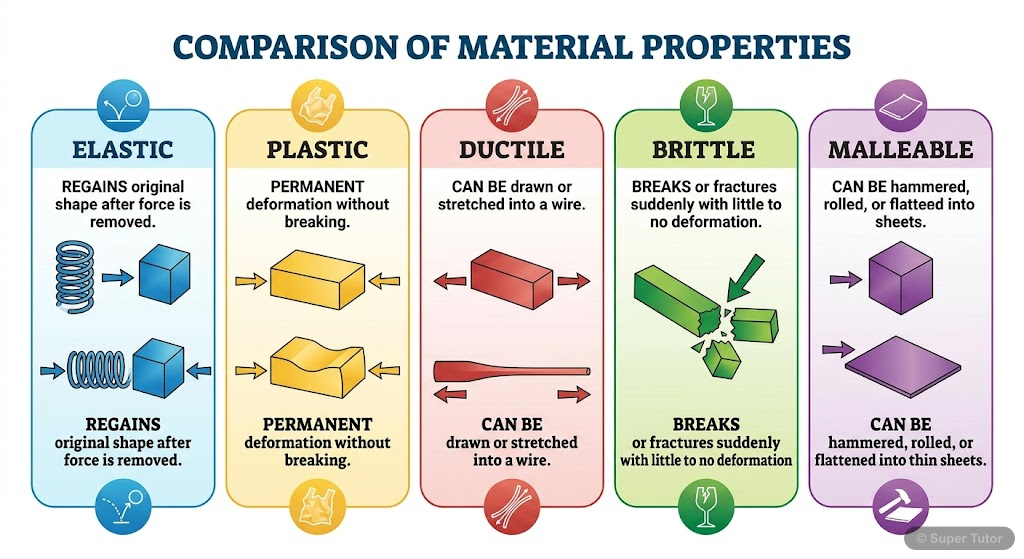
One of 10 illustrations for Elasticity in Super Tutor — alongside flashcards, concept maps and practice questions.
Important Questions from Elasticity
The Poisson's ratio of a material is 0.4. If a wire of this material is stretched so that its length increases by 0.2%, by what percentage does its radius decrease?
Show answer
0.08%
Step 1: Poisson's ratio σ = (lateral strain) / (longitudinal strain) = (-Δr/r) / (ΔL/L). Step 2: Longitudinal strain = ΔL/L = 0.2% = 0.002. Step 3: Lateral strain = σ × longitudinal strain = 0.4 × 0.002 = 0.0008. Step 4: Percentage decrease in radius = 0.0008 × 100% = 0.08%. Step 5: Common error — students directly multiply 0.4 × 0.2% = 0.08%, which happens to be correct, but they must understand the formula. Option C (0.4%) occurs when students confuse σ with the answer directly. Option D (0.8%) occurs when students forget to take σ as a ratio and just add.
A steel wire (Y = 2 × 10¹¹ N/m²) of length 5 m and diameter 10⁻³ m supports a sphere of mass 8π kg and radius 0.1 m. The wire hangs from a ceiling 5.22 m high. When the sphere is swung as a pendulum, what is the approximate velocity at the lowest point? (g = 9.8 m/s²)
Show answer
8.8 m/s
Step 1: Extension Δl = 5.22 - (l + 2r) = 5.22 - (5 + 0.2) = 0.02 m. Step 2: Tension T = YAΔl/l = 2×10¹¹ × π×(5×10⁻⁴)² × 0.02/5 = 2×10¹¹ × π×25×10⁻⁸ × 0.004 = 2×10¹¹ × π × 10⁻⁹ = 200π N ≈ 628 N. Step 3: At mean position of pendulum, T - Mg = Mv²/R, where R = 5.22 - 0.1 = 5.12 m and Mg = 8π × 9.8 ≈ 246.4 N. Step 4: Mv²/R = T - Mg = 200π - 8π×9.8 = π(200 - 78.4) = 121.6π. Step 5: v² = 121.6π × 5.12/(8π) = 121.6 × 5.12/8 = 622.6/8 ≈ 77.8; v ≈ 8.8 m/s.
The interatomic force constant k of a solid material is related to its Young's modulus Y and equilibrium interatomic distance r₀ by which of the following relations?
Show answer
k = Y × r₀
Step 1: Consider a wire of length L and cross-sectional area A. There are A/r₀² atomic chains in the cross-section. Step 2: Force on each chain = F/(A/r₀²) = Fr₀²/A. Step 3: Each chain has L/r₀ atoms, so strain = Δr/r₀ = (l/L) (where l is total elongation). Step 4: k = F'/Δr = (Fr₀²/A)/(r₀ × l/L) = (F/A)/(l/L) × r₀ = Y × r₀. Step 5: Option A (Y/r₀) is dimensionally wrong — Y has units N/m² and r₀ has units m, so Y×r₀ gives N/m (force per length = spring constant), which is correct for k. Y/r₀ gives N/m³ which is incorrect.
In the stress-strain graph of a ductile material, the region between yield point C and the point D of maximum stress is called:
Show answer
Plastic region
Step 1: In the stress-strain graph, OA is the proportional region (Hooke's law obeyed). Step 2: OB is the elastic region (up to elastic limit at B — body returns to original shape). Step 3: Beyond B, at point C (yield point), permanent deformation begins. Step 4: The region from C to D (maximum stress / ultimate stress) is the plastic region — here the material flows like a viscous fluid and permanent deformation occurs. Step 5: Beyond D, the wire thins (necking) and finally breaks at E. The breaking stress is at D, not E. The elastic region (option A) is from O to B, not C to D.
+37 more questions on Elasticity (ICSE Class 11 Physics)
Practise AllFrequently Asked Questions
What are the important topics in Elasticity for ICSE Class 11 Physics?
How many important questions are there in Elasticity?
Sources & Official References
Content is aligned to the official syllabus. Refer to the board website for the latest curriculum.
More resources for Elasticity
Practice Quiz
Test yourself with a quick quiz
Revision Notes
Key points for last-minute revision
Formula Sheet
The chapter's formulas in one place
Chapter Summary
Understand the chapter at a glance
Concept Maps
See how topics connect
Study Plan
Step-by-step plan for this chapter
Flashcards
Quick-fire cards for active recall
Syllabus
What topics to cover
For serious students
Get the full Elasticity chapter — start free.
Quizzes, flashcards, an AI doubt solver and a study plan for ICSE Class 11 Physics. Free to start, no card needed.