Rotational Motion of a Rigid Body: Moment of Inertia — Important Questions
ICSE · Class 11 · Physics
51 important questions from Rotational Motion of a Rigid Body: Moment of Inertia for ICSE Class 11 Physics, with answers.
Interactive on Super Tutor
Studying Rotational Motion of a Rigid Body: Moment of Inertia? Get the full interactive chapter.
Quizzes, flashcards, AI doubt-solver and a step-by-step study plan — built for important questions and more.
Free trial, no card needed.
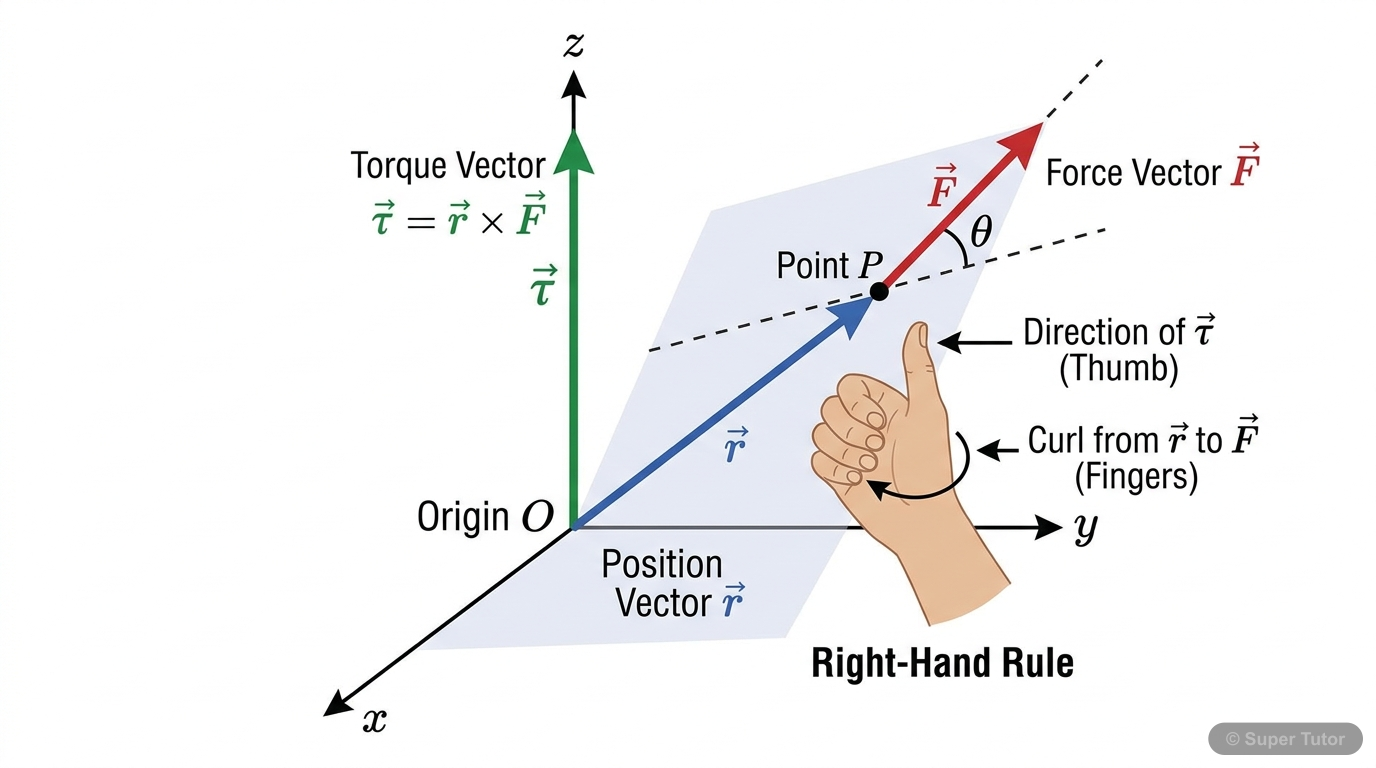
Learn better with visuals Super Tutor pairs illustrations like this with notes and quizzes for Rotational Motion of a Rigid Body: Moment of Inertia.
Important Questions from Rotational Motion of a Rigid Body: Moment of Inertia
A body has angular momentum 24 kg m²/s and moment of inertia 8.0 kg m². If the angular momentum remains constant and the moment of inertia becomes 6.0 kg m², what is the new angular velocity?
Show answer
4.0 rad/s
Since L = Iω remains constant, first confirm L = 24 kg m²/s. For the new situation, ω = L/I = 24/6.0 = 4.0 rad/s.
A ring of mass 4.0 kg and radius 0.50 m rotates about its central axis perpendicular to its plane with angular velocity 10 rad/s. What is its rotational kinetic energy?
Show answer
50 J
For a ring about its central axis, I = MR² = 4.0 × 0.50² = 4.0 × 0.25 = 1.0 kg m². Then K = 1/2 Iω² = 1/2 × 1.0 × 10² = 50 J.
A rigid body has moment of inertia 9.0 kg m² and rotational kinetic energy 72 J. What is its angular velocity?
Show answer
4.0 rad/s
Use K = 1/2 Iω². So 72 = 1/2 × 9.0 × ω² = 4.5ω². Hence ω² = 16 and ω = 4.0 rad/s.
A body with angular momentum 30 kg m²/s has its moment of inertia reduced from 10 kg m² to 6.0 kg m² without external torque. What is the ratio of the final angular velocity to the initial angular velocity?
Show answer
5/3
With no external torque, Iω is constant. So I₁ω₁ = I₂ω₂. Therefore ω₂/ω₁ = I₁/I₂ = 10/6 = 5/3.
+47 more questions on Rotational Motion of a Rigid Body: Moment of Inertia (ICSE Class 11 Physics)
Practise AllFrequently Asked Questions
What are the important topics in Rotational Motion of a Rigid Body: Moment of Inertia for ICSE Class 11 Physics?
How many important questions are there in Rotational Motion of a Rigid Body: Moment of Inertia?
Sources & Official References
Content is aligned to the official syllabus. Refer to the board website for the latest curriculum.
More resources for Rotational Motion of a Rigid Body: Moment of Inertia
Practice Quiz
Test yourself with a quick quiz
Revision Notes
Key points for last-minute revision
Formula Sheet
The chapter's formulas in one place
Chapter Summary
Understand the chapter at a glance
Concept Maps
See how topics connect
Study Plan
Step-by-step plan for this chapter
Flashcards
Quick-fire cards for active recall
Syllabus
What topics to cover
For serious students
Get the full Rotational Motion of a Rigid Body: Moment of Inertia chapter — start free.
Quizzes, flashcards, an AI doubt solver and a study plan for ICSE Class 11 Physics. Free to start, no card needed.