Aldehydes, Ketones and Carboxylic Acids — Chapter Summary
ICSE · Class 12 · Chemistry
Summary of Aldehydes, Ketones and Carboxylic Acids for ICSE Class 12 Chemistry. Part of the ICSE Class 12 Chemistry syllabus.
Interactive on Super Tutor
Studying Aldehydes, Ketones and Carboxylic Acids? Get the full interactive chapter.
Quizzes, flashcards, AI doubt-solver and a step-by-step study plan — built for chapter summary and more.
Free trial, no card needed.
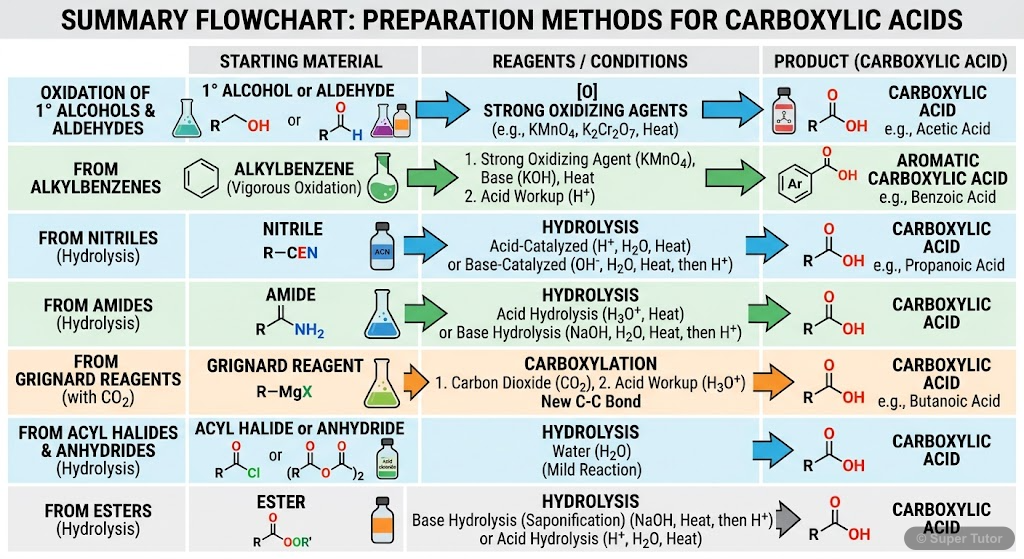
One of 2 illustrations for Aldehydes, Ketones and Carboxylic Acids in Super Tutor — alongside flashcards, concept maps and practice questions.
Overview
Carbonyl compounds form an important class of organic compounds because the carbonyl group controls their structure, reactivity and uses. Aldehydes and ketones show nucleophilic addition, oxidation, reduction and condensation reactions, while carboxylic acids and their derivatives show acidic behavi
Key Concepts
Aldehydes and ketones contain the carbonyl
Aldehydes and ketones contain the carbonyl group, C=O. The carbonyl carbon is sp2 hybridised and electrophilic because oxygen pulls electron density t
Aldehydes have at least one hydrogen
Aldehydes have at least one hydrogen attached to the carbonyl carbon, while ketones have two carbon groups attached to the carbonyl carbon. Aldehydes
Carbonyl compounds undergo nucleophilic addition because
Carbonyl compounds undergo nucleophilic addition because the carbonyl carbon is positively polarised. Weakly acidic or basic conditions can help the a
Aldehydes are oxidised to carboxylic acids
Aldehydes are oxidised to carboxylic acids even by mild oxidising agents such as Tollens' reagent. Tollens' reagent gives a silver mirror, and Fehling
Aldehydes reduce to primary alcohols
Aldehydes reduce to primary alcohols and ketones reduce to secondary alcohols. Lithium aluminium hydride reduces aldehydes, ketones, carboxylic acids,
Learning Objectives
- Identify the structure and general behaviour of aldehydes, ketones and carboxylic acids
- Compare the reactivity of aldehydes and ketones in nucleophilic addition reactions
- Understand oxidation, reduction and important name reactions of carbonyl compounds
- Explain the preparation, properties and acidity of carboxylic acids
- Describe the structure, preparation and reactivity of acyl chlorides, anhydrides, esters and amides
Frequently Asked Questions
What are the important topics in Aldehydes, Ketones and Carboxylic Acids for ICSE Class 12 Chemistry?
How should I revise Aldehydes, Ketones and Carboxylic Acids for the ICSE Class 12 board exam?
Sources & Official References
Content is aligned to the official syllabus. Refer to the board website for the latest curriculum.
More resources for Aldehydes, Ketones and Carboxylic Acids
Practice Quiz
Test yourself with a quick quiz
Important Questions
Exam-style questions with answers
Revision Notes
Key points for last-minute revision
Formula Sheet
The chapter's formulas in one place
Concept Maps
See how topics connect
Study Plan
Step-by-step plan for this chapter
Flashcards
Quick-fire cards for active recall
Syllabus
What topics to cover
For serious students
Get the full Aldehydes, Ketones and Carboxylic Acids chapter — start free.
Quizzes, flashcards, an AI doubt solver and a study plan for ICSE Class 12 Chemistry. Free to start, no card needed.