Coordination Compounds — Chapter Summary
ICSE · Class 12 · Chemistry
Summary of Coordination Compounds for ICSE Class 12 Chemistry. Key concepts: These are compounds in which, Double salts exist and Ligands are atoms.
Interactive on Super Tutor
Studying Coordination Compounds? Get the full interactive chapter.
Quizzes, flashcards, AI doubt-solver and a step-by-step study plan — built for chapter summary and more.
Free trial, no card needed.
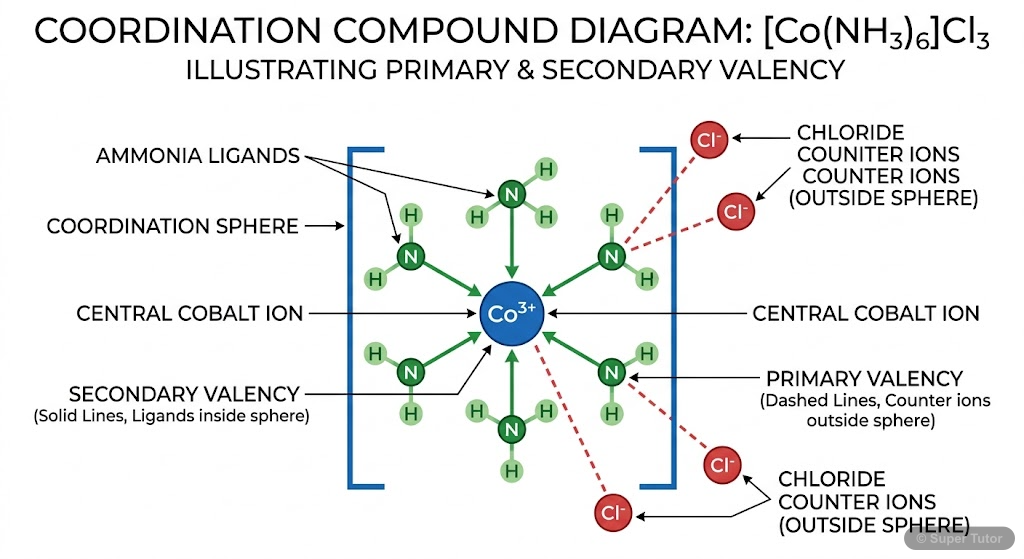
Learn better with visuals Super Tutor pairs illustrations like this with notes and quizzes for Coordination Compounds.
Overview
Coordination compounds are molecular or addition compounds in which a central metal atom or ion is permanently attached to ligands by coordinate bonds. These compounds keep their identity in solution and show properties different from those of their constituent ions. The chapter explains their basic
Key Concepts
These are compounds in which
These are compounds in which a central metal atom or ion is directly attached to ligands. Ligands donate electron pairs to the metal through coordinat
Double salts exist in the solid
Double salts exist in the solid state but dissociate completely into their constituent ions when dissolved in water. They lose their identity in solut
Ligands are atoms
Ligands are atoms, ions, or molecules that donate lone pair electrons to the central metal atom or ion. They may be neutral, anionic, or rarely cation
A polydentate ligand that attaches through
A polydentate ligand that attaches through two or more donor atoms and forms a five- or six-membered ring with the metal ion is a chelating ligand. Th
Werner proposed that metals show primary
Werner proposed that metals show primary valency and secondary valency. Primary valency is ionisable and corresponds to oxidation state. Secondary val
Learning Objectives
- Define coordination compounds, ligands, coordination sphere, ionic sphere, and coordination number
- Distinguish coordination compounds from double salts
- Classify ligands by charge and denticity
- Explain chelation and the extra stability of chelates
- Understand Werner's theory and primary and secondary valencies
Frequently Asked Questions
What are the important topics in Coordination Compounds for ICSE Class 12 Chemistry?
How should I revise Coordination Compounds for the ICSE Class 12 board exam?
Sources & Official References
Content is aligned to the official syllabus. Refer to the board website for the latest curriculum.
More resources for Coordination Compounds
For serious students
Get the full Coordination Compounds chapter — start free.
Quizzes, flashcards, an AI doubt solver and a study plan for ICSE Class 12 Chemistry. Free to start, no card needed.