Coordination Compounds — Practice Quiz
ICSE · Class 12 · Chemistry
Try a 4-question quiz on Coordination Compounds for ICSE Class 12 Chemistry: tap an answer to check it and see why. 105 questions in the full chapter test.
Interactive on Super Tutor
Studying Coordination Compounds? Get the full interactive chapter.
Quizzes, flashcards, AI doubt-solver and a step-by-step study plan — built for practice quiz and more.
Free trial, no card needed.
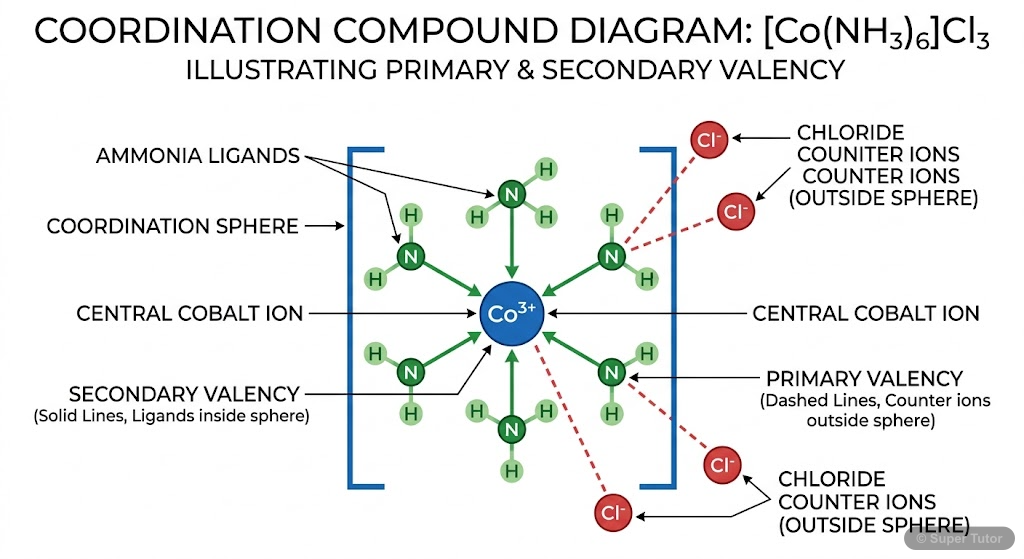
Learn better with visuals Super Tutor pairs illustrations like this with notes and quizzes for Coordination Compounds.
Quick Quiz: Coordination Compounds
0/4Tap an answer to check it instantly. No sign-up needed for these 4.
Which of the following is NOT a coordination compound?
The central metal ion in a coordination compound acts as:
What is the coordination number of Co in [Co(NH₃)₆]³⁺?
Which ligand is hexadentate?
Sample Questions
The IUPAC name of [Co(NH₃)₆]Cl₃ is:
Show answer
hexaamminecobalt(III) chloride
NH₃ = ammine (double m); × 6 = hexaammine; Co(III) = cobalt(III); counter ion Cl⁻ = chloride. Name: hexaamminecobalt(III) chloride. Note: 'ammine' not 'amine' — this is an IUPAC-specific spelling.
Which of the following is the correct name for K₃[Fe(CN)₆]?
Show answer
Potassium hexacyanidoferrate(III)
The complex is an anion [Fe(CN)₆]³⁻ → metal gets -ate suffix: Fe → ferrate. OS of Fe: x + 6(−1) = −3 → x = +3 → ferrate(III). Counter ion K⁺ = potassium. Name: potassium hexacyanidoferrate(III).
What is the oxidation state of Fe in K₄[Fe(CN)₆]?
Show answer
+2
OS of Fe: x + 6(−1) = −4 (charge of complex ion). x = −4 + 6 = +2. Fe is in +2 oxidation state. The compound is potassium hexacyanidoferrate(II).
In Werner's theory, primary valency corresponds to:
Show answer
Oxidation state
Werner's primary valency = oxidation state of the metal. It is ionisable and satisfied only by negative ions (counter ions). Secondary valency = coordination number.
+101 more questions on Coordination Compounds (ICSE Class 12 Chemistry)
Practise AllFrequently Asked Questions
What are the important topics in Coordination Compounds for ICSE Class 12 Chemistry?
How many practice questions are there for Coordination Compounds?
Sources & Official References
Content is aligned to the official syllabus. Refer to the board website for the latest curriculum.
More resources for Coordination Compounds
Important Questions
Exam-style questions with answers
Revision Notes
Key points for last-minute revision
Chapter Summary
Understand the chapter at a glance
Concept Maps
See how topics connect
Study Plan
Step-by-step plan for this chapter
Flashcards
Quick-fire cards for active recall
Syllabus
What topics to cover
For serious students
Get the full Coordination Compounds chapter — start free.
Quizzes, flashcards, an AI doubt solver and a study plan for ICSE Class 12 Chemistry. Free to start, no card needed.