Coordination Compounds — Flashcards
ICSE · Class 12 · Chemistry
40 flashcards for Coordination Compounds (ICSE Class 12 Chemistry) to test yourself on key terms and facts. Sample: "What is a coordination compound?"
Interactive on Super Tutor
Studying Coordination Compounds? Get the full interactive chapter.
Quizzes, flashcards, AI doubt-solver and a step-by-step study plan — built for flashcards and more.
Free trial, no card needed.
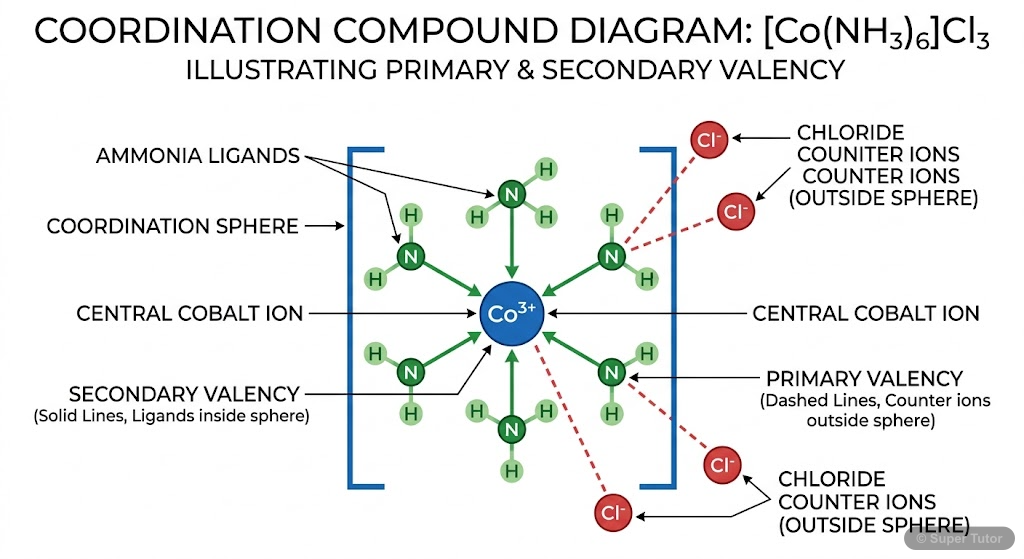
Learn better with visuals Super Tutor pairs illustrations like this with notes and quizzes for Coordination Compounds.
What is a coordination compound?
Answer
A coordination compound is a molecular or addition compound in which a central metal atom or ion is permanently attached to ligands. The ligands donate electron pairs to the metal through coordinate b…
How is a coordination compound different from a double salt?
Answer
Double salts exist in the solid state but dissociate completely into constituent ions in water. Coordination compounds retain their identity in aqueous solution and show properties different from thei…
Why does K4[Fe(CN)6] behave as a coordination compound in water?
Answer
K4[Fe(CN)6] dissociates as K4[Fe(CN)6] ⇌ 4K+(aq) + [Fe(CN)6]4-(aq). The complex ion [Fe(CN)6]4- remains intact in solution and does not break into Fe2+ and CN- ions. Therefore, the compound retains it…
What is a ligand? Give two examples.
Answer
A ligand is an atom, ion, or molecule that donates at least one pair of electrons to a central metal atom or ion. Examples: NH3, CN-, H2O, CO.
What is coordination number?
Answer
The coordination number is the maximum number of ligands that can be attached to a central metal atom or ion. It commonly has values 4 or 6, but can vary from 2 to 10. Example: coordination number of …
How does coordination number decide geometry?
Answer
A central metal with coordination number 6 usually forms an octahedral complex. A central metal with coordination number 4 usually forms a tetrahedral or square planar complex. Example: [Co(NH3)6]3+ i…
What are primary valency and secondary valency in Werner's theory?
Answer
Primary valency is ionisable and corresponds to oxidation state. It is satisfied by negative ions. Secondary valency is non-ionisable and corresponds to coordination number. It is satisfied by negativ…
Why was octahedral geometry accepted for six-coordinate complexes?
Answer
Werner isolated only two isomers for six-coordinate compounds, and this is possible only for octahedral structures. Six-coordinate planar hexagon or trigonal prism arrangements would give three isomer…
+32 more flashcards
Practise AllFrequently Asked Questions
What are the important topics in Coordination Compounds for ICSE Class 12 Chemistry?
How many flashcards are available for Coordination Compounds?
How should I revise Coordination Compounds for the ICSE Class 12 board exam?
Sources & Official References
Content is aligned to the official syllabus. Refer to the board website for the latest curriculum.
More resources for Coordination Compounds
Practice Quiz
Test yourself with a quick quiz
Important Questions
Exam-style questions with answers
Revision Notes
Key points for last-minute revision
Chapter Summary
Understand the chapter at a glance
Concept Maps
See how topics connect
Study Plan
Step-by-step plan for this chapter
Syllabus
What topics to cover
For serious students
Get the full Coordination Compounds chapter — start free.
Quizzes, flashcards, an AI doubt solver and a study plan for ICSE Class 12 Chemistry. Free to start, no card needed.