Aldehydes, Ketones and Carboxylic Acids — Flashcards
ICSE · Class 12 · Chemistry
36 flashcards for Aldehydes, Ketones and Carboxylic Acids (ICSE Class 12 Chemistry) to test yourself on key terms and facts.
Interactive on Super Tutor
Studying Aldehydes, Ketones and Carboxylic Acids? Get the full interactive chapter.
Quizzes, flashcards, AI doubt-solver and a step-by-step study plan — built for flashcards and more.
Free trial, no card needed.
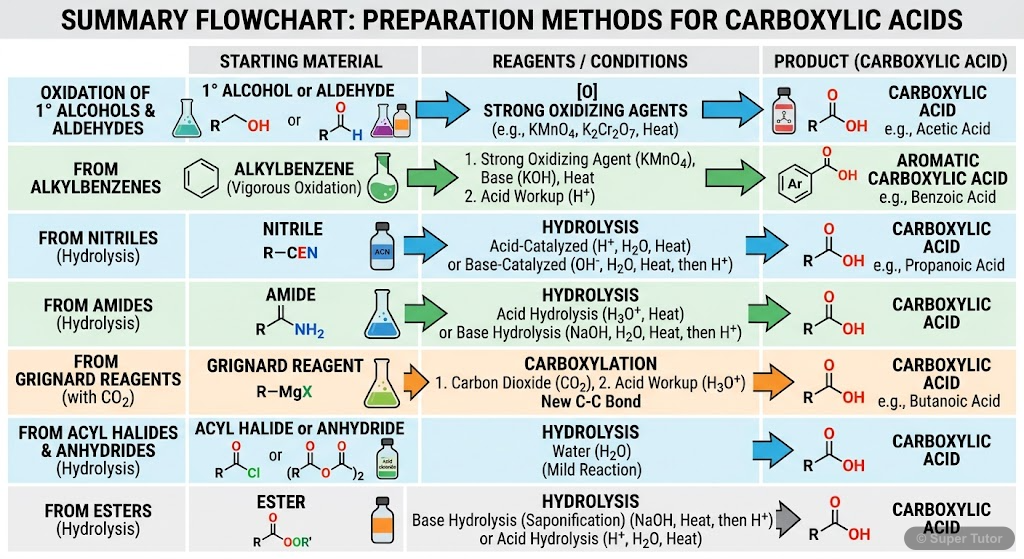
One of 2 illustrations for Aldehydes, Ketones and Carboxylic Acids in Super Tutor — alongside flashcards, concept maps and practice questions.
What is the general acid dissociation of a carboxylic acid in water?
Answer
RCOOH + H2O ⇌ RCOO− + H3O+ The acid strength depends on the extent of ionisation in water. The carboxylate ion is resonance stabilised, so carboxylic acids show acidic nature.
How is Ka related to acid strength for a carboxylic acid?
Answer
Ka = [RCOO−][H3O+]/[RCOOH] Higher Ka means greater acid strength. Lower pKa means greater acid strength. pKa = -log10 Ka…
Why is formic acid stronger than acetic acid?
Answer
Formic acid has H attached to the carboxyl group, while acetic acid has an electron-releasing CH3 group. The CH3 group increases electron density on the carboxyl group and makes release of H+ more di…
Why are carboxylic acids more acidic than alcohols?
Answer
Carboxylic acids form resonance-stabilised carboxylate ions. Alcohols form alkoxide ions, which are not resonance stabilised. Because the conjugate base of a carboxylic acid is much more stable, carb…
What happens when a carboxylic acid reacts with sodium metal?
Answer
2RCOOH + 2Na → 2RCOONa + H2↑ A salt is formed and hydrogen gas is liberated.
What happens when acetic acid reacts with sodium bicarbonate?
Answer
CH3COOH + NaHCO3 → CH3COONa + H2O + CO2↑ Brisk effervescence is seen because carbon dioxide gas is evolved.
How is an acid chloride prepared from a carboxylic acid using thionyl chloride?
Answer
RCOOH + SOCl2 → RCOCl + SO2↑ + HCl↑ Thionyl chloride is preferred because the by-products are gaseous and escape readily.
Why are acyl chlorides the most reactive carboxylic acid derivatives?
Answer
Acyl chlorides are most reactive because chlorine exerts a strong -I effect. This makes the carbonyl carbon highly electron deficient and easily attacked by nucleophiles.
+28 more flashcards
Practise AllFrequently Asked Questions
What are the important topics in Aldehydes, Ketones and Carboxylic Acids for ICSE Class 12 Chemistry?
How many flashcards are available for Aldehydes, Ketones and Carboxylic Acids?
How should I revise Aldehydes, Ketones and Carboxylic Acids for the ICSE Class 12 board exam?
Sources & Official References
Content is aligned to the official syllabus. Refer to the board website for the latest curriculum.
More resources for Aldehydes, Ketones and Carboxylic Acids
Practice Quiz
Test yourself with a quick quiz
Important Questions
Exam-style questions with answers
Revision Notes
Key points for last-minute revision
Formula Sheet
The chapter's formulas in one place
Chapter Summary
Understand the chapter at a glance
Concept Maps
See how topics connect
Study Plan
Step-by-step plan for this chapter
Syllabus
What topics to cover
For serious students
Get the full Aldehydes, Ketones and Carboxylic Acids chapter — start free.
Quizzes, flashcards, an AI doubt solver and a study plan for ICSE Class 12 Chemistry. Free to start, no card needed.