Aldehydes, Ketones and Carboxylic Acids — Practice Quiz
ICSE · Class 12 · Chemistry
Try a 4-question quiz on Aldehydes, Ketones and Carboxylic Acids for ICSE Class 12 Chemistry: tap an answer to check it and see why.
Interactive on Super Tutor
Studying Aldehydes, Ketones and Carboxylic Acids? Get the full interactive chapter.
Quizzes, flashcards, AI doubt-solver and a step-by-step study plan — built for practice quiz and more.
Free trial, no card needed.
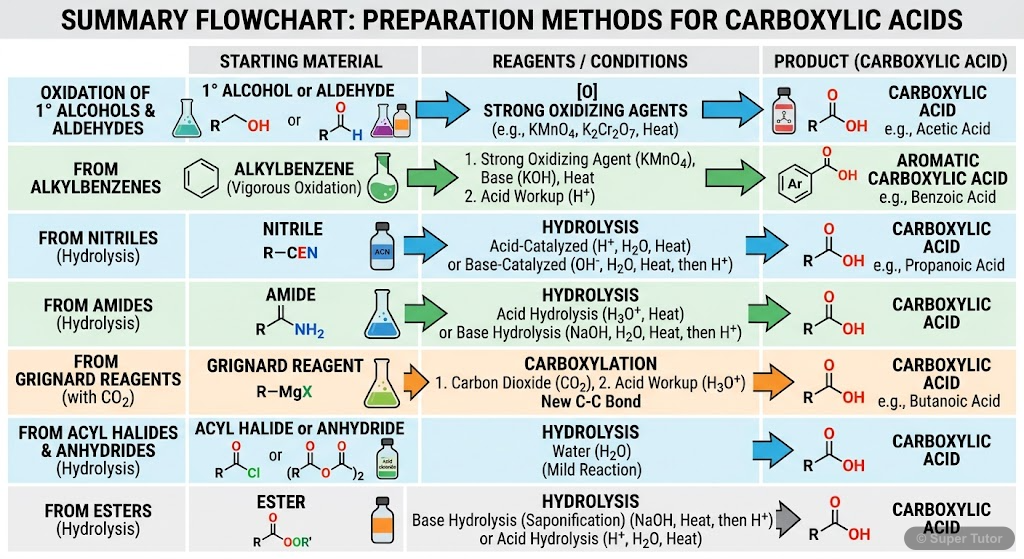
One of 2 illustrations for Aldehydes, Ketones and Carboxylic Acids in Super Tutor — alongside flashcards, concept maps and practice questions.
Quick Quiz: Aldehydes, Ketones and Carboxylic Acids
0/4Tap an answer to check it instantly. No sign-up needed for these 4.
What is the functional group in aldehydes?
What is the IUPAC name of CH3COCH3?
Which reagent is used in Rosenmund reduction?
Aldehydes and ketones do not show hydrogen bonding between their molecules. This is because:
Sample Questions
What is the product of the reaction: Acetaldehyde + HCN →?
Show answer
CH3CH(OH)CN (lactonitrile)
HCN adds to acetaldehyde in nucleophilic addition to give CH3CH(OH)CN (lactonitrile or acetaldehyde cyanohydrin).
Aldehydes give a silver mirror with Tollens' reagent. This is because they are:
Show answer
Reducing agents
Aldehydes are oxidised to carboxylic acids by Tollens' reagent (ammoniacal AgNO3), reducing Ag+ to Ag (silver mirror). They act as reducing agents.
What is the product of aldol condensation of acetaldehyde (CH3CHO) with dilute NaOH?
Show answer
3-hydroxybutanal (aldol)
2 CH3CHO (dilute NaOH) → CH3CH(OH)CH2CHO (3-hydroxybutanal = aldol). This is the classic aldol condensation product.
Which of the following does NOT reduce Fehling's solution?
Show answer
Benzaldehyde (C6H5CHO)
Aromatic aldehydes (like benzaldehyde) do NOT reduce Fehling's or Benedict's solution. Only aliphatic aldehydes give red Cu2O precipitate.
+99 more questions on Aldehydes, Ketones and Carboxylic Acids (ICSE Class 12 Chemistry)
Practise AllFrequently Asked Questions
What are the important topics in Aldehydes, Ketones and Carboxylic Acids for ICSE Class 12 Chemistry?
How many practice questions are there for Aldehydes, Ketones and Carboxylic Acids?
Sources & Official References
Content is aligned to the official syllabus. Refer to the board website for the latest curriculum.
More resources for Aldehydes, Ketones and Carboxylic Acids
Important Questions
Exam-style questions with answers
Revision Notes
Key points for last-minute revision
Formula Sheet
The chapter's formulas in one place
Chapter Summary
Understand the chapter at a glance
Concept Maps
See how topics connect
Study Plan
Step-by-step plan for this chapter
Flashcards
Quick-fire cards for active recall
Syllabus
What topics to cover
For serious students
Get the full Aldehydes, Ketones and Carboxylic Acids chapter — start free.
Quizzes, flashcards, an AI doubt solver and a study plan for ICSE Class 12 Chemistry. Free to start, no card needed.