Haloalkanes and Haloarenes — Practice Quiz
ICSE · Class 12 · Chemistry
Try a 4-question quiz on Haloalkanes and Haloarenes for ICSE Class 12 Chemistry: tap an answer to check it and see why.
Interactive on Super Tutor
Studying Haloalkanes and Haloarenes? Get the full interactive chapter.
Quizzes, flashcards, AI doubt-solver and a step-by-step study plan — built for practice quiz and more.
Free trial, no card needed.
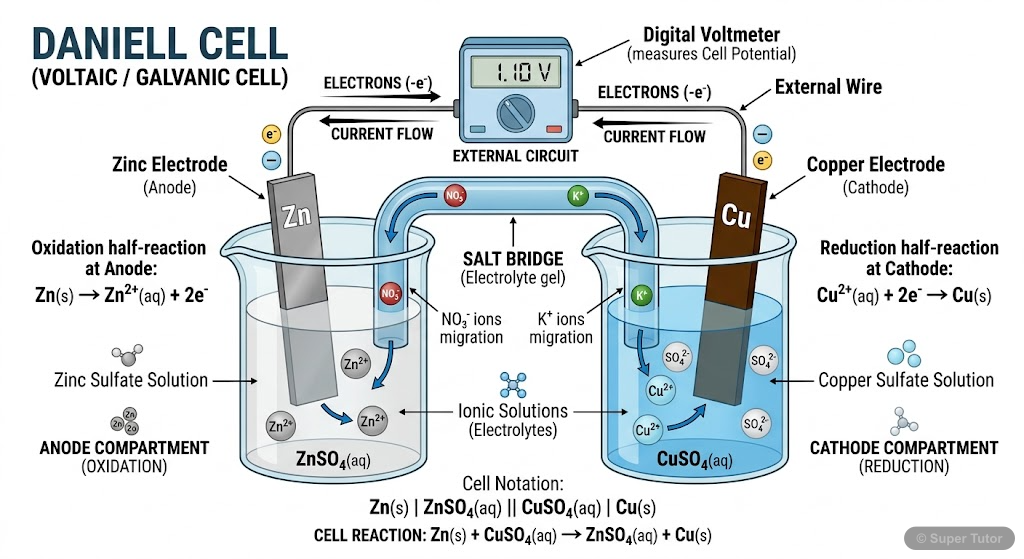
One of 20 illustrations for Haloalkanes and Haloarenes in Super Tutor — alongside flashcards, concept maps and practice questions.
Quick Quiz: Haloalkanes and Haloarenes
0/4Tap an answer to check it instantly. No sign-up needed for these 4.
The general formula of haloalkanes (monohalogen derivatives of alkanes) is:
Chloroethane (CH3CH2Cl) is classified as:
2-chloro-2-methylpropane is classified as:
The IUPAC name of CH3CH2CH2Br is:
Sample Questions
Which of the following is the correct IUPAC name for (CH3)2CHCH2Cl?
Show answer
1-chloro-2-methylpropane
Parent chain: propane (3C). Cl on C1, methyl group on C2. IUPAC: 1-chloro-2-methylpropane. List substituents alphabetically: chloro before methyl. Common name: iso-butyl chloride (not IUPAC).
Which reagent is preferred for preparing alkyl chlorides from alcohols and WHY?
Show answer
SOCl2 — byproducts are gases that escape
R-OH + SOCl2 → R-Cl + SO2↑ + HCl↑. Both byproducts (SO2 and HCl) are gases and escape from reaction mixture, leaving pure R-Cl. With PCl5, POCl3 remains as liquid byproduct requiring separation.
The Finkelstein reaction involves:
Show answer
Conversion of RCl/RBr to RI using NaI in acetone
Finkelstein reaction: R-Cl + NaI → R-I + NaCl (in dry acetone). NaCl precipitates in acetone (insoluble) → equilibrium shifts to products. Used to prepare iodoalkanes which are hard to make directly.
The boiling points of haloalkanes with the same alkyl group follow the order:
Show answer
RF < RCl < RBr < RI
BP increases with atomic mass of halogen (RF < RCl < RBr < RI) because larger halogens have stronger van der Waals forces. Example: CH3F (194.6K) < CH3Cl (248.8K) < CH3Br (276.6K) < CH3I (315.4K).
+100 more questions on Haloalkanes and Haloarenes (ICSE Class 12 Chemistry)
Practise AllFrequently Asked Questions
What are the important topics in Haloalkanes and Haloarenes for ICSE Class 12 Chemistry?
How many practice questions are there for Haloalkanes and Haloarenes?
Sources & Official References
Content is aligned to the official syllabus. Refer to the board website for the latest curriculum.
More resources for Haloalkanes and Haloarenes
Important Questions
Exam-style questions with answers
Revision Notes
Key points for last-minute revision
Formula Sheet
The chapter's formulas in one place
Chapter Summary
Understand the chapter at a glance
Concept Maps
See how topics connect
Study Plan
Step-by-step plan for this chapter
Flashcards
Quick-fire cards for active recall
Syllabus
What topics to cover
For serious students
Get the full Haloalkanes and Haloarenes chapter — start free.
Quizzes, flashcards, an AI doubt solver and a study plan for ICSE Class 12 Chemistry. Free to start, no card needed.