Junction Diodes — Chapter Summary
ICSE · Class 12 · Physics
Summary of Junction Diodes for ICSE Class 12 Physics. Key concepts: A p, Near the junction and The potential difference.
Interactive on Super Tutor
Studying Junction Diodes? Get the full interactive chapter.
Quizzes, flashcards, AI doubt-solver and a step-by-step study plan — built for chapter summary and more.
Free trial, no card needed.
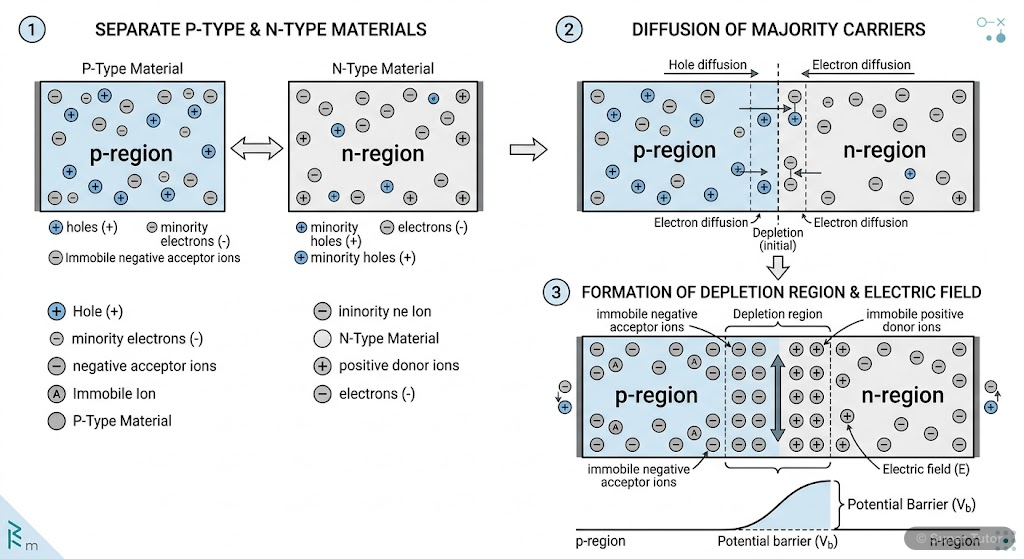
One of 3 illustrations for Junction Diodes in Super Tutor — alongside flashcards, concept maps and practice questions.
Overview
Junction diodes are basic semiconductor devices formed by joining p-type and n-type regions. Their action depends on the depletion region, potential barrier, forward bias, reverse bias, and the movement of majority and minority charge carriers. The same junction principle gives rise to rectification
Key Concepts
A p
A p-n junction diode is a semiconductor device formed by joining p-type and n-type regions. The boundary between them is the p-n junction. The p-regio
Near the junction
Near the junction, diffusion of majority carriers leaves behind fixed ions. This carrier-free region containing immobile ions is called the depletion
The potential difference across the depletion
The potential difference across the depletion region is called the potential barrier or barrier potential. It is about 0.3 V for germanium junctions a
Diffusion current is produced by majority
Diffusion current is produced by majority carriers moving across the junction from p-block to n-block. Drift current is produced by minority carriers
A junction diode is forward
A junction diode is forward-biased when the positive terminal of the battery is connected to the p-region and the negative terminal to the n-region. T
Learning Objectives
- Understand the formation of a p-n junction and the creation of depletion region and potential barrier.
- Explain diffusion current, drift current, and equilibrium in a junction diode.
- Describe forward bias and reverse bias and their effect on diode resistance and current.
- Interpret the I-V characteristics of a p-n junction diode.
- Explain diode action as a half-wave and full-wave rectifier.
Frequently Asked Questions
What are the important topics in Junction Diodes for ICSE Class 12 Physics?
How should I revise Junction Diodes for the ICSE Class 12 board exam?
Sources & Official References
Content is aligned to the official syllabus. Refer to the board website for the latest curriculum.
More resources for Junction Diodes
Practice Quiz
Test yourself with a quick quiz
Important Questions
Exam-style questions with answers
Revision Notes
Key points for last-minute revision
Formula Sheet
The chapter's formulas in one place
Concept Maps
See how topics connect
Study Plan
Step-by-step plan for this chapter
Flashcards
Quick-fire cards for active recall
Syllabus
What topics to cover
For serious students
Get the full Junction Diodes chapter — start free.
Quizzes, flashcards, an AI doubt solver and a study plan for ICSE Class 12 Physics. Free to start, no card needed.