Nuclear Fission and Nuclear Fusion: Source of Energy — Chapter Summary
ICSE · Class 12 · Physics
Summary of Nuclear Fission and Nuclear Fusion: Source of Energy for ICSE Class 12 Physics. Key concepts: Nuclear fission is a process, U and A typical U.
Interactive on Super Tutor
Studying Nuclear Fission and Nuclear Fusion: Source of Energy? Get the full interactive chapter.
Quizzes, flashcards, AI doubt-solver and a step-by-step study plan — built for chapter summary and more.
Free trial, no card needed.
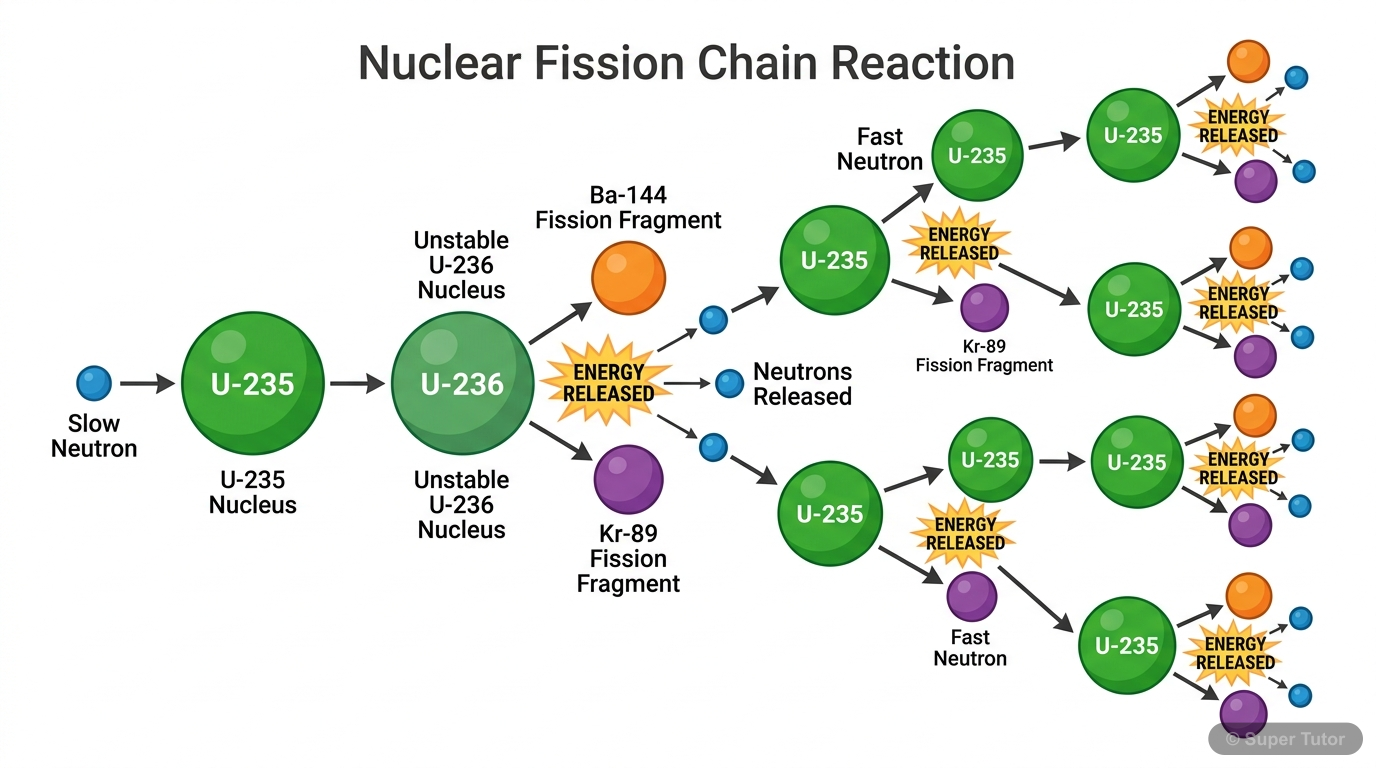
An illustration from Super Tutor's Nuclear Fission and Nuclear Fusion: Source of Energy chapter — alongside flashcards, concept maps and practice questions.
Overview
Nuclear energy comes from changes inside the nucleus and is far greater than energy from ordinary chemical reactions. In nuclear fission, a heavy nucleus splits into lighter nuclei and releases a large amount of energy. In nuclear fusion, very light nuclei combine to form a heavier nucleus and also
Key Concepts
Nuclear fission is a process
Nuclear fission is a process in which a heavy nucleus, after capturing a thermal neutron, splits into two lighter nuclei of comparable masses. The pro
U
U-235 is fissionable by slow or thermal neutrons, while U-238 can be fissioned only by fast neutrons above 1 MeV. Natural uranium contains only 0.7% U
A typical U
A typical U-235 fission releases about 200 MeV. The energy comes from the fact that fission fragments have greater binding energy per nucleon than the
Neutrons released in one fission can
Neutrons released in one fission can cause further fissions. If the process continues, a chain reaction is formed. The reaction may be uncontrolled, c
K is the ratio of
K is the ratio of the number of neutrons present at the beginning of the present generation to the number present at the beginning of the previous gen
Learning Objectives
- Understand nuclear fission and nuclear fusion as two main sources of nuclear energy
- Explain why U-235 undergoes fission with slow neutrons while U-238 needs fast neutrons
- Learn the idea of chain reaction and the meaning of multiplication factor K
- Identify the functions of moderator, control rods, coolant, and shut-off rods in a nuclear reactor
- Understand how Pu-239 is produced in reactors and why it is useful as a fuel
Frequently Asked Questions
What are the important topics in Nuclear Fission and Nuclear Fusion: Source of Energy for ICSE Class 12 Physics?
How should I revise Nuclear Fission and Nuclear Fusion: Source of Energy for the ICSE Class 12 board exam?
Sources & Official References
Content is aligned to the official syllabus. Refer to the board website for the latest curriculum.
More resources for Nuclear Fission and Nuclear Fusion: Source of Energy
Practice Quiz
Test yourself with a quick quiz
Important Questions
Exam-style questions with answers
Revision Notes
Key points for last-minute revision
Formula Sheet
The chapter's formulas in one place
Concept Maps
See how topics connect
Study Plan
Step-by-step plan for this chapter
Flashcards
Quick-fire cards for active recall
Syllabus
What topics to cover
For serious students
Get the full Nuclear Fission and Nuclear Fusion: Source of Energy chapter — start free.
Quizzes, flashcards, an AI doubt solver and a study plan for ICSE Class 12 Physics. Free to start, no card needed.