Reflection of Light: Spherical Mirrors — Practice Quiz
ICSE · Class 12 · Physics
Try a 4-question quiz on Reflection of Light: Spherical Mirrors for ICSE Class 12 Physics: tap an answer to check it and see why.
Interactive on Super Tutor
Studying Reflection of Light: Spherical Mirrors? Get the full interactive chapter.
Quizzes, flashcards, AI doubt-solver and a step-by-step study plan — built for practice quiz and more.
Free trial, no card needed.
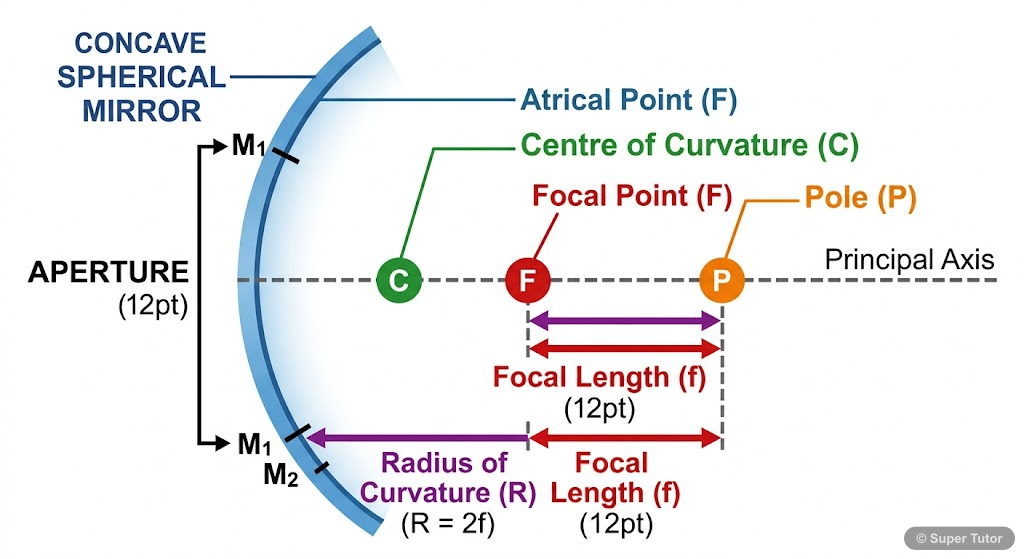
One of 5 illustrations for Reflection of Light: Spherical Mirrors in Super Tutor — alongside flashcards, concept maps and practice questions.
Quick Quiz: Reflection of Light: Spherical Mirrors
0/4Tap an answer to check it instantly. No sign-up needed for these 4.
What is the relationship between the focal length (f) and the radius of curvature (R) of a spherical mirror?
A concave mirror has a radius of curvature of 30 cm. What is its focal length?
Which type of mirror always forms a virtual, erect, and diminished image for any position of the object?
The mirror formula is given by 1/v + 1/u = 1/f. A concave mirror has a focal length of 10 cm. An object is placed 20 cm in front of it. Where is the image formed?
Sample Questions
The magnification produced by a spherical mirror is given by m = -v/u. If the magnification is +0.5 for a mirror, what does this tell us about the image?
Show answer
The image is virtual, erect, and diminished
Step 1: m = +0.5. The sign of magnification tells us about orientation. Step 2: A positive magnification means the image is erect (same side as object with respect to the principal axis). Step 3: A negative magnification means the image is inverted (real image). Step 4: |m| = 0.5 < 1, which means the image is smaller (diminished) than the object. Step 5: So m = +0.5 → virtual, erect, and diminished. m = -0.5 would be real, inverted, and diminished. m = +2 would be virtual, erect, and magnified.
According to the New Cartesian Sign Convention, what sign is assigned to the focal length of a concave mirror?
Show answer
Negative (-)
Step 1: In the New Cartesian Sign Convention, the pole P is the origin and the principal axis is the x-axis. Step 2: All distances are measured from the pole. Distances to the left (where the object is placed) are negative. Step 3: For a concave mirror, the focus F lies in front of the mirror, i.e., on the same side as the object. Step 4: Since the focus is to the left of the pole, PF is measured in the negative x-direction. Step 5: Therefore, the focal length f of a concave mirror is negative. A convex mirror's focus is behind the mirror (positive side), so its f is positive.
An object is placed between the pole and focus of a concave mirror. What type of image is formed?
Show answer
Virtual, erect, and magnified
Step 1: When the object is between the pole (P) and focus (F) of a concave mirror, the object distance u satisfies f < u < 0 (in magnitude terms, u < f). Step 2: Applying the mirror formula, 1/v = 1/f - 1/u. With f < 0 and |u| < |f|, 1/v comes out positive. Step 3: Positive v means the image is formed behind the mirror, so it is virtual. Step 4: A virtual image formed by a mirror is always erect. Step 5: Since |v| > |u| in this case, the image is magnified. This is the principle used in shaving mirrors and makeup mirrors.
A convex mirror of focal length 15 cm produces an image that is 1/3 the size of the object. Using m = f/(f - u), what is the object distance?
Show answer
30 cm in front of the mirror
Step 1: For a convex mirror, f = +15 cm. The image is 1/3 the size, so m = +1/3 (positive since convex mirror always gives erect image). Step 2: Use m = f/(f - u): 1/3 = 15/(15 - u). Step 3: Cross multiply: 15 - u = 45, so u = 15 - 45 = -30 cm. Step 4: u = -30 cm means the object is 30 cm in front of the mirror (negative sign = in front). Step 5: Verify: 1/v = 1/15 - 1/(-30) = 1/15 + 1/30 = 3/30, v = 10 cm; m = -10/(-30) = +1/3. Correct! '10 cm' is the image distance, not the object distance.
+40 more questions on Reflection of Light: Spherical Mirrors (ICSE Class 12 Physics)
Practise AllFrequently Asked Questions
What are the important topics in Reflection of Light: Spherical Mirrors for ICSE Class 12 Physics?
How many practice questions are there for Reflection of Light: Spherical Mirrors?
Sources & Official References
Content is aligned to the official syllabus. Refer to the board website for the latest curriculum.
More resources for Reflection of Light: Spherical Mirrors
Important Questions
Exam-style questions with answers
Revision Notes
Key points for last-minute revision
Formula Sheet
The chapter's formulas in one place
Chapter Summary
Understand the chapter at a glance
Concept Maps
See how topics connect
Study Plan
Step-by-step plan for this chapter
Flashcards
Quick-fire cards for active recall
Syllabus
What topics to cover
For serious students
Get the full Reflection of Light: Spherical Mirrors chapter — start free.
Quizzes, flashcards, an AI doubt solver and a study plan for ICSE Class 12 Physics. Free to start, no card needed.