Reflection of Light: Spherical Mirrors — Revision Notes
ICSE · Class 12 · Physics
Reflection of Light: Spherical Mirrors revision notes for ICSE Class 12 Physics: 4 topics in quick points. Part of the ICSE Class 12 Physics syllabus.
Interactive on Super Tutor
Studying Reflection of Light: Spherical Mirrors? Get the full interactive chapter.
Quizzes, flashcards, AI doubt-solver and a step-by-step study plan — built for revision notes and more.
Free trial, no card needed.
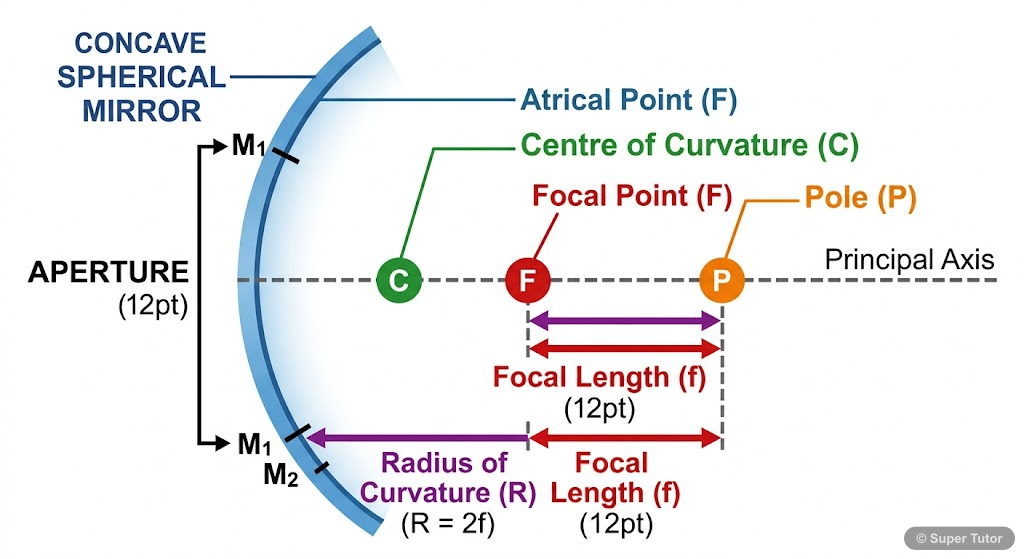
One of 5 illustrations for Reflection of Light: Spherical Mirrors in Super Tutor — alongside flashcards, concept maps and practice questions.
Key Topics to Revise
1. Basic Terms and Types of Spherical Mirrors
- A spherical mirror is a part of a hollow sphere with one side silvered and coated, and the other side acting as the reflecting surface.
- A concave mirror is one whose reflecting surface is towards the centre of the sphere of which the mirror is a part.
- A convex mirror is one whose reflecting surface is away from the centre of the sphere of which the mirror is a part.
2. Rays, Images, and Ray Diagrams
- Rays close to the principal axis are paraxial rays.
- Rays quite distant from the principal axis are marginal rays.
- Most derivations relating object and image parameters are valid only for paraxial rays.
3. New Cartesian Sign Convention
- The pole is taken as the origin.
- The principal axis is the X-axis, and a perpendicular line through the pole is the Y-axis.
- Distances to the right of the pole are positive, and distances to the left are negative.
4. Focal Length and Radius of Curvature
- For a spherical mirror of aperture small compared with its radius of curvature, the focal length is one-half the radius of curvature.
- The relation f = R/2 is strictly valid for paraxial rays.
- For marginal rays and large aperture, the more general relation must be used.
Get complete notes with diagrams and examples
Full NotesKey Concepts
Frequently Asked Questions
What are the important topics in Reflection of Light: Spherical Mirrors for ICSE Class 12 Physics?
How should I revise Reflection of Light: Spherical Mirrors for the ICSE Class 12 board exam?
Sources & Official References
Content is aligned to the official syllabus. Refer to the board website for the latest curriculum.
More resources for Reflection of Light: Spherical Mirrors
Practice Quiz
Test yourself with a quick quiz
Important Questions
Exam-style questions with answers
Formula Sheet
The chapter's formulas in one place
Chapter Summary
Understand the chapter at a glance
Concept Maps
See how topics connect
Study Plan
Step-by-step plan for this chapter
Flashcards
Quick-fire cards for active recall
Syllabus
What topics to cover
For serious students
Get the full Reflection of Light: Spherical Mirrors chapter — start free.
Quizzes, flashcards, an AI doubt solver and a study plan for ICSE Class 12 Physics. Free to start, no card needed.