Refraction and Dispersion of Light through a Prism — Practice Quiz
ICSE · Class 12 · Physics
Try a 4-question quiz on Refraction and Dispersion of Light through a Prism for ICSE Class 12 Physics: tap an answer to check it and see why.
Interactive on Super Tutor
Studying Refraction and Dispersion of Light through a Prism? Get the full interactive chapter.
Quizzes, flashcards, AI doubt-solver and a step-by-step study plan — built for practice quiz and more.
Free trial, no card needed.
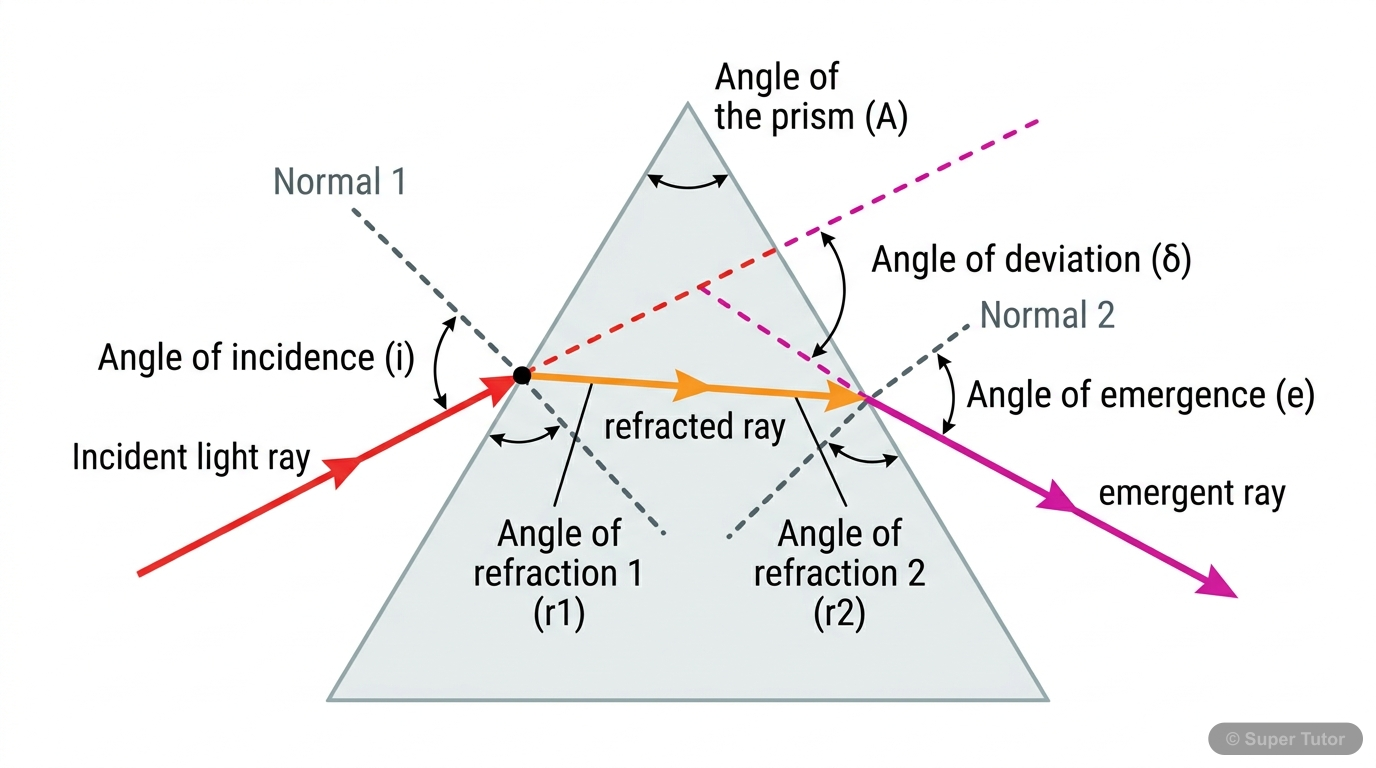
Learn better with visuals Super Tutor pairs illustrations like this with notes and quizzes for Refraction and Dispersion of Light through a Prism.
Quick Quiz: Refraction and Dispersion of Light through a Prism
0/4Tap an answer to check it instantly. No sign-up needed for these 4.
A ray of light passes through a prism of refracting angle A. If i is the angle of incidence at the first face and i′ is the angle of emergence at the second face, which formula correctly gives the angle of deviation δ?
For a prism of refracting angle A = 60°, the angle of minimum deviation is δm = 30°. What is the refractive index of the prism material? (Use sin 45° = 0.707, sin 30° = 0.5)
At the position of minimum deviation through a prism, which of the following statements is TRUE?
A thin prism of refracting angle A = 5° is made of glass with refractive index n = 1.6. What is the angle of deviation produced by this thin prism?
Sample Questions
White light is dispersed by a glass prism. Which colour of light is deviated the MOST by the prism?
Show answer
Violet
Step 1: Dispersion occurs because different colours of light have different speeds in glass, giving different refractive indices. Step 2: Violet light has the shortest wavelength and travels slowest in glass, so it has the highest refractive index (nV is largest). Step 3: Since deviation δ = (n − 1)A for a thin prism, higher refractive index means more deviation. Step 4: Violet light bends the most towards the base. Red light (longest wavelength) has the lowest refractive index and is deviated the least. Green and Yellow are intermediate colours.
The dispersive power ω of a prism material is defined as:
Show answer
ω = (nV − nR) / (nY − 1)
Step 1: Dispersive power is the ratio of angular dispersion to mean deviation. Step 2: Angular dispersion = δV − δR = (nV − nR) × A (for thin prism). Step 3: Mean deviation (for yellow ray) = δY = (nY − 1) × A. Step 4: So ω = [(nV − nR) × A] / [(nY − 1) × A] = (nV − nR) / (nY − 1). The angle A cancels, showing dispersive power depends only on the material. Option B uses a sum instead of difference. Option C multiplies instead of dividing. Option D uses nY instead of (nY − 1).
A prism has nV = 1.62, nR = 1.52, and nY = 1.59. What is the dispersive power of the prism material?
Show answer
0.169
Step 1: Use ω = (nV − nR) / (nY − 1). Step 2: Numerator = nV − nR = 1.62 − 1.52 = 0.10. Step 3: Denominator = nY − 1 = 1.59 − 1 = 0.59. Step 4: ω = 0.10 / 0.59 ≈ 0.169. Option B (0.059) incorrectly uses (nV − nR) in denominator. Option C (0.250) is an over-estimate. Option D (0.100) only calculates the numerator without dividing.
In the primary rainbow, which colour appears on the INNER edge (closer to the ground)?
Show answer
Violet
Step 1: The primary rainbow is formed by sunlight undergoing one total internal reflection and two refractions inside raindrops. Step 2: Red light reaches the observer at a semi-vertical angle of 43° from the line SE produced, while violet light reaches at 41°. Step 3: Since the red rays make a larger angle, they appear on the OUTER edge (top arc). Step 4: Violet rays, making a smaller angle, appear on the INNER edge (bottom arc). This is the reverse of the secondary rainbow. Option A (Red) is the outer edge of the primary rainbow.
+41 more questions on Refraction and Dispersion of Light through a Prism (ICSE Class 12 Physics)
Practise AllFrequently Asked Questions
What are the important topics in Refraction and Dispersion of Light through a Prism for ICSE Class 12 Physics?
How many practice questions are there for Refraction and Dispersion of Light through a Prism?
Sources & Official References
Content is aligned to the official syllabus. Refer to the board website for the latest curriculum.
More resources for Refraction and Dispersion of Light through a Prism
Important Questions
Exam-style questions with answers
Revision Notes
Key points for last-minute revision
Formula Sheet
The chapter's formulas in one place
Chapter Summary
Understand the chapter at a glance
Concept Maps
See how topics connect
Study Plan
Step-by-step plan for this chapter
Flashcards
Quick-fire cards for active recall
Syllabus
What topics to cover
For serious students
Get the full Refraction and Dispersion of Light through a Prism chapter — start free.
Quizzes, flashcards, an AI doubt solver and a study plan for ICSE Class 12 Physics. Free to start, no card needed.