Nuclear Fission and Nuclear Fusion: Source of Energy — Practice Quiz
ICSE · Class 12 · Physics
Try a 4-question quiz on Nuclear Fission and Nuclear Fusion: Source of Energy for ICSE Class 12 Physics: tap an answer to check it and see why.
Interactive on Super Tutor
Studying Nuclear Fission and Nuclear Fusion: Source of Energy? Get the full interactive chapter.
Quizzes, flashcards, AI doubt-solver and a step-by-step study plan — built for practice quiz and more.
Free trial, no card needed.
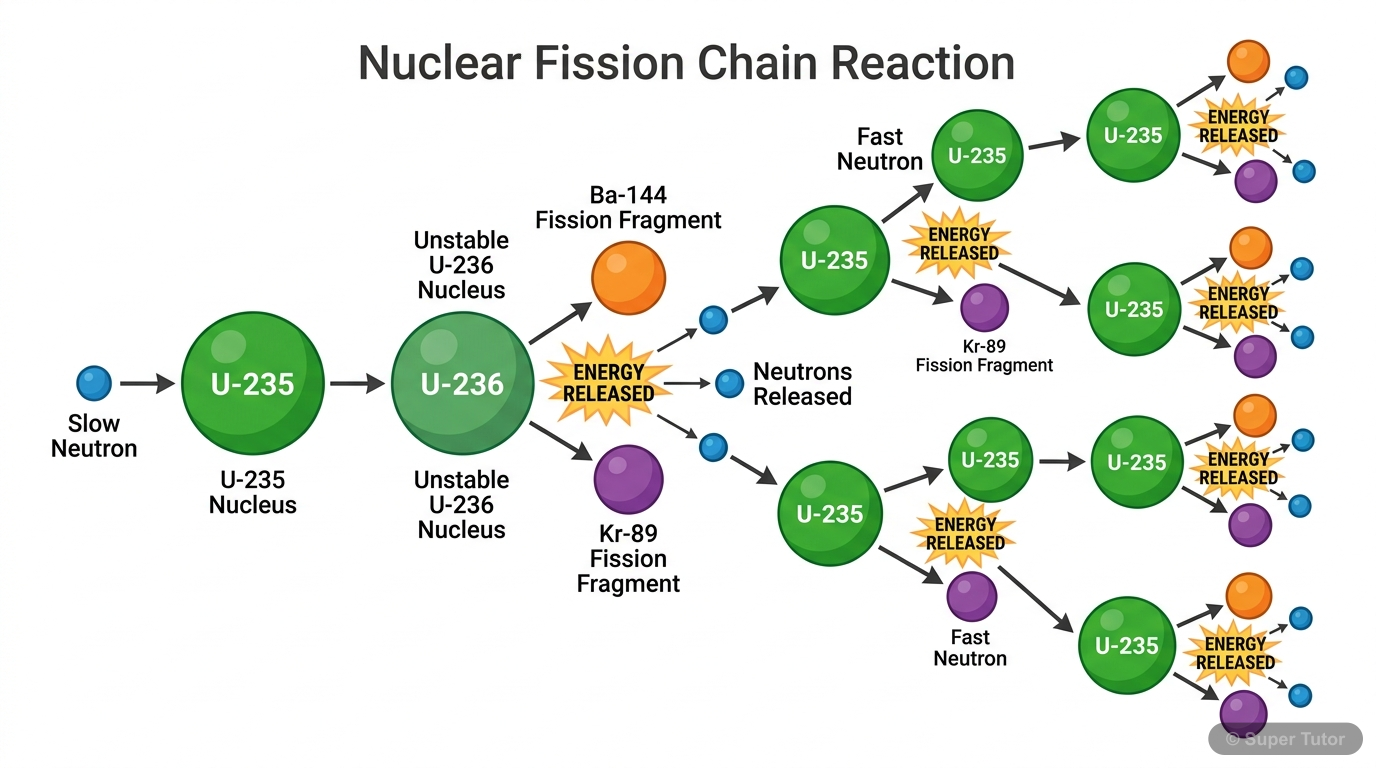
An illustration from Super Tutor's Nuclear Fission and Nuclear Fusion: Source of Energy chapter — alongside flashcards, concept maps and practice questions.
Quick Quiz: Nuclear Fission and Nuclear Fusion: Source of Energy
0/4Tap an answer to check it instantly. No sign-up needed for these 4.
A U-235 fission event releases 200 MeV of energy. If a reactor produces 320 MW, what is the fission rate per second?
A 1 g sample of U-235 is fully fissioned and each fission releases 200 MeV. How much energy is released in joules?
A 1000 MW reactor operates at 80% efficiency for 5 years and consumes only U-235 by fission. If each fission releases 200 MeV, what initial mass of U-235 was present?
A U-235 reactor uses 2 kg of fuel in 30 days. If each fission gives 185 MeV of usable energy, what is the power output of the reactor?
Sample Questions
A 50 kg uranium bomb releases 2.5 × 10^28 MeV. What is this energy equivalent in tons of TNT?
Show answer
20,000 tons of TNT
The stated equivalence for 50 kg uranium is 2.5 × 10^28 MeV, which corresponds to about 20,000 tons of TNT. This also matches the energy scale of large fission explosions.
A reactor produces 144 × 10^10 J of useful energy in 1 hour with 10% efficiency. What mass loss corresponds to the total energy released in the reactor during that hour?
Show answer
0.16 g
Useful energy = 144 × 10^10 J. At 10% efficiency, total released energy = 10 times this = 144 × 10^11 J. Using E = mc^2, m = 144 × 10^11 / (3 × 10^8)^2 = 0.16 g.
A plutonium-239 sample of 1 kg undergoes complete fission, and each fission releases 180 MeV. How much total energy is released in MeV?
Show answer
4.54 × 10^26 MeV
1 kg of Pu-239 contains (6.02 × 10^23 / 239) × 1000 = 2.52 × 10^24 atoms. Multiply by 180 MeV per fission to get 4.54 × 10^26 MeV.
A 2 kg sample of U-235 contains how many atoms?
Show answer
5.12 × 10^24 atoms
1 mole of U-235 has 6.02 × 10^23 atoms in 235 g. So 2000 g contains (6.02 × 10^23 / 235) × 2000 = 5.12 × 10^24 atoms.
+65 more questions on Nuclear Fission and Nuclear Fusion: Source of Energy (ICSE Class 12 Physics)
Practise AllFrequently Asked Questions
What are the important topics in Nuclear Fission and Nuclear Fusion: Source of Energy for ICSE Class 12 Physics?
How many practice questions are there for Nuclear Fission and Nuclear Fusion: Source of Energy?
Sources & Official References
Content is aligned to the official syllabus. Refer to the board website for the latest curriculum.
More resources for Nuclear Fission and Nuclear Fusion: Source of Energy
Important Questions
Exam-style questions with answers
Revision Notes
Key points for last-minute revision
Formula Sheet
The chapter's formulas in one place
Chapter Summary
Understand the chapter at a glance
Concept Maps
See how topics connect
Study Plan
Step-by-step plan for this chapter
Flashcards
Quick-fire cards for active recall
Syllabus
What topics to cover
For serious students
Get the full Nuclear Fission and Nuclear Fusion: Source of Energy chapter — start free.
Quizzes, flashcards, an AI doubt solver and a study plan for ICSE Class 12 Physics. Free to start, no card needed.