Reflection of Light: Spherical Mirrors — Syllabus
ICSE · Class 12 · Physics
What Reflection of Light: Spherical Mirrors covers in ICSE Class 12 Physics: 4 topics, for the 2026-27 session. Part of the ICSE Class 12 Physics syllabus.
Interactive on Super Tutor
Studying Reflection of Light: Spherical Mirrors? Get the full interactive chapter.
Quizzes, flashcards, AI doubt-solver and a step-by-step study plan — built for syllabus and more.
Free trial, no card needed.
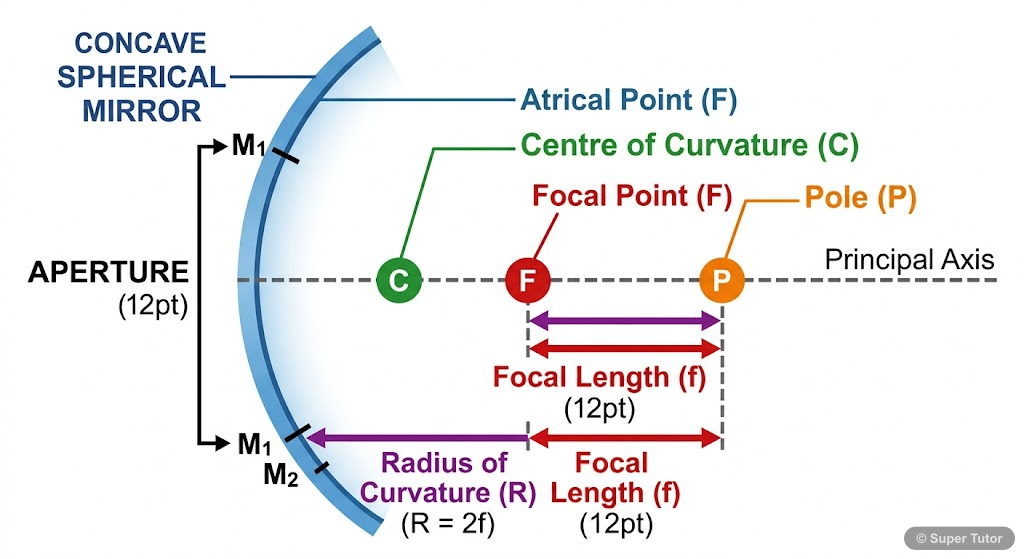
One of 5 illustrations for Reflection of Light: Spherical Mirrors in Super Tutor — alongside flashcards, concept maps and practice questions.
Topics in Reflection of Light: Spherical Mirrors
1. Basic Terms and Types of Spherical Mirrors
- A spherical mirror is a part of a hollow sphere with one side silvered and coated, and the other side acting as the reflecting surface.
- A concave mirror is one whose reflecting surface is towards the centre of the sphere of which the mirror is a part.
- A convex mirror is one whose reflecting surface is away from the centre of the sphere of which the mirror is a part.
2. Rays, Images, and Ray Diagrams
- Rays close to the principal axis are paraxial rays.
- Rays quite distant from the principal axis are marginal rays.
- Most derivations relating object and image parameters are valid only for paraxial rays.
3. New Cartesian Sign Convention
- The pole is taken as the origin.
- The principal axis is the X-axis, and a perpendicular line through the pole is the Y-axis.
- Distances to the right of the pole are positive, and distances to the left are negative.
4. Focal Length and Radius of Curvature
- For a spherical mirror of aperture small compared with its radius of curvature, the focal length is one-half the radius of curvature.
- The relation f = R/2 is strictly valid for paraxial rays.
- For marginal rays and large aperture, the more general relation must be used.
Key Concepts
Central concept: Spherical mirrors form images by regular reflection and are described using principal axis, focus, curvature, sign convention, mirror formula, magnification, and applications.
Work through every topic in Reflection of Light: Spherical Mirrors with notes and quizzes
Start This ChapterFrequently Asked Questions
What are the important topics in Reflection of Light: Spherical Mirrors for ICSE Class 12 Physics?
How should I revise Reflection of Light: Spherical Mirrors for the ICSE Class 12 board exam?
Sources & Official References
Content is aligned to the official syllabus. Refer to the board website for the latest curriculum.
More resources for Reflection of Light: Spherical Mirrors
Practice Quiz
Test yourself with a quick quiz
Important Questions
Exam-style questions with answers
Revision Notes
Key points for last-minute revision
Formula Sheet
The chapter's formulas in one place
Chapter Summary
Understand the chapter at a glance
Concept Maps
See how topics connect
Study Plan
Step-by-step plan for this chapter
Flashcards
Quick-fire cards for active recall
For serious students
Get the full Reflection of Light: Spherical Mirrors chapter — start free.
Quizzes, flashcards, an AI doubt solver and a study plan for ICSE Class 12 Physics. Free to start, no card needed.