Refraction and Dispersion of Light through a Prism — Revision Notes
ICSE · Class 12 · Physics
Refraction and Dispersion of Light through a Prism revision notes for ICSE Class 12 Physics: 4 topics in quick points.
Interactive on Super Tutor
Studying Refraction and Dispersion of Light through a Prism? Get the full interactive chapter.
Quizzes, flashcards, AI doubt-solver and a step-by-step study plan — built for revision notes and more.
Free trial, no card needed.
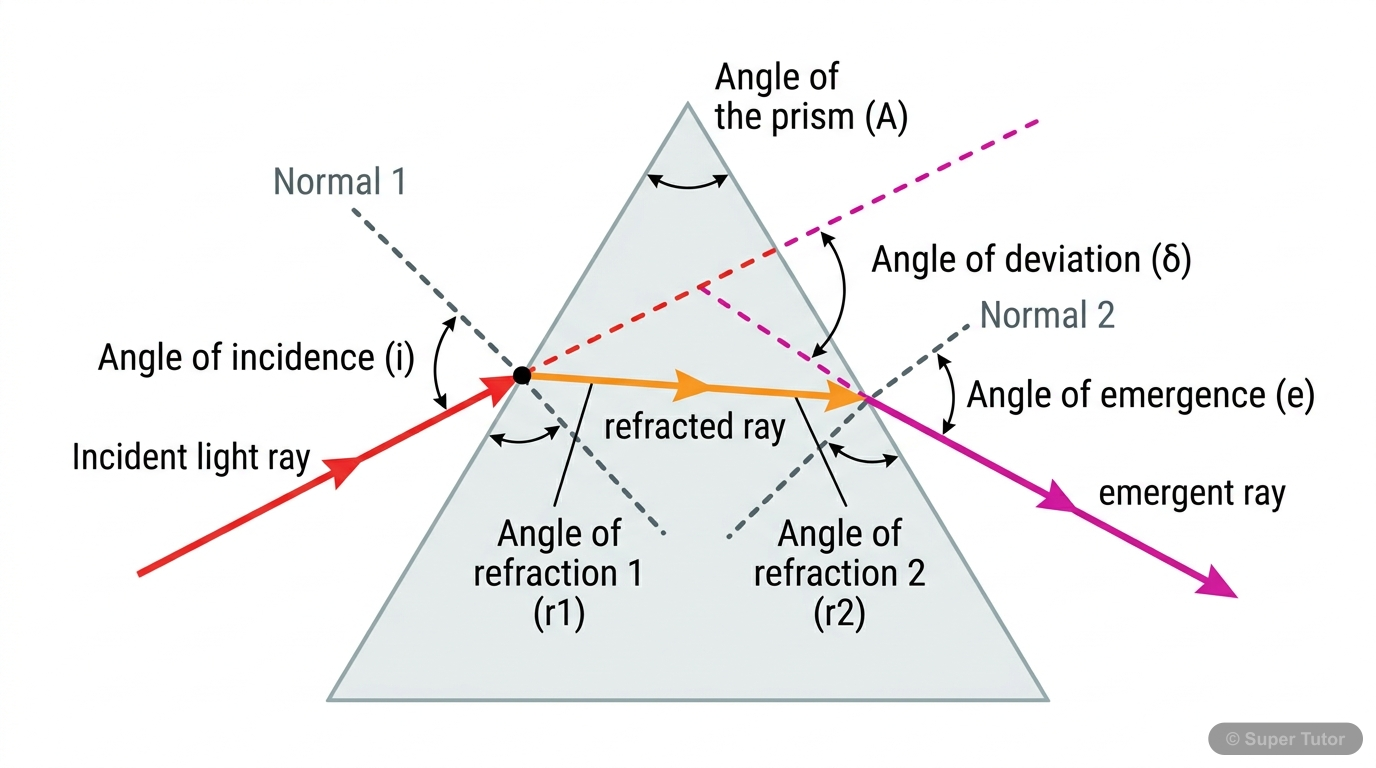
Learn better with visuals Super Tutor pairs illustrations like this with notes and quizzes for Refraction and Dispersion of Light through a Prism.
Key Topics to Revise
1. Prism and Refraction through a Prism
- A prism is a homogeneous, transparent medium such as glass bounded by two plane surfaces inclined to each other at an angle.
- The two refracting faces of a prism are the two plane surfaces.
- The angle A between the two refracting faces is called the refracting angle or angle of prism.
2. Minimum Deviation and Refractive Index
- For different angles of incidence, the deviation first decreases, reaches a minimum, and then increases.
- There is one and only one particular angle of incidence for minimum deviation.
- At minimum deviation, i = i′.
3. Limiting Angle, Grazing Incidence, and Maximum Deviation
- For the ray to just emerge from the second face, the angle of incidence at the second face must be the critical angle.
- The critical angle is C = sin⁻¹(1/n).
- The limiting angle of incidence is the angle of incidence at the first face for which the emergent ray just grazes the second face.
4. Dispersion of White Light and Angular Dispersion
- White light is a mixture of lights of different colours.
- Dispersion occurs because different colours travel at different speeds inside a material medium.
- In vacuum or air, all colours travel with the same speed, 3 × 10^8 m/s.
Get complete notes with diagrams and examples
Full NotesKey Concepts
Frequently Asked Questions
What are the important topics in Refraction and Dispersion of Light through a Prism for ICSE Class 12 Physics?
How should I revise Refraction and Dispersion of Light through a Prism for the ICSE Class 12 board exam?
Sources & Official References
Content is aligned to the official syllabus. Refer to the board website for the latest curriculum.
More resources for Refraction and Dispersion of Light through a Prism
Practice Quiz
Test yourself with a quick quiz
Important Questions
Exam-style questions with answers
Formula Sheet
The chapter's formulas in one place
Chapter Summary
Understand the chapter at a glance
Concept Maps
See how topics connect
Study Plan
Step-by-step plan for this chapter
Flashcards
Quick-fire cards for active recall
Syllabus
What topics to cover
For serious students
Get the full Refraction and Dispersion of Light through a Prism chapter — start free.
Quizzes, flashcards, an AI doubt solver and a study plan for ICSE Class 12 Physics. Free to start, no card needed.