Atmospheric Pollution — Chapter Summary
ICSE · Class 9 · Chemistry
Summary of Atmospheric Pollution for ICSE Class 9 Chemistry. Part of the ICSE Class 9 Chemistry syllabus. Atmospheric pollution is the contamination.
Interactive on Super Tutor
Studying Atmospheric Pollution? Get the full interactive chapter.
Quizzes, flashcards, AI doubt-solver and a step-by-step study plan — built for chapter summary and more.
Free trial, no card needed.
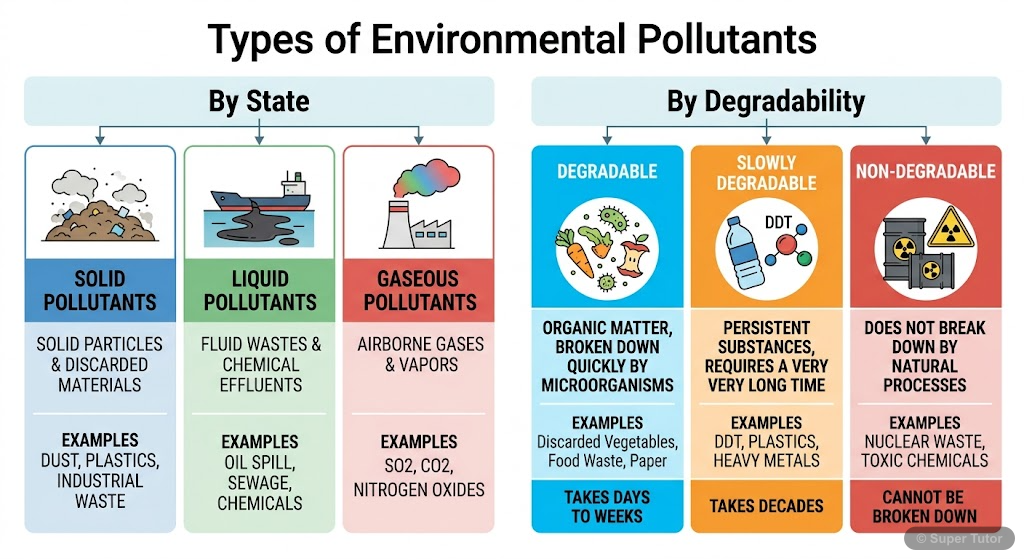
Learn better with visuals Super Tutor pairs illustrations like this with notes and quizzes for Atmospheric Pollution.
Overview
Atmospheric pollution is the contamination of air by harmful gases and particles that damage plants, animals, and human beings. It includes pollutants from natural sources such as volcanoes, forest fires, and dust storms, as well as man-made sources like automobiles, factories, and industrial proces
Key Concepts
Pollution is the effect of undesirable
Pollution is the effect of undesirable changes in the surroundings that harm plants, animals, and human beings. Pollutants are harmful substances that
Natural sources include volcanoes
Natural sources include volcanoes, decaying vegetation, forest fires, winds, and dust storms. Man-made sources include automobiles, factories, industr
Carbon monoxide is poisonous and reduces
Carbon monoxide is poisonous and reduces oxygen transport in blood. Sulphur dioxide damages crops and lungs. Nitrogen oxides harm plants, cause respir
Smog is a dark
Smog is a dark, thick fog laden with dust and soot formed by a combination of oxides of nitrogen and sulphur with partially oxidized hydrocarbons. Pho
Carbon monoxide is produced by incomplete
Carbon monoxide is produced by incomplete combustion of fuels. It binds with haemoglobin more than 200 times more strongly than oxygen, forming carbox
Learning Objectives
- Understand the meaning of pollution, pollutant, and air pollution.
- Identify natural and man-made sources of air pollutants.
- Explain the harmful effects of common air pollutants such as carbon monoxide, sulphur dioxide, nitrogen oxides, ozone, and CFCs.
- Describe the formation, composition, causes, and impact of acid rain.
- Explain the greenhouse effect and global warming along with their sources and effects.
Frequently Asked Questions
What are the important topics in Atmospheric Pollution for ICSE Class 9 Chemistry?
How should I revise Atmospheric Pollution for Class 9 exams?
Sources & Official References
Content is aligned to the official syllabus. Refer to the board website for the latest curriculum.
More resources for Atmospheric Pollution
Practice Quiz
Test yourself with a quick quiz
Important Questions
Exam-style questions with answers
Revision Notes
Key points for last-minute revision
Formula Sheet
The chapter's formulas in one place
Concept Maps
See how topics connect
Study Plan
Step-by-step plan for this chapter
Flashcards
Quick-fire cards for active recall
Syllabus
What topics to cover
For serious students
Get the full Atmospheric Pollution chapter — start free.
Quizzes, flashcards, an AI doubt solver and a study plan for ICSE Class 9 Chemistry. Free to start, no card needed.