Volcanoes — Syllabus
ICSE · Class 9 · Geography
What Volcanoes covers in ICSE Class 9 Geography: 4 topics, for the 2026-27 session. Part of the ICSE Class 9 Geography syllabus.
Interactive on Super Tutor
Studying Volcanoes? Get the full interactive chapter.
Quizzes, flashcards, AI doubt-solver and a step-by-step study plan — built for syllabus and more.
Free trial, no card needed.
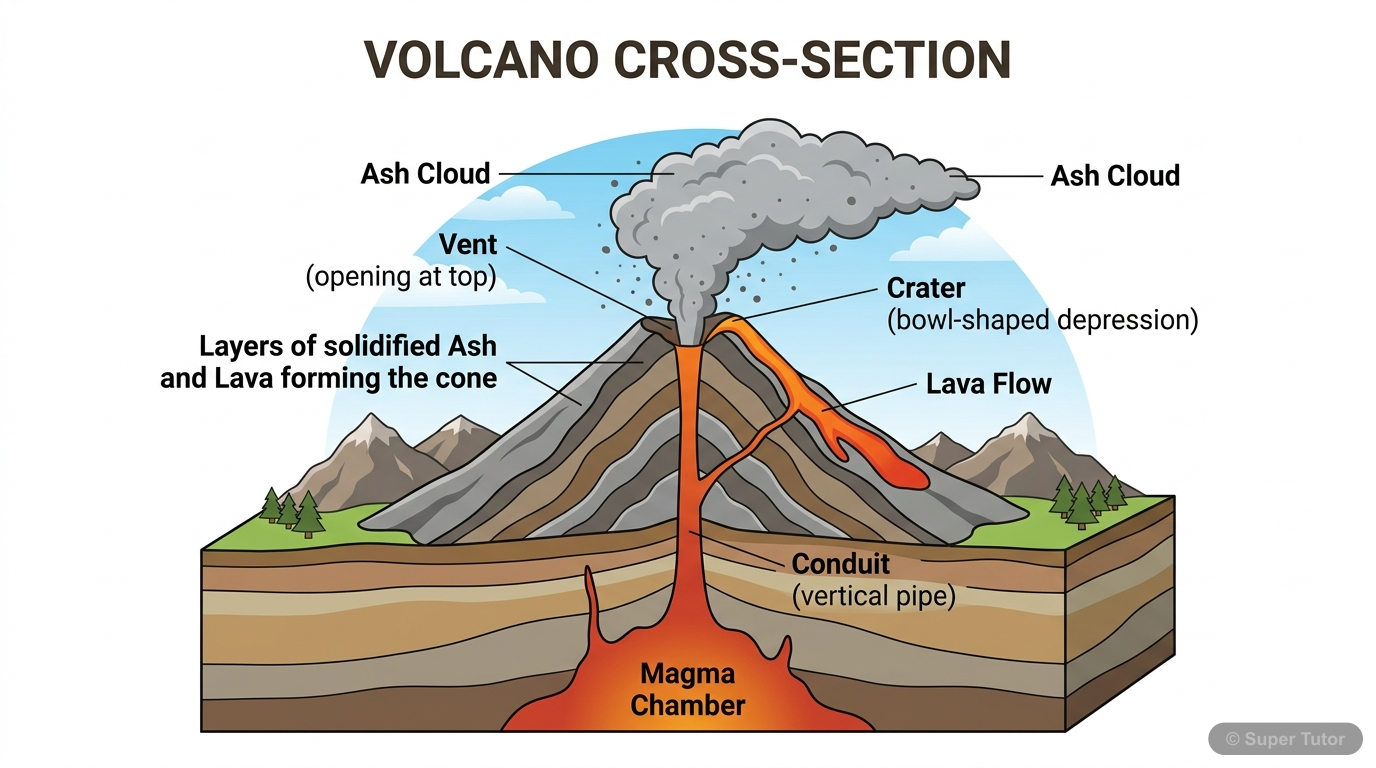
One of 6 illustrations for Volcanoes in Super Tutor — alongside flashcards, concept maps and practice questions.
Topics in Volcanoes
1. Meaning and Types of Volcanoes
- Volcanicity is the intrusion of magma in the Earth's crust or the extrusion of molten material on the Earth's surface.
- A volcano is usually cone-shaped or dome-shaped according to the material ejected.
- The two main types of volcanic landforms are intrusive forms and extrusive forms.
2. Intrusive Volcanic Forms
- Batholith is a large, coarse-grained igneous landmass that forms the base of mountains after erosion of the upper lying landmass.
- Laccoliths are large sills of acid lava that solidify slowly and give a dome shape.
- Sills are formed when lava solidifies before coming out between horizontal layers of parent rocks.
3. Extrusive Volcanic Forms
- Ash and Cinder Cones are built when eruptions are explosive.
- Growth of an ash or cinder cone begins around a crater and it is not very high.
- Lava Dome is formed when viscous lava solidifies quickly and forms a steep-sided cone.
4. Classification Based on Activity
- Volcanoes may be classified on the basis of intensity of eruption into active, dormant and extinct.
- Active volcanoes constantly eject lava, gases, ashes, cinder and pumice.
- About 50 out of 1500 active volcanoes erupt every year.
Key Concepts
Central concept: Volcanicity and volcanic activity
Work through every topic in Volcanoes with notes and quizzes
Start This ChapterFrequently Asked Questions
What are the important topics in Volcanoes for ICSE Class 9 Geography?
How should I revise Volcanoes for Class 9 exams?
Sources & Official References
Content is aligned to the official syllabus. Refer to the board website for the latest curriculum.
More resources for Volcanoes
Practice Quiz
Test yourself with a quick quiz
Important Questions
Exam-style questions with answers
Revision Notes
Key points for last-minute revision
Formula Sheet
The chapter's formulas in one place
Chapter Summary
Understand the chapter at a glance
Concept Maps
See how topics connect
Study Plan
Step-by-step plan for this chapter
Flashcards
Quick-fire cards for active recall
For serious students
Get the full Volcanoes chapter — start free.
Quizzes, flashcards, an AI doubt solver and a study plan for ICSE Class 9 Geography. Free to start, no card needed.