Complementary Angles — Flashcards
ICSE · Class 9 · Mathematics
28 flashcards for Complementary Angles (ICSE Class 9 Mathematics) to test yourself on key terms and facts. Part of the ICSE Class 9 Mathematics syllabus.
Interactive on Super Tutor
Studying Complementary Angles? Get the full interactive chapter.
Quizzes, flashcards, AI doubt-solver and a step-by-step study plan — built for flashcards and more.
Free trial, no card needed.
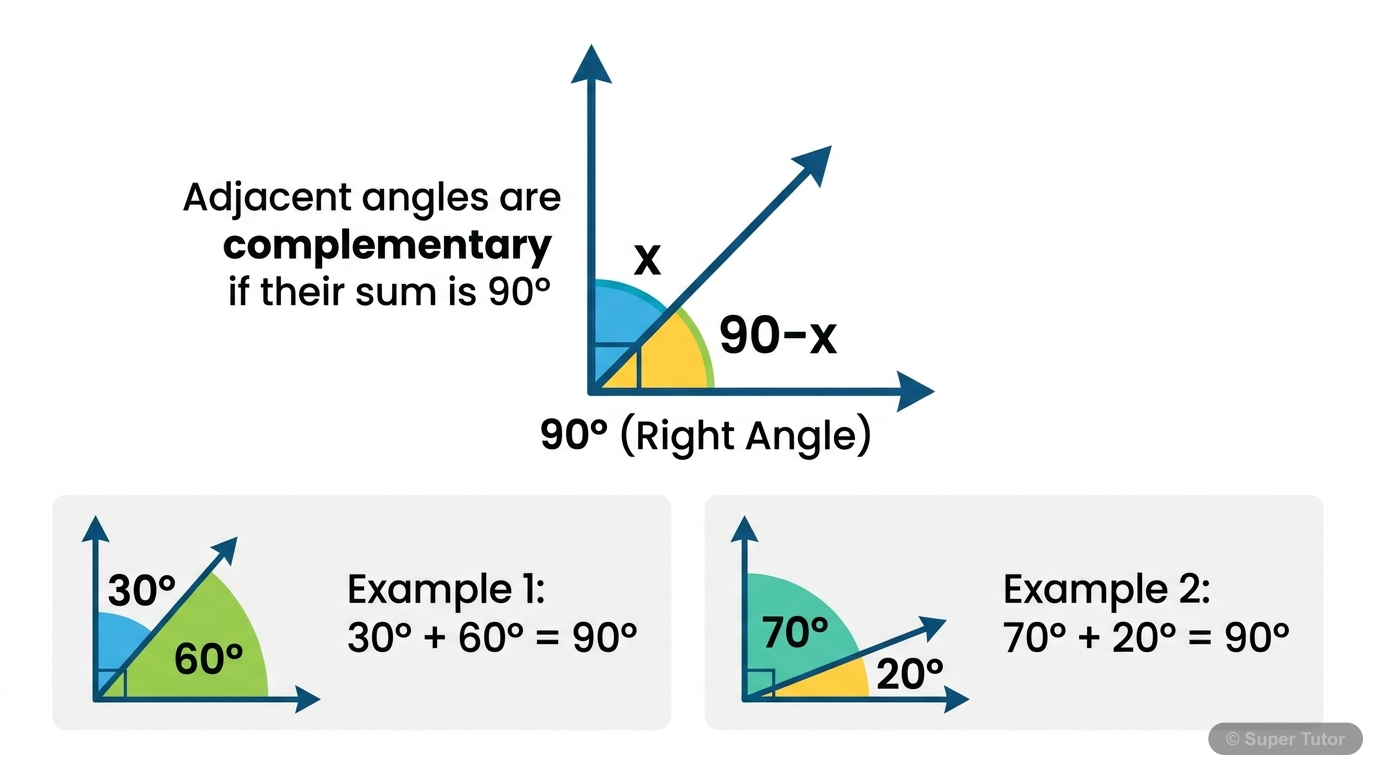
One of 3 illustrations for Complementary Angles in Super Tutor — alongside flashcards, concept maps and practice questions.
Solve: 30° and 60° form what type of angle pair?
Answer
Step 1: Add the angles: 30° + 60° = 90°. Step 2: Two acute angles are complementary if their sum is 90°. Answer: 30° and 60° are complementary angles.
Solve: 70° and 20° form what type of angle pair?
Answer
Step 1: Add the angles: 70° + 20° = 90°. Step 2: Since the sum is 90°, the angles are complementary. Answer: 70° and 20° are complementary angles.
Find the complement of 48°.
Answer
Step 1: Use the formula: complement of θ° = (90 − θ)°. Step 2: Substitute θ = 48°. Step 3: 90° − 48° = 42°. Answer: 42°…
Find the complement of 35°.
Answer
Step 1: Use complement of θ° = (90 − θ)°. Step 2: 90° − 35° = 55°. Answer: 55°…
If one acute angle is x°, what is its complement?
Answer
Step 1: A complementary pair adds to 90°. Step 2: Subtract x° from 90°. Answer: The complement is (90 − x)°.
Why are 30° and 60° called complementary angles?
Answer
Step 1: Check the sum: 30° + 60° = 90°. Step 2: Complementary angles are acute angles whose sum is 90°. Answer: They are complementary because their sum is 90°.
Why is the complement of θ° written as (90 − θ)°?
Answer
Step 1: Complementary angles must add to 90°. Step 2: If one angle is θ°, the other angle must complete the sum to 90°. Step 3: So the missing angle is 90° − θ°. Answer: The complement of θ° is (90 − …
Use the complementary identity to simplify: cos(90° − 47°).
Answer
Step 1: Use cos(90° − θ) = sin θ. Step 2: Here θ = 47°. Step 3: cos(90° − 47°) = sin 47°. Answer: sin 47°…
+20 more flashcards
Practise AllFrequently Asked Questions
What are the important topics in Complementary Angles for ICSE Class 9 Mathematics?
How many flashcards are available for Complementary Angles?
How should I revise Complementary Angles for Class 9 exams?
Sources & Official References
Content is aligned to the official syllabus. Refer to the board website for the latest curriculum.
More resources for Complementary Angles
Practice Quiz
Test yourself with a quick quiz
Important Questions
Exam-style questions with answers
Revision Notes
Key points for last-minute revision
Formula Sheet
The chapter's formulas in one place
Chapter Summary
Understand the chapter at a glance
Concept Maps
See how topics connect
Study Plan
Step-by-step plan for this chapter
Syllabus
What topics to cover
For serious students
Get the full Complementary Angles chapter — start free.
Quizzes, flashcards, an AI doubt solver and a study plan for ICSE Class 9 Mathematics. Free to start, no card needed.