Compound Interest (Using Formula) — Flashcards
ICSE · Class 9 · Mathematics
25 flashcards for Compound Interest (Using Formula) (ICSE Class 9 Mathematics) to test yourself on key terms and facts.
Interactive on Super Tutor
Studying Compound Interest (Using Formula)? Get the full interactive chapter.
Quizzes, flashcards, AI doubt-solver and a step-by-step study plan — built for flashcards and more.
Free trial, no card needed.
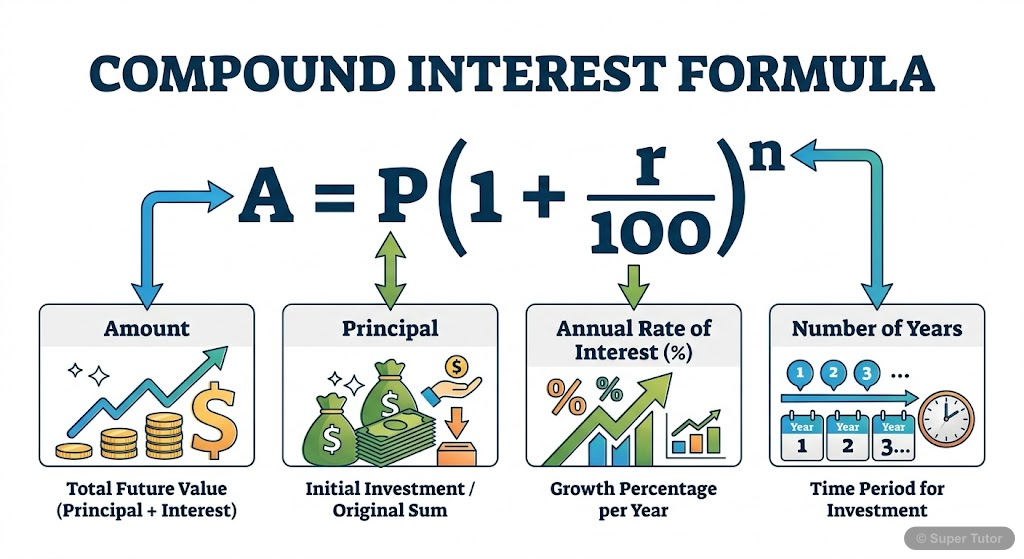
One of 7 illustrations for Compound Interest (Using Formula) in Super Tutor — alongside flashcards, concept maps and practice questions.
Find the amount on ₹7,500 in 2 years at 6% compounded annually.
Answer
Use A = P(1+r/100)^n. Step 1: P = 7,500, r = 6, n = 2. Step 2: A = 7,500(1 + 6/100)^2 = 7,500(1.06)^2. Step 3: A = 7,500 × 1.1236 = ₹8,427. Answer: Amount = ₹8,427.
Find the compound interest on ₹18,000 for 2 years at 15% per annum.
Answer
Use A = P(1+r/100)^n. Step 1: P = 18,000, r = 15, n = 2. Step 2: A = 18,000(1.15)^2 = 18,000 × 1.3225 = ₹23,805. Step 3: C.I. = A - P = 23,805 - 18,000 = ₹5,805. Answer: Compound interest = ₹5,805.
What sum will amount to ₹3,630 in 2 years at 10% compound interest per annum?
Answer
Use A = P(1+r/100)^n. Step 1: A = 3,630, r = 10, n = 2. Step 2: 3,630 = P(1.10)^2 = P × 1.21. Step 3: P = 3,630 / 1.21 = ₹3,000. Answer: Principal = ₹3,000.
A sum earns compound interest of ₹164 in 2 years at 5% per annum. Find the principal.
Answer
Use C.I. = P[(1+r/100)^n - 1]. Step 1: C.I. = 164, r = 5, n = 2. Step 2: 164 = P[(1.05)^2 - 1] = P(1.1025 - 1). Step 3: 164 = P(0.1025). Step 4: P = 164 / 0.1025 = ₹1,600. Answer: Principal = ₹1,600.
Find the rate if ₹2,000 amounts to ₹2,662 in 3 years at compound interest.
Answer
Use A = P(1+r/100)^n. Step 1: A = 2,662, P = 2,000, n = 3. Step 2: 2,662/2,000 = (1+r/100)^3. Step 3: 1.331 = (1+r/100)^3 = (11/10)^3. Step 4: 1+r/100 = 11/10. Step 5: r = 10%. Answer: Rate = 10% per …
A sum of ₹10,000 becomes ₹11,200 after 1 year at compound interest. Find the rate and the amount after the second year.
Answer
Step 1: Use A = P(1+r/100)^n for 1 year. 11,200 = 10,000(1+r/100). Step 2: 11,200/10,000 = 1 + r/100. Step 3: 1.12 = 1 + r/100, so r = 12%. Step 4: For the second year, new principal = ₹11,200. A = 11…
For ₹2,000 at 10% compound interest, how many years are needed to reach ₹2,662?
Answer
Use A = P(1+r/100)^n. Step 1: 2,662 = 2,000(1.10)^n. Step 2: 2,662/2,000 = 1.331. Step 3: 1.331 = 1.1^3. Step 4: So n = 3 years. Answer: Time = 3 years.
₹12,000 is invested for 3 years at successive rates of 8%, 10%, and 15%. Find the amount.
Answer
Use A = P(1+r1/100)(1+r2/100)(1+r3/100). Step 1: P = 12,000. Step 2: A = 12,000 × 1.08 × 1.10 × 1.15. Step 3: 12,000 × 1.08 = 12,960. Step 4: 12,960 × 1.10 = 14,256. Step 5: 14,256 × 1.15 = ₹16,394.40…
+17 more flashcards
Practise AllFrequently Asked Questions
What are the important topics in Compound Interest (Using Formula) for ICSE Class 9 Mathematics?
How many flashcards are available for Compound Interest (Using Formula)?
How should I revise Compound Interest (Using Formula) for Class 9 exams?
Sources & Official References
Content is aligned to the official syllabus. Refer to the board website for the latest curriculum.
More resources for Compound Interest (Using Formula)
Practice Quiz
Test yourself with a quick quiz
Important Questions
Exam-style questions with answers
Revision Notes
Key points for last-minute revision
Formula Sheet
The chapter's formulas in one place
Chapter Summary
Understand the chapter at a glance
Concept Maps
See how topics connect
Study Plan
Step-by-step plan for this chapter
Syllabus
What topics to cover
For serious students
Get the full Compound Interest (Using Formula) chapter — start free.
Quizzes, flashcards, an AI doubt solver and a study plan for ICSE Class 9 Mathematics. Free to start, no card needed.