Rational and Irrational Numbers — Flashcards
ICSE · Class 9 · Mathematics
30 flashcards for Rational and Irrational Numbers (ICSE Class 9 Mathematics) to test yourself on key terms and facts.
Interactive on Super Tutor
Studying Rational and Irrational Numbers? Get the full interactive chapter.
Quizzes, flashcards, AI doubt-solver and a step-by-step study plan — built for flashcards and more.
Free trial, no card needed.
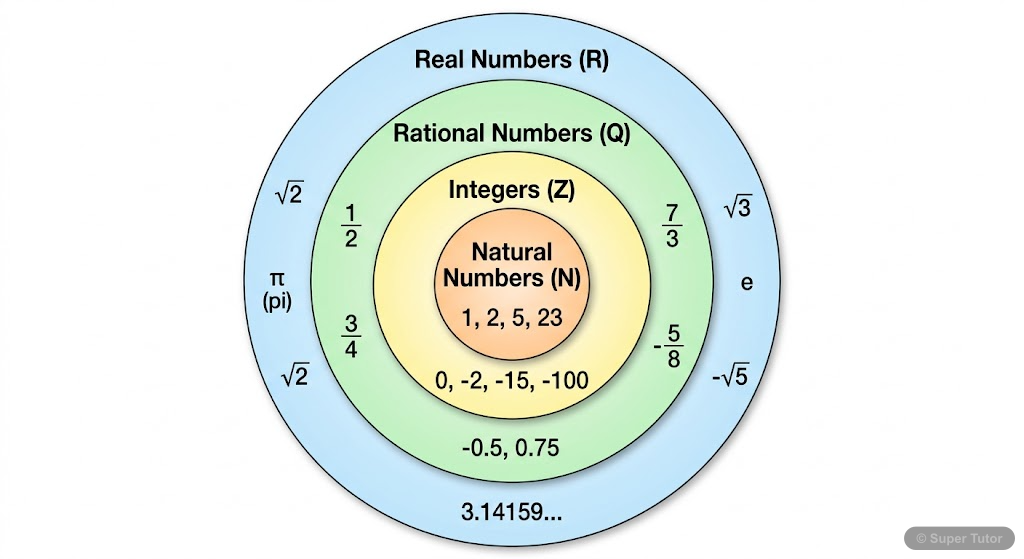
Learn better with visuals Super Tutor pairs illustrations like this with notes and quizzes for Rational and Irrational Numbers.
Classify √4, √2, ∛27, and π as rational, irrational, surd, or not a surd.
Answer
Step 1: √4 = 2, so it is rational and not a surd. Step 2: √2 cannot be written as a/b, so it is irrational. Step 3: ∛27 = 3, so it is rational and not a surd. Step 4: π is irrational, but it is not a …
Write the rational number definition in fraction form and state the condition on the denominator.
Answer
A rational number can be written as a/b, where a and b are integers and b ≠ 0. Example: 5/8 is rational because both numbers are integers and the denominator is not zero. Important check: b must never…
Is 7/8 a terminating decimal? Show the reason.
Answer
Step 1: Check the denominator 8. Step 2: 8 = 2³, so it can be written only with factors 2 and 5. Step 3: Therefore 7/8 is a terminating decimal. Quick check: 7 ÷ 8 = 0.875. Answer: Yes, it is terminat…
Is 23/72 a terminating decimal? Show the reason.
Answer
Step 1: Factor the denominator 72. Step 2: 72 = 2³ × 3². Step 3: A terminating decimal needs the denominator in the form 2^m × 5^n only. Step 4: Since 72 has a factor 3, it is not terminating. Answer:…
Insert three rational numbers between 3 and 5.
Answer
Step 1: Find one number between them: (3 + 5)/2 = 4. Step 2: Now split 3 to 4 and 4 to 5 again. Step 3: (3 + 4)/2 = 7/2 = 3.5. Step 4: (4 + 5)/2 = 9/2 = 4.5. Answer: 3.5, 4, 4.5.
Use the formula d = (y - x)/(n + 1) to insert 4 rational numbers between 2/3 and 5/6.
Answer
Step 1: x = 2/3, y = 5/6, n = 4. Step 2: d = (5/6 - 2/3)/(4 + 1) = (5/6 - 4/6)/5 = (1/6)/5 = 1/30. Step 3: Required numbers are x + d, x + 2d, x + 3d, x + 4d. Step 4: 2/3 + 1/30 = 21/30 = 7/10. Step 5…
Which is greater: 3/5 or 5/7? Show the cross-multiplication test.
Answer
Step 1: Compare 3/5 and 5/7 by cross-multiplication. Step 2: 3 × 7 = 21. Step 3: 5 × 5 = 25. Step 4: Since 21 < 25, 3/5 < 5/7. Answer: 5/7 is greater.
Find three rational numbers between 3/5 and 5/7 in ascending order.
Answer
Step 1: Since 3/5 < 5/7, find the middle first. Step 2: Middle number = (3/5 + 5/7)/2 = (21/35 + 25/35)/2 = 46/70 = 23/35. Step 3: Middle between 3/5 and 23/35 = (3/5 + 23/35)/2 = (21/35 + 23/35)/2 = …
+22 more flashcards
Practise AllFrequently Asked Questions
What are the important topics in Rational and Irrational Numbers for ICSE Class 9 Mathematics?
How many flashcards are available for Rational and Irrational Numbers?
How should I revise Rational and Irrational Numbers for Class 9 exams?
Sources & Official References
Content is aligned to the official syllabus. Refer to the board website for the latest curriculum.
More resources for Rational and Irrational Numbers
Practice Quiz
Test yourself with a quick quiz
Important Questions
Exam-style questions with answers
Revision Notes
Key points for last-minute revision
Formula Sheet
The chapter's formulas in one place
Chapter Summary
Understand the chapter at a glance
Concept Maps
See how topics connect
Study Plan
Step-by-step plan for this chapter
Syllabus
What topics to cover
For serious students
Get the full Rational and Irrational Numbers chapter — start free.
Quizzes, flashcards, an AI doubt solver and a study plan for ICSE Class 9 Mathematics. Free to start, no card needed.