Solids — Flashcards
ICSE · Class 9 · Mathematics
28 flashcards for Solids (ICSE Class 9 Mathematics) to test yourself on key terms and facts. Sample: "Solve: Find the volume of a cuboid"
Interactive on Super Tutor
Studying Solids? Get the full interactive chapter.
Quizzes, flashcards, AI doubt-solver and a step-by-step study plan — built for flashcards and more.
Free trial, no card needed.
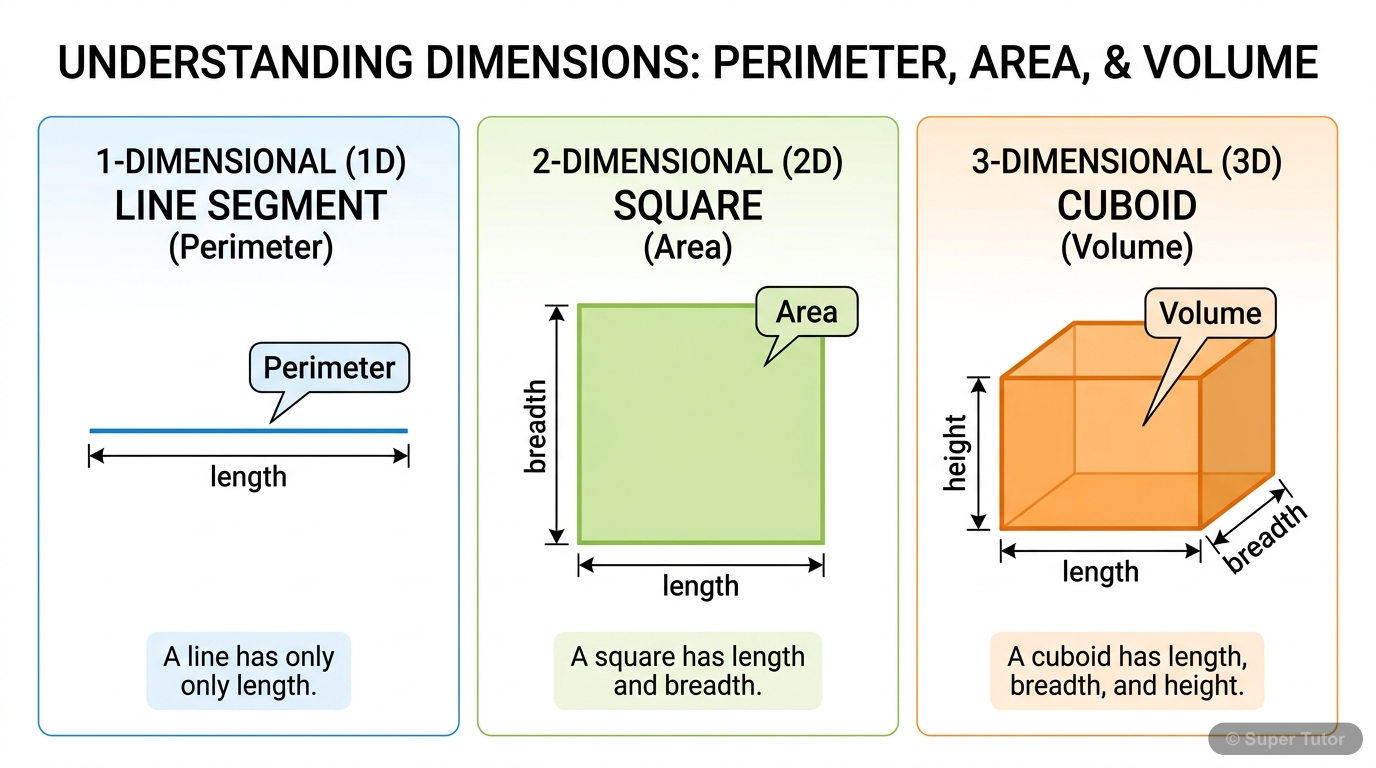
One of 14 illustrations for Solids in Super Tutor — alongside flashcards, concept maps and practice questions.
Solve: Find the volume of a cuboid with length 12 cm, breadth 5 cm, and height 4 cm.
Answer
Step 1: Use the formula Volume = l × b × h. Step 2: Substitute the values: 12 × 5 × 4. Step 3: Multiply: 12 × 5 = 60, and 60 × 4 = 240. Answer: 240 cm³.
Solve: Find the total surface area of a cuboid with length 10 cm, breadth 6 cm, and height 4 cm.
Answer
Step 1: Use Total surface area = 2(l×b + b×h + h×l). Step 2: Substitute: 2(10×6 + 6×4 + 4×10). Step 3: Calculate each part: 10×6 = 60, 6×4 = 24, 4×10 = 40. Step 4: Add: 60 + 24 + 40 = 124. Step 5: Mul…
Solve: Find the lateral surface area of a cuboid with length 8 cm, breadth 7 cm, and height 3 cm.
Answer
Step 1: Use Lateral surface area = 2(l+b) × h. Step 2: Substitute: 2(8+7) × 3. Step 3: Add inside the bracket: 8 + 7 = 15. Step 4: Multiply: 2 × 15 × 3 = 90. Answer: 90 cm².
Solve: Find the diagonal of a cuboid with length 3 cm, breadth 4 cm, and height 12 cm.
Answer
Step 1: Use Length of diagonal = √(l² + b² + h²). Step 2: Substitute: √(3² + 4² + 12²). Step 3: Square the numbers: 9 + 16 + 144. Step 4: Add: 169. Step 5: Take square root: √169 = 13. Answer: 13 cm.
When do you use the formula Volume = length × breadth × height?
Answer
Use it for a cuboid or a rectangular box. Example: A box has l = 2 cm, b = 3 cm, h = 5 cm. Step 1: Volume = l × b × h. Step 2: Volume = 2 × 3 × 5. Step 3: Volume = 30 cm³. Answer: This formula is used…
Solve: A cube has edge 6 cm. Find its volume.
Answer
Step 1: Use Volume = a³. Step 2: Substitute a = 6 cm. Step 3: Volume = 6 × 6 × 6. Step 4: Volume = 216. Answer: 216 cm³.
Solve: A cube has edge 4 cm. Find its total surface area.
Answer
Step 1: Use Total surface area = 6a². Step 2: Substitute a = 4 cm. Step 3: a² = 4² = 16. Step 4: 6 × 16 = 96. Answer: 96 cm².
Solve: A cube has edge 5 cm. Find its diagonal.
Answer
Step 1: Use Length of diagonal = a√3. Step 2: Substitute a = 5 cm. Step 3: Diagonal = 5√3 cm. Answer: 5√3 cm.
+20 more flashcards
Practise AllFrequently Asked Questions
What are the important topics in Solids for ICSE Class 9 Mathematics?
How many flashcards are available for Solids?
How should I revise Solids for Class 9 exams?
Sources & Official References
Content is aligned to the official syllabus. Refer to the board website for the latest curriculum.
More resources for Solids
Practice Quiz
Test yourself with a quick quiz
Important Questions
Exam-style questions with answers
Revision Notes
Key points for last-minute revision
Formula Sheet
The chapter's formulas in one place
Chapter Summary
Understand the chapter at a glance
Concept Maps
See how topics connect
Study Plan
Step-by-step plan for this chapter
Syllabus
What topics to cover
For serious students
Get the full Solids chapter — start free.
Quizzes, flashcards, an AI doubt solver and a study plan for ICSE Class 9 Mathematics. Free to start, no card needed.