Co-ordinate Geometry — Flashcards
ICSE · Class 9 · Mathematics
28 flashcards for Co-ordinate Geometry (ICSE Class 9 Mathematics) to test yourself on key terms and facts. Part of the ICSE Class 9 Mathematics syllabus.
Interactive on Super Tutor
Studying Co-ordinate Geometry? Get the full interactive chapter.
Quizzes, flashcards, AI doubt-solver and a step-by-step study plan — built for flashcards and more.
Free trial, no card needed.
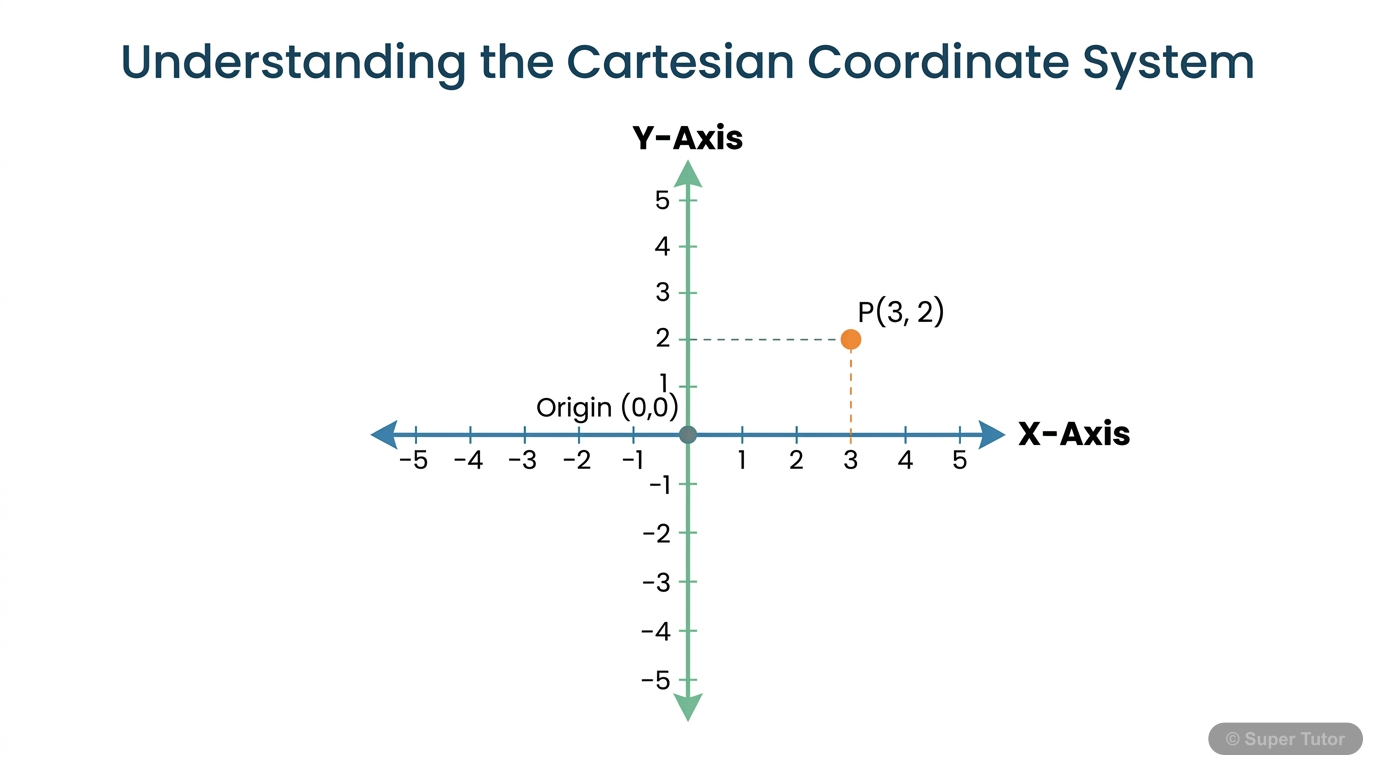
Learn better with visuals Super Tutor pairs illustrations like this with notes and quizzes for Co-ordinate Geometry.
Plot the point A(4,2). What are the two steps?
Answer
Step 1: Start at the origin and move 4 units along the positive x-axis. Step 2: From there, move 2 units parallel to the positive y-axis. The point lies in the first quadrant. Answer: A(4,2).
Plot the point B(-5,3). Which quadrant does it lie in?
Answer
Step 1: Move 5 units along the negative x-direction. Step 2: Move 3 units upward parallel to the positive y-axis. The point has negative abscissa and positive ordinate, so it lies in the second quadra…
Plot the point C(-4,-5). Which signs do the coordinates have?
Answer
Step 1: Move 4 units left from the origin. Step 2: Move 5 units downward. Both abscissa and ordinate are negative, so the point lies in the third quadrant. Answer: C(-4,-5).
Plot the point D(5,-2). Which quadrant does it lie in?
Answer
Step 1: Move 5 units to the right. Step 2: Move 2 units downward. The abscissa is positive and the ordinate is negative, so the point lies in the fourth quadrant. Answer: D(5,-2).
If two ordered pairs are equal, what must be true? Use (x-3,6)=(4,x+y).
Answer
Equal ordered pairs have equal first components and equal second components. So x-3=4 and 6=x+y. From x-3=4, x=7. Then 6=7+y, so y=-1. Answer: x=7, y=-1.
Why are (5,7) and (7,5) different?
Answer
Order matters in an ordered pair. The first component and second component are not interchangeable. Since (5,7) has first component 5 and second component 7, while (7,5) has first component 7 and seco…
Find the coordinates of a point whose abscissa and ordinate satisfy: 0.5x - 3 = -0.25x and 8 - 0.2(y+3) = 3y + 1.
Answer
For x: 0.5x - 3 = -0.25x 0.5x + 0.25x = 3 0.75x = 3 x = 4 For y: 8 - 0.2(y+3) = 3y + 1 8 - 0.2y - 0.6 = 3y + 1 7.4 - 0.2y = 3y + 1 6.4 = 3.2y y = 2 Answer: (4,2).
What are the coordinates of the origin?
Answer
The origin is the point where the x-axis and y-axis meet. Its coordinates are (0,0). Answer: (0,0).
+20 more flashcards
Practise AllFrequently Asked Questions
What are the important topics in Co-ordinate Geometry for ICSE Class 9 Mathematics?
How many flashcards are available for Co-ordinate Geometry?
How should I revise Co-ordinate Geometry for Class 9 exams?
Sources & Official References
Content is aligned to the official syllabus. Refer to the board website for the latest curriculum.
More resources for Co-ordinate Geometry
Practice Quiz
Test yourself with a quick quiz
Important Questions
Exam-style questions with answers
Revision Notes
Key points for last-minute revision
Formula Sheet
The chapter's formulas in one place
Chapter Summary
Understand the chapter at a glance
Concept Maps
See how topics connect
Study Plan
Step-by-step plan for this chapter
Syllabus
What topics to cover
For serious students
Get the full Co-ordinate Geometry chapter — start free.
Quizzes, flashcards, an AI doubt solver and a study plan for ICSE Class 9 Mathematics. Free to start, no card needed.