Upthrust in Fluids and Archimedes Principle and Floatation — Flashcards
ICSE · Class 9 · Physics
32 flashcards for Upthrust in Fluids and Archimedes Principle and Floatation (ICSE Class 9 Physics) to test yourself on key terms and facts.
Interactive on Super Tutor
Studying Upthrust in Fluids and Archimedes Principle and Floatation? Get the full interactive chapter.
Quizzes, flashcards, AI doubt-solver and a step-by-step study plan — built for flashcards and more.
Free trial, no card needed.
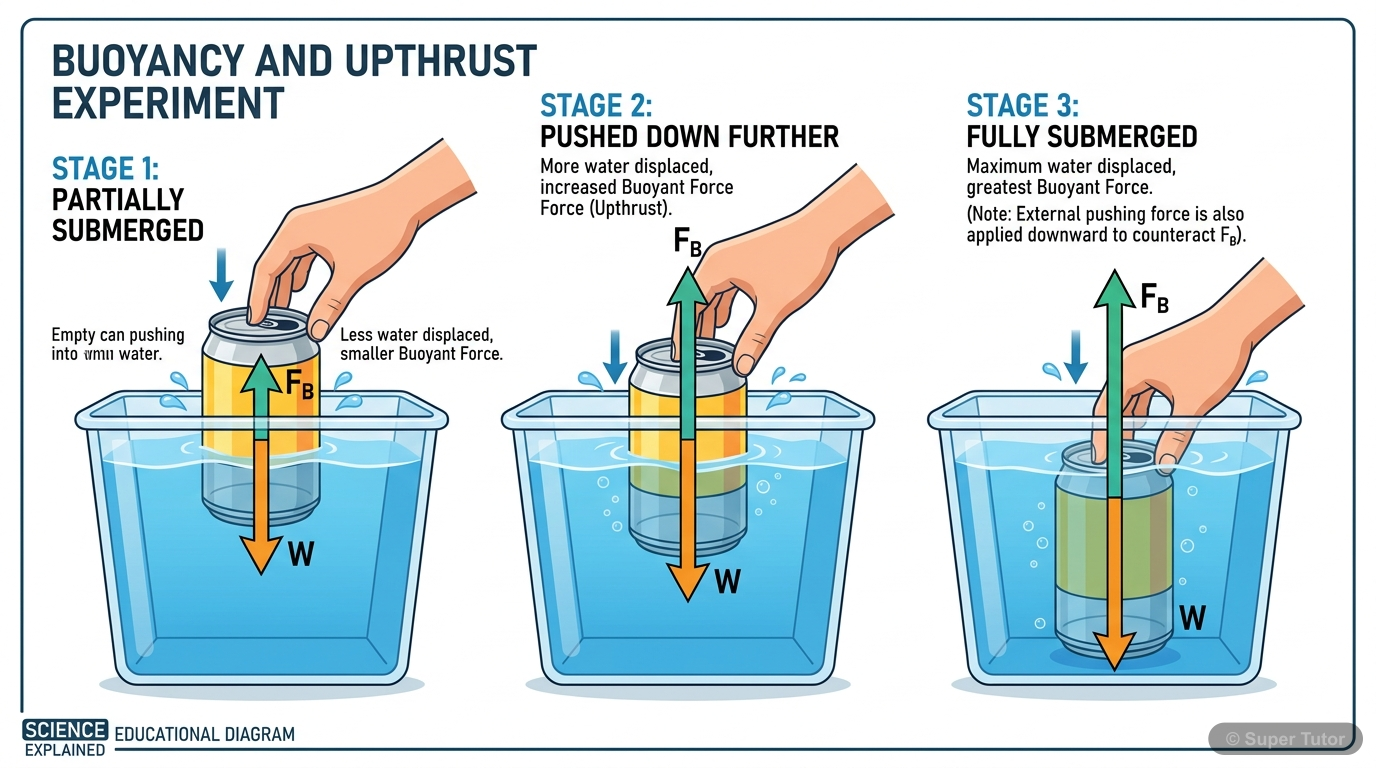
Learn better with visuals Super Tutor pairs illustrations like this with notes and quizzes for Upthrust in Fluids and Archimedes Principle and Floatation.
State the definition of upthrust or buoyant force.
Answer
The upward force exerted on a body by the fluid in which it is submerged is called the upthrust or buoyant force. Symbol: F_B. Unit: newton (N).
State the definition of buoyancy.
Answer
Buoyancy is the property of a liquid to exert an upward force on a body immersed in it.
What is Archimedes' principle?
Answer
Archimedes' principle states that when a body is immersed partially or completely in a liquid, it experiences an upthrust equal to the weight of the liquid displaced by it. It applies to liquids and g…
Why does a body appear lighter when immersed in water?
Answer
A body appears lighter because water exerts an upward force on it. This upthrust reduces the apparent weight. The apparent loss in weight is equal to the upthrust.
A body weighs 200 gf in air and 190 gf in water. Find the loss in weight and upthrust.
Answer
Given: Weight in air = 200 gf, weight in water = 190 gf Step 1: Loss in weight = 200 gf - 190 gf = 10 gf Step 2: Upthrust = loss in weight = 10 gf Answer: Loss in weight = 10 gf, upthrust = 10 gf…
A stone has mass 200 g and volume 80 cm³. It is fully immersed in water. Find the mass of water displaced.
Answer
Given: Volume of stone = 80 cm³ Since the stone is fully immersed, volume of water displaced = 80 cm³ Density of water = 1 g cm^-3 Step 1: Mass of water displaced = density × volume Step 2: Mass = 1 g…
A stone of mass 200 g and volume 80 cm³ is fully immersed in water. Find its weight, upthrust, net downward force, and acceleration. Take g = 10 m s^-2.
Answer
Given: mass of stone = 200 g = 0.2 kg, volume = 80 cm³, density of water = 1 g cm^-3, g = 10 m s^-2 Step 1: Weight of stone = m g = 0.2 kg × 10 m s^-2 = 2 N Step 2: Mass of water displaced = 80 g = 0.
State the formula for density and name its SI unit.
Answer
Density = mass / volume Formula: ρ = M / V SI unit: kg m^-3 CGS unit: g cm^-3…
+24 more flashcards
Practise AllFrequently Asked Questions
What are the important topics in Upthrust in Fluids and Archimedes Principle and Floatation for ICSE Class 9 Physics?
How many flashcards are available for Upthrust in Fluids and Archimedes Principle and Floatation?
How should I revise Upthrust in Fluids and Archimedes Principle and Floatation for Class 9 exams?
Sources & Official References
Content is aligned to the official syllabus. Refer to the board website for the latest curriculum.
More resources for Upthrust in Fluids and Archimedes Principle and Floatation
Practice Quiz
Test yourself with a quick quiz
Important Questions
Exam-style questions with answers
Revision Notes
Key points for last-minute revision
Formula Sheet
The chapter's formulas in one place
Chapter Summary
Understand the chapter at a glance
Concept Maps
See how topics connect
Study Plan
Step-by-step plan for this chapter
Syllabus
What topics to cover
For serious students
Get the full Upthrust in Fluids and Archimedes Principle and Floatation chapter — start free.
Quizzes, flashcards, an AI doubt solver and a study plan for ICSE Class 9 Physics. Free to start, no card needed.