Chapter 5 of 16
NCERT Solutions

Arithmetic Progressions

Madhya Pradesh Board · Class 10 · Mathematics

NCERT Solutions for Arithmetic Progressions — Madhya Pradesh Board Class 10 Mathematics.

135 questions56 flashcards5 concepts

Interactive on Super Tutor

Studying Arithmetic Progressions? Get the full interactive chapter.

Quizzes, flashcards, AI doubt-solver and a step-by-step study plan — built for ncert solutions and more.

1,000+ Class 10 students started this chapter today

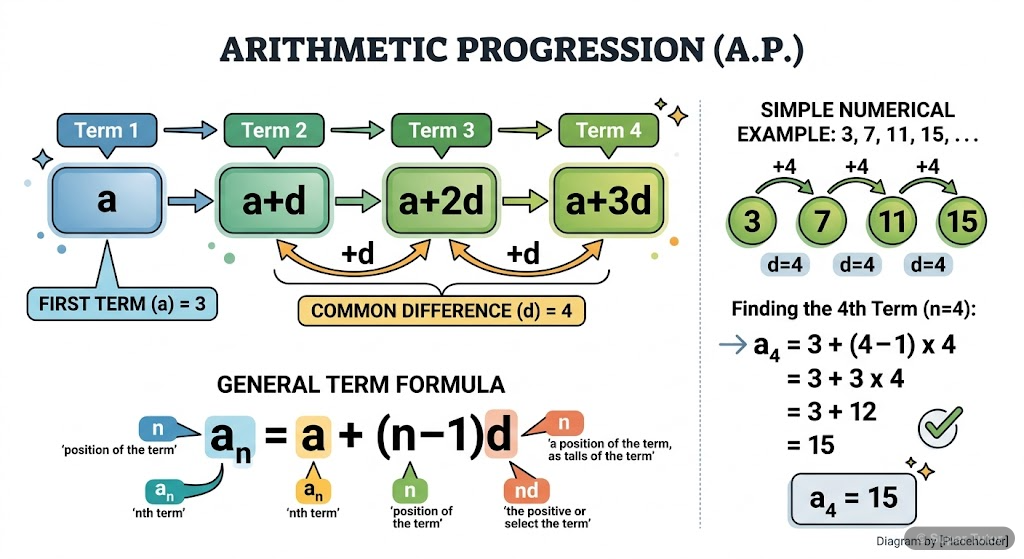
Illustrates the structure of an Arithmetic Progression (A.P.), showing the first term 'a' and common difference 'd', along with the general term formula.
Super Tutor

Super Tutor has 5+ illustrations like this for Arithmetic Progressions alone — flashcards, concept maps, and step-by-step visuals.

See them all
45 Questions Solved · 4 Sections

23 worked solutions below. Unlock all 45 free in Super Tutor

EXERCISE 5.1

1In which of the following situations, does the list of numbers involved make an arithmetic progression, and why?Show solution
(i) Yes, it is an AP. The fare after each km is ₹15, ₹23, ₹31, …, because each time the fare increases by ₹8. The common difference is 8.

(ii) No, it is not an AP. If a fixed fraction of air is removed each time, the remaining amount becomes 34\frac34 of the previous amount, so the terms decrease multiplicatively, not by a fixed difference.

(iii) Yes, it is an AP. The cost is ₹150, ₹200, ₹250, … since each metre adds ₹50. The common difference is 50.

(iv) No, it is not an AP. With compound interest, the amount increases by multiplying by a fixed factor each year, not by adding a fixed number.

Not sure why a step works? check your working in Super Tutor

2Write first four terms of the AP, when the first term aa and the common difference dd are given as follows:Show solution
Using the AP rule: first term + common difference repeatedly.

(i) a=10,d=10a=10, d=10: 10, 20, 30, 40

(ii) a=2,d=0a=-2, d=0: -2, -2, -2, -2

(iii) a=4,d=3a=4, d=-3: 4, 1, -2, -5

(iv) a=1,d=12a=-1, d=\frac12: -1, -\frac12, 0, \frac12

(v) a=1.25,d=0.25a=-1.25, d=-0.25: -1.25, -1.50, -1.75, -2.00

Not sure why a step works? check your working in Super Tutor

3For the following APs, write the first term and the common difference:Show solution
For an AP, the first term is the first number and the common difference is the difference of consecutive terms.

(i) 3, 1, -1, -3, …
- First term a=3a=3
- Common difference d=13=2d=1-3=-2

(ii) -5, -1, 3, 7, …
- a=5a=-5
- d=1(5)=4d=-1-(-5)=4

(iii) 13,53,93,133,\frac13, \frac53, \frac93, \frac{13}{3}, \dots
- a=13a=\frac13
- d=5313=43d=\frac53-\frac13=\frac43

(iv) 0.6, 1.7, 2.8, 3.9, …
- a=0.6a=0.6
- d=1.70.6=1.1d=1.7-0.6=1.1

Not sure why a step works? check your working in Super Tutor

4Which of the following are APs? If they form an AP, find the common difference dd and write three more terms.Show solution
Check the difference between consecutive terms.

(i) 2, 4, 8, 16, …
- Differences: 2, 4, 8
- Not an AP

(ii) 2, 52\frac52, 3, 72\frac72, …
- Differences: 12,12,12\frac12, \frac12, \frac12
- AP, with d=12d=\frac12
- Next three terms: 4, 92\frac92, 5

(iii) -1.2, -3.2, -5.2, -7.2, …
- Differences: -2, -2, -2
- AP, with d=2d=-2
- Next three terms: -9.2, -11.2, -13.2

(iv) -10, -6, -2, 2, …
- Differences: 4, 4, 4
- AP, with d=4d=4
- Next three terms: 6, 10, 14

(v) 3, 3+23+\sqrt2, 3+223+2\sqrt2, 3+323+3\sqrt2, …
- Differences: 2,2,2\sqrt2, \sqrt2, \sqrt2
- AP, with d=2d=\sqrt2
- Next three terms: 3+42,3+52,3+623+4\sqrt2, 3+5\sqrt2, 3+6\sqrt2

(vi) 0.2, 0.22, 0.222, 0.2222, …
- Differences are not equal
- Not an AP

(vii) 0, -4, -8, -12, …
- Differences: -4, -4, -4
- AP, with d=4d=-4
- Next three terms: -16, -20, -24

(viii) 12,12,12,12,-\frac12, -\frac12, -\frac12, -\frac12, \dots
- Differences are 0
- AP, with d=0d=0
- Next three terms: 12,12,12-\frac12, -\frac12, -\frac12

(ix) 1, 3, 9, 27, …
- Differences are not equal
- Not an AP

(x) a, 2a, 3a, 4a, …
- Differences: a, a, a
- AP, with d=ad=a
- Next three terms: 5a, 6a, 7a

(xi) a, a2a^2, a3a^3, a4a^4, …
- Differences are not generally equal
- Not an AP

(xii) 2,8,18,32,\sqrt2, \sqrt8, \sqrt{18}, \sqrt{32}, \dots
- These are 2,22,32,42\sqrt2, 2\sqrt2, 3\sqrt2, 4\sqrt2
- Differences: 2,2,2\sqrt2, \sqrt2, \sqrt2
- AP, with d=2d=\sqrt2
- Next three terms: 52,62,725\sqrt2, 6\sqrt2, 7\sqrt2

(xiii) 3,6,9,12,\sqrt3, \sqrt6, \sqrt9, \sqrt{12}, \dots
- Differences are not equal
- Not an AP

(xiv) 12,32,52,72,1^2, 3^2, 5^2, 7^2, \dots
- Terms are 1, 9, 25, 49
- Differences are not equal
- Not an AP

(xv) 12,52,72,73,1^2, 5^2, 7^2, 73, \dots
- As printed, the list does not have constant difference
- Not an AP

Not sure why a step works? check your working in Super Tutor

EXERCISE 5.2

1Fill in the blanks in the following table, given that aa is the first term, dd the common difference and ana_n the nnth term of the AP:Show solution
Use an=a+(n1)da_n=a+(n-1)d.

(i) a=7,d=3,n=8a=7, d=3, n=8
a8=7+(81)3=7+21=28 a_8=7+(8-1)\cdot3=7+21=28

(ii) a=18,n=10,an=0a=-18, n=10, a_n=0
0=18+9d9d=18d=2 0=-18+9d \Rightarrow 9d=18 \Rightarrow d=2

(iii) d=3,n=18,an=5d=-3, n=18, a_n=-5
5=a+17(3)=a51a=46 -5=a+17(-3)=a-51 \Rightarrow a=46

(iv) a=18.9,d=2.5,an=3.6a=-18.9, d=2.5, a_n=3.6
3.6=18.9+(n1)2.5 3.6=-18.9+(n-1)2.5
22.5=(n1)2.5n1=9n=10 22.5=(n-1)2.5 \Rightarrow n-1=9 \Rightarrow n=10

(v) a=3.5,d=0,n=105a=3.5, d=0, n=105
a105=3.5+(1051)0=3.5 a_{105}=3.5+(105-1)\cdot0=3.5

Not sure why a step works? check your working in Super Tutor

2Choose the correct choice in the following and justify :Show solution
Use an=a+(n1)da_n=a+(n-1)d.

For 10th term of AP 10,7,4,10,7,4,\dots:
a=10, d=3 a=10,\ d=-3
a30=10+29(3)=1087=77 a_{30}=10+29(-3)=10-87=-77
So the correct option is (C) -77.

For 11th term of AP 3,12,2,-3,-\frac12,2,\dots:
d=12(3)=52 d=-\frac12-(-3)=\frac52
a11=3+1052=3+25=22 a_{11}=-3+10\cdot\frac52=-3+25=22
So the correct option is (B) 22.

Not sure why a step works? check your working in Super Tutor

3In the following APs, find the missing terms in the boxes :Show solution
Find the missing terms by using equal differences.

(i) 2, [ ], 26
- There are 3 terms, so middle term is the arithmetic mean:
2+262=14 \frac{2+26}{2}=14
So the missing term is 14.

(ii) [ ], 13, [ ], 3
Let the terms be a,13,b,3a, 13, b, 3.
The common difference is
d=3132=5 d=\frac{3-13}{2}=-5
So the terms are 18, 13, 8, 3.
Missing terms: 18, 8.

(iii) 5, [ ], [ ], 912\frac12
Let the common difference be dd.
5+3d=9.53d=4.5d=1.5 5+3d=9.5 \Rightarrow 3d=4.5 \Rightarrow d=1.5
So the missing terms are:
5+1.5=6.5=612,5+2(1.5)=8 5+1.5=6.5=6\frac12, \quad 5+2(1.5)=8
Missing terms: **612\frac12, 8**.

(iv) -4, [ ], [ ], [ ], [ ], 6
There are 6 terms, so
d=6(4)5=2 d=\frac{6-(-4)}{5}=2
Terms: -4, -2, 0, 2, 4, 6
Missing terms: -2, 0, 2, 4

(v) [ ], 38, [ ], [ ], [ ], -22
There are 6 terms, so
d=22384=15 d=\frac{-22-38}{4}=-15
Terms: 53, 38, 23, 8, -7, -22
Missing terms: 53, 23, 8, -7

Not sure why a step works? check your working in Super Tutor

4Which term of the AP: 3, 8, 13, 18, ..., is 78?Show solution
For AP 3,8,13,18,3,8,13,18,\dots,
a=3, d=5 a=3,\ d=5
Let the term be 78:
78=3+(n1)5 78=3+(n-1)5
75=5(n1) 75=5(n-1)
n1=15n=16 n-1=15 \Rightarrow n=16
So 78 is the 16th term.

Not sure why a step works? check your working in Super Tutor

5Find the number of terms in each of the following APs :Show solution
Use an=a+(n1)da_n=a+(n-1)d or the last term formula.

(i) 7, 13, 19, ..., 205
a=7, d=6 a=7,\ d=6
205=7+(n1)6198=6(n1)n1=33n=34 205=7+(n-1)6 \Rightarrow 198=6(n-1) \Rightarrow n-1=33 \Rightarrow n=34

(ii) 18, 1512\frac12, 13, ..., -47
a=18, d=2.5 a=18,\ d=-2.5
47=18+(n1)(2.5)65=2.5(n1)n1=26n=27 -47=18+(n-1)(-2.5) \Rightarrow -65=-2.5(n-1) \Rightarrow n-1=26 \Rightarrow n=27

Not sure why a step works? check your working in Super Tutor

6Check whether -150 is a term of the AP: 11, 8, 5, 2 ...Show solution
For AP 11,8,5,2,11,8,5,2,\dots,
a=11, d=3 a=11,\ d=-3
Let the term be 150-150:
150=11+(n1)(3) -150=11+(n-1)(-3)
161=3(n1) -161=-3(n-1)
n1=1613 n-1=\frac{161}{3}
Since nn is not an integer, -150 is not a term of the AP.

Not sure why a step works? check your working in Super Tutor

7Find the 31st term of an AP whose 11th term is 38 and the 16th term is 73.Show solution
For an AP, an=a+(n1)da_n=a+(n-1)d.

Given:
a11=38,a16=73 a_{11}=38,\quad a_{16}=73
So,
a+10d=38(1) a+10d=38 \quad (1)
a+15d=73(2) a+15d=73 \quad (2)
Subtract (1) from (2):
5d=35d=7 5d=35 \Rightarrow d=7
From (1):
a+70=38a=32 a+70=38 \Rightarrow a=-32
Now,
a31=a+30d=32+307=32+210=178 a_{31}=a+30d=-32+30\cdot7=-32+210=178
So the 31st term is 178.

Not sure why a step works? check your working in Super Tutor

8An AP consists of 50 terms of which 3rd term is 12 and the last term is 106. Find the 29th term.Show solution
Given 50 terms, 3rd term = 12 and last term = 106.

Let first term be aa and common difference be dd.
a+2d=12(1) a+2d=12 \quad (1)
a+49d=106(2) a+49d=106 \quad (2)
Subtract:
47d=94d=2 47d=94 \Rightarrow d=2
From (1):
a+4=12a=8 a+4=12 \Rightarrow a=8
29th term:
a29=a+28d=8+282=8+56=64 a_{29}=a+28d=8+28\cdot2=8+56=64
So the 29th term is 64.

Not sure why a step works? check your working in Super Tutor

9If the 3rd and the 9th terms of an AP are 4 and -8 respectively, which term of this AP is zero?Show solution
Let the AP have first term aa and common difference dd.

Given:
a3=a+2d=4(1) a_3=a+2d=4 \quad (1)
a9=a+8d=8(2) a_9=a+8d=-8 \quad (2)
Subtract (1) from (2):
6d=12d=2 6d=-12 \Rightarrow d=-2
From (1):
a+2(2)=4a=8 a+2(-2)=4 \Rightarrow a=8
To find which term is zero:
an=a+(n1)d=0 a_n=a+(n-1)d=0
8+(n1)(2)=0 8+(n-1)(-2)=0
82n+2=0102n=0n=5 8-2n+2=0 \Rightarrow 10-2n=0 \Rightarrow n=5
So, the 5th term is zero.

Not sure why a step works? check your working in Super Tutor

10The 17th term of an AP exceeds its 10th term by 7. Find the common difference.Show solution
For an AP, the difference between the 17th and 10th terms is
a17a10=(1710)d=7d a_{17}-a_{10}=(17-10)d=7d
Given this equals 7:
7d=7d=1 7d=7 \Rightarrow d=1
So the common difference is 1.

Not sure why a step works? check your working in Super Tutor

11Which term of the AP: 3, 15, 27, 39, ... will be 132 more than its 54th term?Show solution
For AP 3,15,27,39,3,15,27,39,\dots,
a=3, d=12 a=3,\ d=12
54th term:
a54=3+(541)12=3+636=639 a_{54}=3+(54-1)12=3+636=639
We need the term that is 132 more than this:
639+132=771 639+132=771
Now solve:
an=3+(n1)12=771 a_n=3+(n-1)12=771
12(n1)=768n1=64n=65 12(n-1)=768 \Rightarrow n-1=64 \Rightarrow n=65
So, it is the 65th term.

Not sure why a step works? check your working in Super Tutor

12Two APs have the same common difference. The difference between their 100th terms is 100, what is the difference between their 1000th terms?Show solution
If two APs have the same common difference, then the difference between their corresponding terms is constant.

Difference between 100th terms = 100.

Difference between 1000th terms is also the same because both terms increase by the same amount for each step.

More explicitly, for the same common difference,
(a100(1)a100(2))=(a1(1)a1(2))+99(dd)=a1(1)a1(2) (a_{100}^{(1)}-a_{100}^{(2)})=(a_1^{(1)}-a_1^{(2)})+99(d-d)=a_1^{(1)}-a_1^{(2)}
So the difference remains 100.

Not sure why a step works? check your working in Super Tutor

13How many three-digit numbers are divisible by 7?Show solution
Three-digit numbers divisible by 7 form the AP:
105,112,119,,994 105, 112, 119, \dots, 994
Here,
a=105, d=7, l=994 a=105,\ d=7,\ l=994
Use
l=a+(n1)d l=a+(n-1)d
994=105+(n1)7 994=105+(n-1)7
889=7(n1) 889=7(n-1)
n1=127n=128 n-1=127 \Rightarrow n=128
So, there are 128 such numbers.

Not sure why a step works? check your working in Super Tutor

14How many multiples of 4 lie between 10 and 250?Show solution
Multiples of 4 between 10 and 250 are:
12,16,20,,248 12,16,20,\dots,248
This is an AP with
a=12, d=4, l=248 a=12,\ d=4,\ l=248
Use
248=12+(n1)4 248=12+(n-1)4
236=4(n1) 236=4(n-1)
n1=59n=60 n-1=59 \Rightarrow n=60
So, there are 60 multiples of 4.

Not sure why a step works? check your working in Super Tutor

15For what value of n, are the nth terms of two APs: 63, 65, 67, ... and 3, 10, 17, ... equal?Show solution
First AP: 63, 65, 67, …
a=63, d=2 a=63,\ d=2
Its nth term:
63+(n1)2=2n+61 63+(n-1)2=2n+61
Second AP: 3, 10, 17, …
a=3, d=7 a=3,\ d=7
Its nth term:
3+(n1)7=7n4 3+(n-1)7=7n-4
Set them equal:
2n+61=7n4 2n+61=7n-4
65=5nn=13 65=5n \Rightarrow n=13
So, the nth terms are equal for n = 13.

Not sure why a step works? check your working in Super Tutor

16Determine the AP whose third term is 16 and the 7th term exceeds the 5th term by 12.Show solution
Let the AP have first term aa and common difference dd.

Given:
a3=a+2d=16(1) a_3=a+2d=16 \quad (1)
The 7th term exceeds the 5th term by 12:
a7a5=12 a_7-a_5=12
But
(a+6d)(a+4d)=2d=12 (a+6d)-(a+4d)=2d=12
So,
d=6 d=6
From (1):
a+12=16a=4 a+12=16 \Rightarrow a=4
Hence the AP is
4,10,16,22,28, 4, 10, 16, 22, 28, \dots

Not sure why a step works? check your working in Super Tutor

EXERCISE 5.3

1Find the sum of the following APs:Show solution
Use Sn=n2[2a+(n1)d]S_n=\frac n2[2a+(n-1)d].

(i) 2, 7, 12, … to 10 terms
a=2,d=5,n=10 a=2, d=5, n=10
S10=102[22+95]=5[4+45]=245 S_{10}=\frac{10}{2}[2\cdot2+9\cdot5]=5[4+45]=245

(ii) -37, -33, -29, … to 12 terms
a=37,d=4,n=12 a=-37, d=4, n=12
S12=122[2(37)+114]=6[74+44]=6(30)=180 S_{12}=\frac{12}{2}[2(-37)+11\cdot4]=6[-74+44]=6(-30)=-180

(iii) 0.6, 1.7, 2.8, … to 100 terms
a=0.6,d=1.1,n=100 a=0.6, d=1.1, n=100
S100=1002[2(0.6)+99(1.1)]=50[1.2+108.9]=50×110.1=5505 S_{100}=\frac{100}{2}[2(0.6)+99(1.1)] =50[1.2+108.9]=50\times110.1=5505

(iv) 115,112,110,\frac{1}{15}, \frac{1}{12}, \frac{1}{10}, \dots, to 11 terms
Here the common difference is
112115=160 \frac{1}{12}-\frac{1}{15}=\frac{1}{60}
So a=115,d=160,n=11a=\frac{1}{15}, d=\frac{1}{60}, n=11.
S11=112[2115+10160]=112[215+16]=112[430+530]=112930=3320 S_{11}=\frac{11}{2}\left[2\cdot\frac{1}{15}+10\cdot\frac{1}{60}\right] =\frac{11}{2}\left[\frac{2}{15}+\frac{1}{6}\right] =\frac{11}{2}\left[\frac{4}{30}+\frac{5}{30}\right] =\frac{11}{2}\cdot\frac{9}{30} =\frac{33}{20}

Not sure why a step works? check your working in Super Tutor

2Find the sums given below :Show solution
(i) 7+1012+14++847+10\frac12+14+\dots+84

This is an AP with
a=7, d=3.5=72, l=84 a=7,\ d=3.5=\frac72,\ l=84
Find number of terms:
84=7+(n1)72 84=7+(n-1)\frac72
77=(n1)72 77=(n-1)\frac72
n1=22n=23 n-1=22 \Rightarrow n=23
Now
S=232(7+84)=23291=20932=1046.5 S=\frac{23}{2}(7+84)=\frac{23}{2}\cdot91=\frac{2093}{2}=1046.5

(ii) 34+32+30++1034+32+30+\dots+10
a=34,d=2,l=10 a=34, d=-2, l=10
Find terms:
10=34+(n1)(2) 10=34+(n-1)(-2)
24=2(n1)n1=12n=13 -24=-2(n-1) \Rightarrow n-1=12 \Rightarrow n=13
S=132(34+10)=13244=286 S=\frac{13}{2}(34+10)=\frac{13}{2}\cdot44=286

(iii) 5+(8)+(11)++(230)-5+(-8)+(-11)+\dots+(-230)
a=5,d=3,l=230 a=-5, d=-3, l=-230
230=5+(n1)(3) -230=-5+(n-1)(-3)
225=3(n1)n1=75n=76 -225=-3(n-1) \Rightarrow n-1=75 \Rightarrow n=76
S=762(5230)=38(235)=8930 S=\frac{76}{2}(-5-230)=38(-235)=-8930

Not sure why a step works? check your working in Super Tutor

3In an AP:Show solution
(i) a=5,d=3,an=50a=5, d=3, a_n=50
50=5+(n1)345=3(n1)n=16 50=5+(n-1)3 \Rightarrow 45=3(n-1) \Rightarrow n=16
S16=162[25+153]=8[10+45]=440 S_{16}=\frac{16}{2}[2\cdot5+15\cdot3]=8[10+45]=440

(ii) a=7,a13=35a=7, a_{13}=35
35=7+12d12d=28d=73 35=7+12d \Rightarrow 12d=28 \Rightarrow d=\frac73
S13=132[27+1273]=132[14+28]=13242=273 S_{13}=\frac{13}{2}[2\cdot7+12\cdot\frac73] =\frac{13}{2}[14+28]=\frac{13}{2}\cdot42=273

(iii) a12=37,d=3a_{12}=37, d=3
37=a+113=a+33a=4 37=a+11\cdot3=a+33 \Rightarrow a=4
S12=122[24+113]=6[8+33]=246 S_{12}=\frac{12}{2}[2\cdot4+11\cdot3]=6[8+33]=246

(iv) a3=15,S10=125a_3=15, S_{10}=125
a+2d=15(1) a+2d=15 \quad (1)
125=102[2a+9d]=5(2a+9d)2a+9d=25(2) 125=\frac{10}{2}[2a+9d]=5(2a+9d) \Rightarrow 2a+9d=25 \quad (2)
From (1), a=152da=15-2d. Substitute in (2):
2(152d)+9d=25304d+9d=255d=5d=1 2(15-2d)+9d=25 \Rightarrow 30-4d+9d=25 \Rightarrow 5d=-5 \Rightarrow d=-1
a=152(1)=17 a=15-2(-1)=17
Then
a10=a+9d=179=8 a_{10}=a+9d=17-9=8

(v) d=5,S9=75d=5, S_9=75
75=92[2a+85]75=92(2a+40) 75=\frac92[2a+8\cdot5] \Rightarrow 75=\frac92(2a+40)
150=9(2a+40)2a+40=1509=503 150=9(2a+40) \Rightarrow 2a+40=\frac{150}{9}=\frac{50}{3}
2a=50340=501203=703a=353 2a=\frac{50}{3}-40=\frac{50-120}{3}=-\frac{70}{3} \Rightarrow a=-\frac{35}{3}
a9=a+8d=353+40=853 a_9=a+8d=-\frac{35}{3}+40=\frac{85}{3}

(vi) a=2,d=8,Sn=90a=2, d=8, S_n=90
90=n2[4+8(n1)]=n2(8n4)=n(4n2) 90=\frac{n}{2}[4+8(n-1)] =\frac{n}{2}(8n-4) =n(4n-2)
4n22n90=02n2n45=0 4n^2-2n-90=0 \Rightarrow 2n^2-n-45=0
(2n+9)(n5)=0 (2n+9)(n-5)=0
So n=5n=5.
an=2+48=34 a_n=2+4\cdot8=34

(vii) a=8,an=62,Sn=210a=8, a_n=62, S_n=210
62=8+(n1)d(n1)d=54(1) 62=8+(n-1)d \Rightarrow (n-1)d=54 \quad (1)
210=n2(8+62)=35nn=6 210=\frac{n}{2}(8+62)=35n \Rightarrow n=6
From (1):
5d=54d=545 5d=54 \Rightarrow d=\frac{54}{5}

(viii) an=4,d=2,Sn=14a_n=4, d=2, S_n=-14
4=a+2(n1)a=62n 4=a+2(n-1) \Rightarrow a=6-2n
14=n2(a+4) -14=\frac{n}{2}(a+4)
Substitute a=62na=6-2n:
14=n2(102n)=n(5n) -14=\frac{n}{2}(10-2n)=n(5-n)
n2+5n+14=0n25n14=0 -n^2+5n+14=0 \Rightarrow n^2-5n-14=0
(n7)(n+2)=0n=7 (n-7)(n+2)=0 \Rightarrow n=7
a=614=8 a=6-14=-8

(ix) a=3,n=8,S=192a=3, n=8, S=192
192=82[23+7d]=4(6+7d) 192=\frac{8}{2}[2\cdot3+7d]=4(6+7d)
48=6+7d7d=42d=6 48=6+7d \Rightarrow 7d=42 \Rightarrow d=6

(x) l=28,S=144l=28, S=144, total 9 terms
144=92(a+28)288=9(a+28)a+28=32a=4 144=\frac92(a+28) \Rightarrow 288=9(a+28) \Rightarrow a+28=32 \Rightarrow a=4

Not sure why a step works? check your working in Super Tutor

4How many terms of the AP : 9, 17, 25, . . . must be taken to give a sum of 636?
5The first term of an AP is 5, the last term is 45 and the sum is 400. Find the number of terms and the common difference.
6The first and the last terms of an AP are 17 and 350 respectively. If the common difference is 9, how many terms are there and what is their sum?
7Find the sum of first 22 terms of an AP in which d=7d = 7 and 22nd term is 149.
8Find the sum of first 51 terms of an AP whose second and third terms are 14 and 18 respectively.
9If the sum of first 7 terms of an AP is 49 and that of 17 terms is 289, find the sum of first nn terms.
10Show that a1,a2,,an,a_1, a_2, \dots, a_n, \dots form an AP where ana_n is defined as below :
11If the sum of the first nn terms of an AP is 4nn24n - n^2, what is the first term (that is S1S_1)? What is the sum of first two terms? What is the second term? Similarly, find the 3rd, the 10th and the nnth terms.
12Find the sum of the first 40 positive integers divisible by 6.
13Find the sum of the first 15 multiples of 8.
14Find the sum of the odd numbers between 0 and 50.
15A contract on construction job specifies a penalty for delay of completion beyond a certain date as follows: ₹ 200 for the first day, ₹ 250 for the second day, ₹ 300 for the third day, etc., the penalty for each succeeding day being ₹ 50 more than for the preceding day. How much money the contractor has to pay as penalty, if he has delayed the work by 30 days?
16A sum of ₹ 700 is to be used to give seven cash prizes to students of a school for their overall academic performance. If each prize is ₹ 20 less than its preceding prize, find the value of each of the prizes.
17In a school, students thought of planting trees in and around the school to reduce air pollution. It was decided that the number of trees, that each section of each class will plant, will be the same as the class, in which they are studying, e.g., a section of Class I will plant 1 tree, a section of Class II will plant 2 trees and so on till Class XII. There are three sections of each class. How many trees will be planted by the students?
18A spiral is made up of successive semicircles, with centres alternately at A and B, starting with centre at A, of radii 0.5 cm, 1.0 cm, 1.5 cm, 2.0 cm, . . . as shown in Fig. 5.4. What is the total length of such a spiral made up of thirteen consecutive semicircles? (Take π=227\pi = \frac{22}{7})
19200 logs are stacked in the following manner: 20 logs in the bottom row, 19 in the next row, 18 in the row next to it and so on (see Fig. 5.5). In how many rows are the 200 logs placed and how many logs are in the top row?
20In a potato race, a bucket is placed at the starting point, which is 5 m from the first potato, and the other potatoes are placed 3 m apart in a straight line. There are ten potatoes in the line (see Fig. 5.6).

EXERCISE 5.4 (Optional)*

1Which term of the AP: 121, 117, 113, ..., is its first negative term?
2The sum of the third and the seventh terms of an AP is 6 and their product is 8. Find the sum of first sixteen terms of the AP.
3A ladder has rungs 25 cm apart. (see Fig. 5.7). The rungs decrease uniformly in length from 45 cm at the bottom to 25 cm at the top. If the top and

the bottom rungs are 2122\frac{1}{2} m apart, what is the length of the wood required for the rungs?
4The houses of a row are numbered consecutively from 1 to 49. Show that there is a value of xx such that the sum of the numbers of the houses preceding the house numbered xx is equal to the sum of the numbers of the houses following it. Find this value of xx.
5A small terrace at a football ground comprises of 15 steps each of which is 50 m long and built of solid concrete.

Each step has a rise of 14\frac{1}{4} m and a tread of 12\frac{1}{2} m. (see Fig. 5.8). Calculate the total volume of concrete required to build the terrace.

22 more solved questions in Arithmetic Progressions

Every remaining exercise is solved step by step in Super Tutor, plus practice quizzes and flashcards for this chapter. Free to start.

Stuck on a step?

Ask Super Tutor AI to explain any solution on this page in a simpler way — free, 24x7.

Ask a Doubt Free

Frequently Asked Questions

What are the important topics in Arithmetic Progressions for Madhya Pradesh Board Class 10 Mathematics?
Arithmetic Progressions covers several key topics that are frequently asked in Madhya Pradesh Board Class 10 board exams. Focus on the core concepts listed on this page and practise related questions to build confidence.
How to score full marks in Arithmetic Progressions — Madhya Pradesh Board Class 10 Mathematics?
Understand the core concepts first, then work through the 135 practice questions available for this chapter. Revise formulas and definitions regularly, and use flashcards for quick recall before the exam.
Where can I get free NCERT Solutions for Arithmetic Progressions Class 10 Mathematics?
This page has free step-by-step NCERT Solutions for every exercise question in Arithmetic Progressions (Madhya Pradesh Board Class 10 Mathematics) — written the way examiners award marks: given, formula, working, answer.

Sources & Official References

Content is aligned to the official syllabus. Refer to the board website for the latest curriculum.

For serious students

Get the full Arithmetic Progressions chapter — for free.

Quizzes, flashcards, AI doubt-solver and a step-by-step study plan for Madhya Pradesh Board Class 10 Mathematics.