Chapter 3 of 16
NCERT Solutions

Pair of Linear Equations in Two Variables — NCERT Solutions

Madhya Pradesh Board · Class 10 · Mathematics

NCERT Solutions for Pair of Linear Equations in Two Variables, Madhya Pradesh Board Class 10 Mathematics: 39 textbook questions solved step by step.

128 questions56 flashcards4 formulas & key relations5 concepts

Interactive on Super Tutor

Studying Pair of Linear Equations in Two Variables? Get the full interactive chapter.

Quizzes, flashcards, AI doubt-solver and a step-by-step study plan — built for NCERT solutions and more.

Free trial, no card needed.
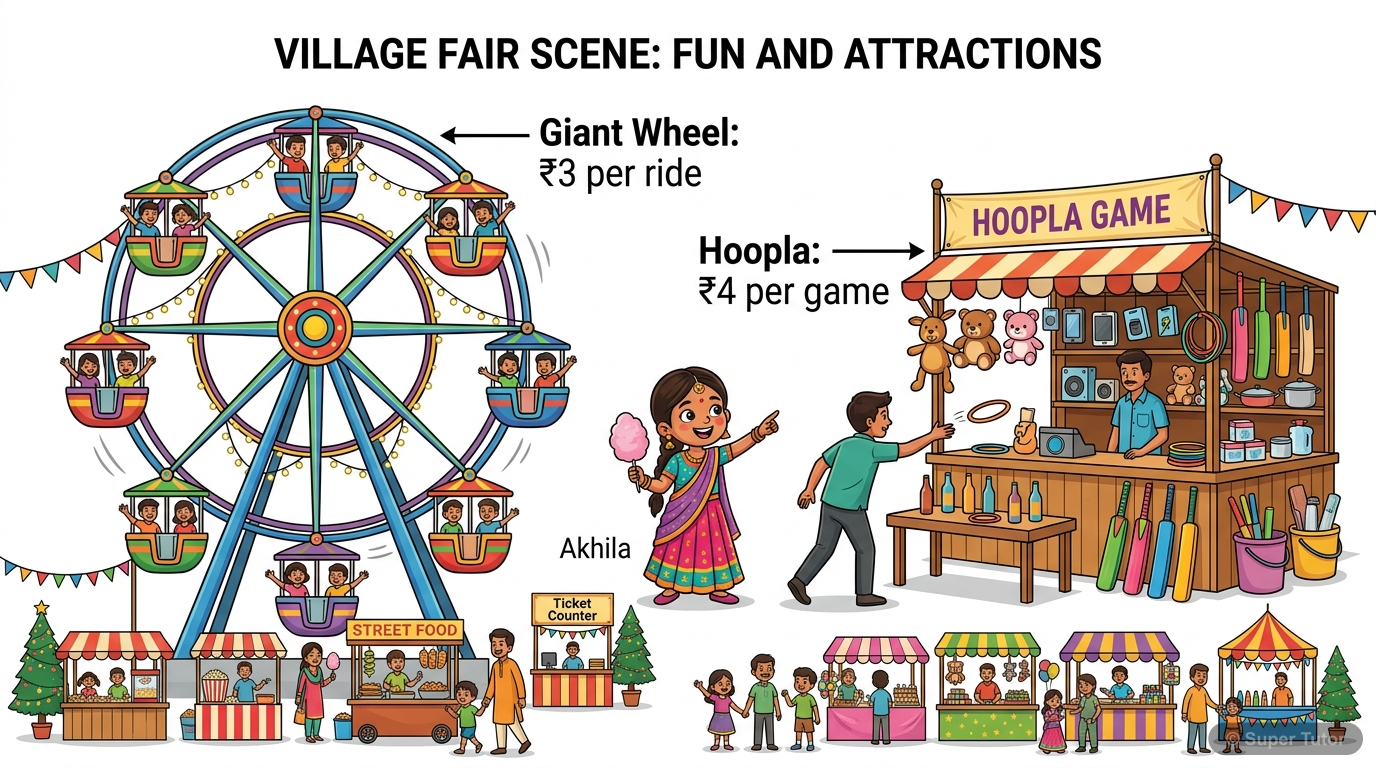
An illustration showing a real-world scenario (Akhila at a fair with a Giant Wheel and Hoopla game) that can be modeled by a pair of linear equations in two variables.
Super Tutor

One of 4 illustrations for Pair of Linear Equations in Two Variables in Super Tutor — alongside flashcards, concept maps and practice questions.

39 Questions Solved · 3 Sections

The first 20 solutions are open to read. The other 19 are free with a Super Tutor account.

Exercise 3.1

1(i)10 students of Class X took part in a Mathematics quiz. If the number of girls is 4 more than the number of boys, find the number of boys and girls who took part in the quiz. (Solve graphically.)Show solution

Given: Total students = 10; Number of girls is 4 more than number of boys.

Let number of boys = xx and number of girls = yy.

Equations formed:
x+y=10...(1)x + y = 10 \quad \text{...(1)}
y−x=4...(2)y - x = 4 \quad \text{...(2)}

Solutions for Equation (1): x+y=10x + y = 10

xx0105
yy1005

Solutions for Equation (2): y=x+4y = x + 4

xx024
yy468

Plot these points and draw both lines on the same graph.

The two lines intersect at the point (3,7)(3, 7).

∴x=3,y=7\therefore x = 3, \quad y = 7

Verification: 3+7=103 + 7 = 10 ✓ and 7−3=47 - 3 = 4 ✓

Answer: Number of boys = 3 and number of girls = 7.

1(ii)5 pencils and 7 pens together cost ₹ 50, whereas 7 pencils and 5 pens together cost ₹ 46. Find the cost of one pencil and that of one pen. (Solve graphically.)Show solution

Let cost of one pencil = ₹ xx and cost of one pen = ₹ yy.

Equations formed:
5x+7y=50...(1)5x + 7y = 50 \quad \text{...(1)}
7x+5y=46...(2)7x + 5y = 46 \quad \text{...(2)}

Solutions for Equation (1): y=50−5x7y = \dfrac{50 - 5x}{7}

xx310
yy50

Solutions for Equation (2): y=46−7x5y = \dfrac{46 - 7x}{5}

xx38
yy5-2

Plot these points and draw both lines on the same graph.

The two lines intersect at the point (3,5)(3, 5).

∴x=3,y=5\therefore x = 3, \quad y = 5

Verification: 5(3)+7(5)=15+35=505(3) + 7(5) = 15 + 35 = 50 ✓ and 7(3)+5(5)=21+25=467(3) + 5(5) = 21 + 25 = 46 ✓

Answer: Cost of one pencil = ₹ 3 and cost of one pen = ₹ 5.

2(i)On comparing the ratios a1a2,b1b2\frac{a_1}{a_2}, \frac{b_1}{b_2} and c1c2\frac{c_1}{c_2}, find out whether the lines representing the following pair of linear equations intersect at a point, are parallel or coincident:
5x−4y+8=05x - 4y + 8 = 0
7x+6y−9=07x + 6y - 9 = 0
Show solution

Given equations:
5x−4y+8=0⇒a1=5, b1=−4, c1=85x - 4y + 8 = 0 \quad \Rightarrow a_1=5,\ b_1=-4,\ c_1=8
7x+6y−9=0⇒a2=7, b2=6, c2=−97x + 6y - 9 = 0 \quad \Rightarrow a_2=7,\ b_2=6,\ c_2=-9

Comparing ratios:
a1a2=57,b1b2=−46=−23\frac{a_1}{a_2} = \frac{5}{7}, \qquad \frac{b_1}{b_2} = \frac{-4}{6} = \frac{-2}{3}

Since 57≠−23\dfrac{5}{7} \neq \dfrac{-2}{3}, i.e., a1a2≠b1b2\dfrac{a_1}{a_2} \neq \dfrac{b_1}{b_2}.

Conclusion: The lines intersect at a point (unique solution; consistent pair).

2(ii)On comparing the ratios a1a2,b1b2\frac{a_1}{a_2}, \frac{b_1}{b_2} and c1c2\frac{c_1}{c_2}, find out whether the lines representing the following pair of linear equations intersect at a point, are parallel or coincident:
9x+3y+12=09x + 3y + 12 = 0
18x+6y+24=018x + 6y + 24 = 0
Show solution

Given equations:
9x+3y+12=0⇒a1=9, b1=3, c1=129x + 3y + 12 = 0 \quad \Rightarrow a_1=9,\ b_1=3,\ c_1=12
18x+6y+24=0⇒a2=18, b2=6, c2=2418x + 6y + 24 = 0 \quad \Rightarrow a_2=18,\ b_2=6,\ c_2=24

Comparing ratios:
a1a2=918=12,b1b2=36=12,c1c2=1224=12\frac{a_1}{a_2} = \frac{9}{18} = \frac{1}{2}, \qquad \frac{b_1}{b_2} = \frac{3}{6} = \frac{1}{2}, \qquad \frac{c_1}{c_2} = \frac{12}{24} = \frac{1}{2}

Since a1a2=b1b2=c1c2=12\dfrac{a_1}{a_2} = \dfrac{b_1}{b_2} = \dfrac{c_1}{c_2} = \dfrac{1}{2}.

Conclusion: The lines are coincident (infinitely many solutions; dependent and consistent pair).

2(iii)On comparing the ratios a1a2,b1b2\frac{a_1}{a_2}, \frac{b_1}{b_2} and c1c2\frac{c_1}{c_2}, find out whether the lines representing the following pair of linear equations intersect at a point, are parallel or coincident:
6x−3y+10=06x - 3y + 10 = 0
2x−y+9=02x - y + 9 = 0
Show solution

Given equations:
6x−3y+10=0⇒a1=6, b1=−3, c1=106x - 3y + 10 = 0 \quad \Rightarrow a_1=6,\ b_1=-3,\ c_1=10
2x−y+9=0⇒a2=2, b2=−1, c2=92x - y + 9 = 0 \quad \Rightarrow a_2=2,\ b_2=-1,\ c_2=9

Comparing ratios:
a1a2=62=3,b1b2=−3−1=3,c1c2=109\frac{a_1}{a_2} = \frac{6}{2} = 3, \qquad \frac{b_1}{b_2} = \frac{-3}{-1} = 3, \qquad \frac{c_1}{c_2} = \frac{10}{9}

Since a1a2=b1b2=3\dfrac{a_1}{a_2} = \dfrac{b_1}{b_2} = 3 but c1c2=109≠3\dfrac{c_1}{c_2} = \dfrac{10}{9} \neq 3.

So a1a2=b1b2≠c1c2\dfrac{a_1}{a_2} = \dfrac{b_1}{b_2} \neq \dfrac{c_1}{c_2}.

Conclusion: The lines are parallel (no solution; inconsistent pair).

3(i)On comparing the ratios a1a2,b1b2\frac{a_1}{a_2}, \frac{b_1}{b_2} and c1c2\frac{c_1}{c_2}, find out whether the following pair of linear equations are consistent or inconsistent:
3x+2y=53x + 2y = 5; 2x−3y=72x - 3y = 7
Show solution

Rewriting in standard form:
3x+2y−5=0⇒a1=3, b1=2, c1=−53x + 2y - 5 = 0 \quad \Rightarrow a_1=3,\ b_1=2,\ c_1=-5
2x−3y−7=0⇒a2=2, b2=−3, c2=−72x - 3y - 7 = 0 \quad \Rightarrow a_2=2,\ b_2=-3,\ c_2=-7

Comparing ratios:
a1a2=32,b1b2=2−3=−23\frac{a_1}{a_2} = \frac{3}{2}, \qquad \frac{b_1}{b_2} = \frac{2}{-3} = -\frac{2}{3}

Since 32≠−23\dfrac{3}{2} \neq -\dfrac{2}{3}, i.e., a1a2≠b1b2\dfrac{a_1}{a_2} \neq \dfrac{b_1}{b_2}.

Conclusion: The pair of linear equations is consistent (unique solution).

3(ii)On comparing the ratios a1a2,b1b2\frac{a_1}{a_2}, \frac{b_1}{b_2} and c1c2\frac{c_1}{c_2}, find out whether the following pair of linear equations are consistent or inconsistent:
2x−3y=82x - 3y = 8; 4x−6y=94x - 6y = 9
Show solution

Rewriting in standard form:
2x−3y−8=0⇒a1=2, b1=−3, c1=−82x - 3y - 8 = 0 \quad \Rightarrow a_1=2,\ b_1=-3,\ c_1=-8
4x−6y−9=0⇒a2=4, b2=−6, c2=−94x - 6y - 9 = 0 \quad \Rightarrow a_2=4,\ b_2=-6,\ c_2=-9

Comparing ratios:
a1a2=24=12,b1b2=−3−6=12,c1c2=−8−9=89\frac{a_1}{a_2} = \frac{2}{4} = \frac{1}{2}, \qquad \frac{b_1}{b_2} = \frac{-3}{-6} = \frac{1}{2}, \qquad \frac{c_1}{c_2} = \frac{-8}{-9} = \frac{8}{9}

Since a1a2=b1b2=12\dfrac{a_1}{a_2} = \dfrac{b_1}{b_2} = \dfrac{1}{2} but c1c2=89≠12\dfrac{c_1}{c_2} = \dfrac{8}{9} \neq \dfrac{1}{2}.

Conclusion: The pair of linear equations is inconsistent (no solution; parallel lines).

3(iii)On comparing the ratios a1a2,b1b2\frac{a_1}{a_2}, \frac{b_1}{b_2} and c1c2\frac{c_1}{c_2}, find out whether the following pair of linear equations are consistent or inconsistent:
32x+53y=7\frac{3}{2}x + \frac{5}{3}y = 7; 9x−10y=149x - 10y = 14
Show solution

Rewriting in standard form:
32x+53y−7=0⇒a1=32, b1=53, c1=−7\frac{3}{2}x + \frac{5}{3}y - 7 = 0 \quad \Rightarrow a_1=\frac{3}{2},\ b_1=\frac{5}{3},\ c_1=-7
9x−10y−14=0⇒a2=9, b2=−10, c2=−149x - 10y - 14 = 0 \quad \Rightarrow a_2=9,\ b_2=-10,\ c_2=-14

Comparing ratios:
a1a2=3/29=318=16\frac{a_1}{a_2} = \frac{3/2}{9} = \frac{3}{18} = \frac{1}{6}
b1b2=5/3−10=5−30=−16\frac{b_1}{b_2} = \frac{5/3}{-10} = \frac{5}{-30} = -\frac{1}{6}

Since 16≠−16\dfrac{1}{6} \neq -\dfrac{1}{6}, i.e., a1a2≠b1b2\dfrac{a_1}{a_2} \neq \dfrac{b_1}{b_2}.

Conclusion: The pair of linear equations is consistent (unique solution).

3(iv)On comparing the ratios a1a2,b1b2\frac{a_1}{a_2}, \frac{b_1}{b_2} and c1c2\frac{c_1}{c_2}, find out whether the following pair of linear equations are consistent or inconsistent:
5x−3y=115x - 3y = 11; −10x+6y=−22-10x + 6y = -22
Show solution

Rewriting in standard form:
5x−3y−11=0⇒a1=5, b1=−3, c1=−115x - 3y - 11 = 0 \quad \Rightarrow a_1=5,\ b_1=-3,\ c_1=-11
−10x+6y+22=0⇒a2=−10, b2=6, c2=22-10x + 6y + 22 = 0 \quad \Rightarrow a_2=-10,\ b_2=6,\ c_2=22

Comparing ratios:
a1a2=5−10=−12,b1b2=−36=−12,c1c2=−1122=−12\frac{a_1}{a_2} = \frac{5}{-10} = -\frac{1}{2}, \qquad \frac{b_1}{b_2} = \frac{-3}{6} = -\frac{1}{2}, \qquad \frac{c_1}{c_2} = \frac{-11}{22} = -\frac{1}{2}

Since a1a2=b1b2=c1c2=−12\dfrac{a_1}{a_2} = \dfrac{b_1}{b_2} = \dfrac{c_1}{c_2} = -\dfrac{1}{2}.

Conclusion: The pair of linear equations is consistent (infinitely many solutions; coincident lines).

3(v)On comparing the ratios a1a2,b1b2\frac{a_1}{a_2}, \frac{b_1}{b_2} and c1c2\frac{c_1}{c_2}, find out whether the following pair of linear equations are consistent or inconsistent:
43x+2y=8\frac{4}{3}x + 2y = 8; 2x+3y=122x + 3y = 12
Show solution

Rewriting in standard form:
43x+2y−8=0⇒a1=43, b1=2, c1=−8\frac{4}{3}x + 2y - 8 = 0 \quad \Rightarrow a_1=\frac{4}{3},\ b_1=2,\ c_1=-8
2x+3y−12=0⇒a2=2, b2=3, c2=−122x + 3y - 12 = 0 \quad \Rightarrow a_2=2,\ b_2=3,\ c_2=-12

Comparing ratios:
a1a2=4/32=46=23,b1b2=23,c1c2=−8−12=23\frac{a_1}{a_2} = \frac{4/3}{2} = \frac{4}{6} = \frac{2}{3}, \qquad \frac{b_1}{b_2} = \frac{2}{3}, \qquad \frac{c_1}{c_2} = \frac{-8}{-12} = \frac{2}{3}

Since a1a2=b1b2=c1c2=23\dfrac{a_1}{a_2} = \dfrac{b_1}{b_2} = \dfrac{c_1}{c_2} = \dfrac{2}{3}.

Conclusion: The pair of linear equations is consistent (infinitely many solutions; coincident lines).

4(i)Which of the following pairs of linear equations are consistent/inconsistent? If consistent, obtain the solution graphically:
x+y=5x + y = 5; 2x+2y=102x + 2y = 10
Show solution

Rewriting in standard form:
x+y−5=0⇒a1=1, b1=1, c1=−5x + y - 5 = 0 \quad \Rightarrow a_1=1,\ b_1=1,\ c_1=-5
2x+2y−10=0⇒a2=2, b2=2, c2=−102x + 2y - 10 = 0 \quad \Rightarrow a_2=2,\ b_2=2,\ c_2=-10

Comparing ratios:
a1a2=12,b1b2=12,c1c2=−5−10=12\frac{a_1}{a_2} = \frac{1}{2}, \qquad \frac{b_1}{b_2} = \frac{1}{2}, \qquad \frac{c_1}{c_2} = \frac{-5}{-10} = \frac{1}{2}

Since a1a2=b1b2=c1c2\dfrac{a_1}{a_2} = \dfrac{b_1}{b_2} = \dfrac{c_1}{c_2}, the equations are consistent (coincident lines — infinitely many solutions).

Graphical solution: Both equations represent the same line x+y=5x + y = 5.

Some solutions: (0,5), (5,0), (2,3)(0, 5),\ (5, 0),\ (2, 3), etc.

Answer: The pair is consistent with infinitely many solutions — every point on the line x+y=5x + y = 5 is a solution.

4(ii)Which of the following pairs of linear equations are consistent/inconsistent? If consistent, obtain the solution graphically:
x−y=8x - y = 8; 3x−3y=163x - 3y = 16
Show solution

Rewriting in standard form:
x−y−8=0⇒a1=1, b1=−1, c1=−8x - y - 8 = 0 \quad \Rightarrow a_1=1,\ b_1=-1,\ c_1=-8
3x−3y−16=0⇒a2=3, b2=−3, c2=−163x - 3y - 16 = 0 \quad \Rightarrow a_2=3,\ b_2=-3,\ c_2=-16

Comparing ratios:
a1a2=13,b1b2=−1−3=13,c1c2=−8−16=12\frac{a_1}{a_2} = \frac{1}{3}, \qquad \frac{b_1}{b_2} = \frac{-1}{-3} = \frac{1}{3}, \qquad \frac{c_1}{c_2} = \frac{-8}{-16} = \frac{1}{2}

Since a1a2=b1b2=13\dfrac{a_1}{a_2} = \dfrac{b_1}{b_2} = \dfrac{1}{3} but c1c2=12≠13\dfrac{c_1}{c_2} = \dfrac{1}{2} \neq \dfrac{1}{3}.

Conclusion: The pair is inconsistent (parallel lines, no solution).

4(iii)Which of the following pairs of linear equations are consistent/inconsistent? If consistent, obtain the solution graphically:
2x+y−6=02x + y - 6 = 0; 4x−2y−4=04x - 2y - 4 = 0
Show solution

Given:
2x+y−6=0⇒a1=2, b1=1, c1=−62x + y - 6 = 0 \quad \Rightarrow a_1=2,\ b_1=1,\ c_1=-6
4x−2y−4=0⇒a2=4, b2=−2, c2=−44x - 2y - 4 = 0 \quad \Rightarrow a_2=4,\ b_2=-2,\ c_2=-4

Comparing ratios:
a1a2=24=12,b1b2=1−2=−12\frac{a_1}{a_2} = \frac{2}{4} = \frac{1}{2}, \qquad \frac{b_1}{b_2} = \frac{1}{-2} = -\frac{1}{2}

Since a1a2≠b1b2\dfrac{a_1}{a_2} \neq \dfrac{b_1}{b_2}, the pair is consistent (unique solution).

Graphical solution:

For 2x+y=62x + y = 6:

xx03
yy60

For 4x−2y=44x - 2y = 4, i.e., 2x−y=22x - y = 2:

xx01
yy-20

Plotting and drawing both lines, they intersect at (2,2)(2, 2).

Verification: 2(2)+2−6=02(2)+2-6=0 ✓ and 4(2)−2(2)−4=04(2)-2(2)-4=0 ✓

Answer: The pair is consistent. Solution: x=2, y=2x = 2,\ y = 2.

4(iv)Which of the following pairs of linear equations are consistent/inconsistent? If consistent, obtain the solution graphically:
2x−2y−2=02x - 2y - 2 = 0; 4x−4y−5=04x - 4y - 5 = 0
Show solution

Given:
2x−2y−2=0⇒a1=2, b1=−2, c1=−22x - 2y - 2 = 0 \quad \Rightarrow a_1=2,\ b_1=-2,\ c_1=-2
4x−4y−5=0⇒a2=4, b2=−4, c2=−54x - 4y - 5 = 0 \quad \Rightarrow a_2=4,\ b_2=-4,\ c_2=-5

Comparing ratios:
a1a2=24=12,b1b2=−2−4=12,c1c2=−2−5=25\frac{a_1}{a_2} = \frac{2}{4} = \frac{1}{2}, \qquad \frac{b_1}{b_2} = \frac{-2}{-4} = \frac{1}{2}, \qquad \frac{c_1}{c_2} = \frac{-2}{-5} = \frac{2}{5}

Since a1a2=b1b2=12\dfrac{a_1}{a_2} = \dfrac{b_1}{b_2} = \dfrac{1}{2} but c1c2=25≠12\dfrac{c_1}{c_2} = \dfrac{2}{5} \neq \dfrac{1}{2}.

Conclusion: The pair is inconsistent (parallel lines, no solution).

5Half the perimeter of a rectangular garden, whose length is 4 m more than its width, is 36 m. Find the dimensions of the garden.Show solution

Let length = ll metres and width = bb metres.

Condition 1: Length is 4 m more than width:
l=b+4⇒l−b=4...(1)l = b + 4 \quad \Rightarrow l - b = 4 \quad \text{...(1)}

Condition 2: Half the perimeter = 36 m:
l+b=36...(2)l + b = 36 \quad \text{...(2)}

Adding equations (1) and (2):
2l=40⇒l=20 m2l = 40 \Rightarrow l = 20 \text{ m}

Substituting in (2):
20+b=36⇒b=16 m20 + b = 36 \Rightarrow b = 16 \text{ m}

Verification: l−b=20−16=4l - b = 20 - 16 = 4 ✓ and l+b=20+16=36l + b = 20 + 16 = 36 ✓

Answer: Length = 20 m and Width = 16 m.

6Given the linear equation 2x+3y−8=02x + 3y - 8 = 0, write another linear equation in two variables such that the geometrical representation of the pair so formed is:
(i) intersecting lines
(ii) parallel lines
(iii) coincident lines
Show solution

Given equation: 2x+3y−8=02x + 3y - 8 = 0, where a1=2, b1=3, c1=−8a_1 = 2,\ b_1 = 3,\ c_1 = -8.

(i) Intersecting lines:
Condition: a1a2≠b1b2\dfrac{a_1}{a_2} \neq \dfrac{b_1}{b_2}

Choose any equation where the ratio of coefficients of xx and yy is different.

Example: 3x+2y−8=03x + 2y - 8 = 0

Here 23≠32\dfrac{2}{3} \neq \dfrac{3}{2} ✓

(ii) Parallel lines:
Condition: a1a2=b1b2≠c1c2\dfrac{a_1}{a_2} = \dfrac{b_1}{b_2} \neq \dfrac{c_1}{c_2}

Choose a2:b2=2:3a_2 : b_2 = 2 : 3 but c2≠−8kc_2 \neq -8k for the same kk.

Example: 2x+3y−12=02x + 3y - 12 = 0

Here 22=33=1\dfrac{2}{2} = \dfrac{3}{3} = 1 but −8−12=23≠1\dfrac{-8}{-12} = \dfrac{2}{3} \neq 1 ✓

(iii) Coincident lines:
Condition: a1a2=b1b2=c1c2\dfrac{a_1}{a_2} = \dfrac{b_1}{b_2} = \dfrac{c_1}{c_2}

Multiply the entire equation by any non-zero constant.

Example: 4x+6y−16=04x + 6y - 16 = 0

Here 24=36=−8−16=12\dfrac{2}{4} = \dfrac{3}{6} = \dfrac{-8}{-16} = \dfrac{1}{2} ✓

(Note: Many other valid answers are possible for each part.)

7Draw the graphs of the equations x−y+1=0x - y + 1 = 0 and 3x+2y−12=03x + 2y - 12 = 0. Determine the coordinates of the vertices of the triangle formed by these lines and the xx-axis, and shade the triangular region.Show solution

Equation 1: x−y+1=0⇒y=x+1x - y + 1 = 0 \Rightarrow y = x + 1

xx024
yy135

Equation 2: 3x+2y−12=0⇒y=12−3x23x + 2y - 12 = 0 \Rightarrow y = \dfrac{12 - 3x}{2}

xx024
yy630

Plot these points and draw both lines.

Finding intersection of the two lines:
From Eq. 1: y=x+1y = x + 1. Substitute in Eq. 2:
3x+2(x+1)=12⇒5x+2=12⇒x=2, y=33x + 2(x+1) = 12 \Rightarrow 5x + 2 = 12 \Rightarrow x = 2,\ y = 3
Intersection point: A(2,3)A(2, 3).

Finding where each line meets the xx-axis (y=0y = 0):

  • Line 1: x−0+1=0⇒x=−1x - 0 + 1 = 0 \Rightarrow x = -1 → Point B(−1,0)B(-1, 0)
  • Line 2: 3x+0−12=0⇒x=43x + 0 - 12 = 0 \Rightarrow x = 4 → Point C(4,0)C(4, 0)

Vertices of the triangle:
A(2, 3),B(−1, 0),C(4, 0)A(2,\ 3),\quad B(-1,\ 0),\quad C(4,\ 0)

Shade the triangular region ABCABC on the graph.

Answer: The vertices of the triangle are (−1,0)(-1, 0), (4,0)(4, 0), and (2,3)(2, 3).

Exercise 3.2

1(i)Solve the following pair of linear equations by the substitution method:
x+y=14x + y = 14
x−y=4x - y = 4
Show solution

Given:
x+y=14...(1)x + y = 14 \quad \text{...(1)}
x−y=4...(2)x - y = 4 \quad \text{...(2)}

From equation (2):
x=4+y...(3)x = 4 + y \quad \text{...(3)}

Substituting (3) in (1):
(4+y)+y=14(4 + y) + y = 14
4+2y=144 + 2y = 14
2y=10⇒y=52y = 10 \Rightarrow y = 5

Substituting y=5y = 5 in (3):
x=4+5=9x = 4 + 5 = 9

Verification: 9+5=149 + 5 = 14 ✓ and 9−5=49 - 5 = 4 ✓

Answer: x=9, y=5x = 9,\ y = 5.

1(ii)Solve the following pair of linear equations by the substitution method:
s−t=3s - t = 3
s3+t2=6\dfrac{s}{3} + \dfrac{t}{2} = 6
Show solution

Given:
s−t=3...(1)s - t = 3 \quad \text{...(1)}
s3+t2=6...(2)\frac{s}{3} + \frac{t}{2} = 6 \quad \text{...(2)}

From equation (1):
s=t+3...(3)s = t + 3 \quad \text{...(3)}

Substituting (3) in (2):
t+33+t2=6\frac{t+3}{3} + \frac{t}{2} = 6

Multiplying throughout by 6:
2(t+3)+3t=362(t+3) + 3t = 36
2t+6+3t=362t + 6 + 3t = 36
5t=30⇒t=65t = 30 \Rightarrow t = 6

Substituting t=6t = 6 in (3):
s=6+3=9s = 6 + 3 = 9

Verification: 9−6=39 - 6 = 3 ✓ and 93+62=3+3=6\dfrac{9}{3} + \dfrac{6}{2} = 3 + 3 = 6 ✓

Answer: s=9, t=6s = 9,\ t = 6.

1(iii)Solve the following pair of linear equations by the substitution method:
3x−y=33x - y = 3
9x−3y=99x - 3y = 9
Show solution

Given:
3x−y=3...(1)3x - y = 3 \quad \text{...(1)}
9x−3y=9...(2)9x - 3y = 9 \quad \text{...(2)}

Observe: Equation (2) = 3 × Equation (1), so both equations are the same.

From equation (1):
y=3x−3...(3)y = 3x - 3 \quad \text{...(3)}

Substituting in (2): 9x−3(3x−3)=9⇒9x−9x+9=9⇒9=99x - 3(3x-3) = 9 \Rightarrow 9x - 9x + 9 = 9 \Rightarrow 9 = 9 (always true).

Conclusion: The equations are dependent and have infinitely many solutions.

The solution is y=3x−3y = 3x - 3, i.e., every point on the line 3x−y=33x - y = 3 is a solution.

1(iv)Solve the following pair of linear equations by the substitution method:
0.2x+0.3y=1.30.2x + 0.3y = 1.3
0.4x+0.5y=2.30.4x + 0.5y = 2.3

Free with a Super Tutor account

1(v)Solve the following pair of linear equations by the substitution method:
2 x+3 y=0\sqrt{2}\, x + \sqrt{3}\, y = 0
3 x−8 y=0\sqrt{3}\, x - \sqrt{8}\, y = 0

Free with a Super Tutor account

1(vi)Solve the following pair of linear equations by the substitution method:
3x2−5y3=−2\dfrac{3x}{2} - \dfrac{5y}{3} = -2
x3+y2=136\dfrac{x}{3} + \dfrac{y}{2} = \dfrac{13}{6}

Free with a Super Tutor account

2Solve 2x+3y=112x + 3y = 11 and 2x−4y=−242x - 4y = -24 and hence find the value of mm for which y=mx+3y = mx + 3.

Free with a Super Tutor account

3(i)Form the pair of linear equations for the following problem and find the solution by substitution method:
The difference between two numbers is 26 and one number is three times the other. Find them.

Free with a Super Tutor account

3(ii)Form the pair of linear equations for the following problem and find the solution by substitution method:
The larger of two supplementary angles exceeds the smaller by 18 degrees. Find them.

Free with a Super Tutor account

3(iii)Form the pair of linear equations for the following problem and find the solution by substitution method:
The coach of a cricket team buys 7 bats and 6 balls for ₹ 3800. Later, she buys 3 bats and 5 balls for ₹ 1750. Find the cost of each bat and each ball.

Free with a Super Tutor account

3(iv)Form the pair of linear equations for the following problem and find the solution by substitution method:
The taxi charges in a city consist of a fixed charge together with the charge for the distance covered. For a distance of 10 km, the charge paid is ₹ 105 and for a journey of 15 km, the charge paid is ₹ 155. What are the fixed charges and the charge per km? How much does a person have to pay for travelling a distance of 25 km?

Free with a Super Tutor account

3(v)Form the pair of linear equations for the following problem and find the solution by substitution method:
A fraction becomes 911\dfrac{9}{11}, if 2 is added to both the numerator and the denominator. If 3 is added to both the numerator and the denominator it becomes 56\dfrac{5}{6}. Find the fraction.

Free with a Super Tutor account

3(vi)Form the pair of linear equations for the following problem and find the solution by substitution method:
Five years hence, the age of Jacob will be three times that of his son. Five years ago, Jacob's age was seven times that of his son. What are their present ages?

Free with a Super Tutor account

Exercise 3.3

1(i)Solve the following pair of linear equations by the elimination method and the substitution method:
x+y=5x + y = 5 and 2x−3y=42x - 3y = 4

Free with a Super Tutor account

1(ii)Solve the following pair of linear equations by the elimination method and the substitution method:
3x+4y=103x + 4y = 10 and 2x−2y=22x - 2y = 2

Free with a Super Tutor account

1(iii)Solve the following pair of linear equations by the elimination method and the substitution method:
3x−5y−4=03x - 5y - 4 = 0 and 9x=2y+79x = 2y + 7

Free with a Super Tutor account

1(iv)Solve the following pair of linear equations by the elimination method and the substitution method:
x2+2y3=−1\dfrac{x}{2} + \dfrac{2y}{3} = -1 and x−y3=3x - \dfrac{y}{3} = 3

Free with a Super Tutor account

2(i)Form the pair of linear equations in the following problem, and find the solution (if it exists) by the elimination method:
If we add 1 to the numerator and subtract 1 from the denominator, a fraction reduces to 1. It becomes 12\dfrac{1}{2} if we only add 1 to the denominator. What is the fraction?

Free with a Super Tutor account

2(ii)Form the pair of linear equations in the following problem, and find the solution (if it exists) by the elimination method:
Five years ago, Nuri was thrice as old as Sonu. Ten years later, Nuri will be twice as old as Sonu. How old are Nuri and Sonu?

Free with a Super Tutor account

2(iii)Form the pair of linear equations in the following problem, and find the solution (if it exists) by the elimination method:
The sum of the digits of a two-digit number is 9. Also, nine times this number is twice the number obtained by reversing the order of the digits. Find the number.

Free with a Super Tutor account

2(iv)Form the pair of linear equations in the following problem, and find the solution (if it exists) by the elimination method:
Meena went to a bank to withdraw ₹ 2000. She asked the cashier to give her ₹ 50 and ₹ 100 notes only. Meena got 25 notes in all. Find how many notes of ₹ 50 and ₹ 100 she received.

Free with a Super Tutor account

2(v)Form the pair of linear equations in the following problem, and find the solution (if it exists) by the elimination method:
A lending library has a fixed charge for the first three days and an additional charge for each day thereafter. Saritha paid ₹ 27 for a book kept for seven days, while Susy paid ₹ 21 for the book she kept for five days. Find the fixed charge and the charge for each extra day.

Free with a Super Tutor account

19 more solved questions in Pair of Linear Equations in Two Variables

They are free with a Super Tutor account, along with practice quizzes and flashcards for this chapter. Free to start, no card needed.

Frequently Asked Questions

What are the important topics in Pair of Linear Equations in Two Variables for Madhya Pradesh Board Class 10 Mathematics?
Key topics in Pair of Linear Equations in Two Variables include Basic Ideas and Types of Solutions, Graphical Method and Its Interpretation, Substitution Method, Elimination Method. Study these first, then practise questions on each for the Madhya Pradesh Board Class 10 board exam.
Are these NCERT Solutions for Pair of Linear Equations in Two Variables free?
The first 20 of the 39 solutions on this page are open to read. The other 19 are free with a Super Tutor account — signing up is free and needs no card.
How should I revise Pair of Linear Equations in Two Variables for the Madhya Pradesh Board Class 10 board exam?
Learn the core ideas first, then work through the 128 practice questions on Pair of Linear Equations in Two Variables. Revise definitions regularly and use flashcards for quick recall before the exam.

Sources & Official References

Content is aligned to the official syllabus. Refer to the board website for the latest curriculum.

For serious students

Get the full Pair of Linear Equations in Two Variables chapter — start free.

Quizzes, flashcards, an AI doubt solver and a study plan for Madhya Pradesh Board Class 10 Mathematics. Free to start, no card needed.