Chapter 9 of 14
NCERT Solutions

Some Applications of Trigonometry

Madhya Pradesh Board · Class 10 · Mathematics

NCERT Solutions for Some Applications of Trigonometry — Madhya Pradesh Board Class 10 Mathematics.

54 questions20 flashcards4 concepts

Interactive on Super Tutor

Studying Some Applications of Trigonometry? Get the full interactive chapter.

Quizzes, flashcards, AI doubt-solver and a step-by-step study plan — built for ncert solutions and more.

1,000+ Class 10 students started this chapter today

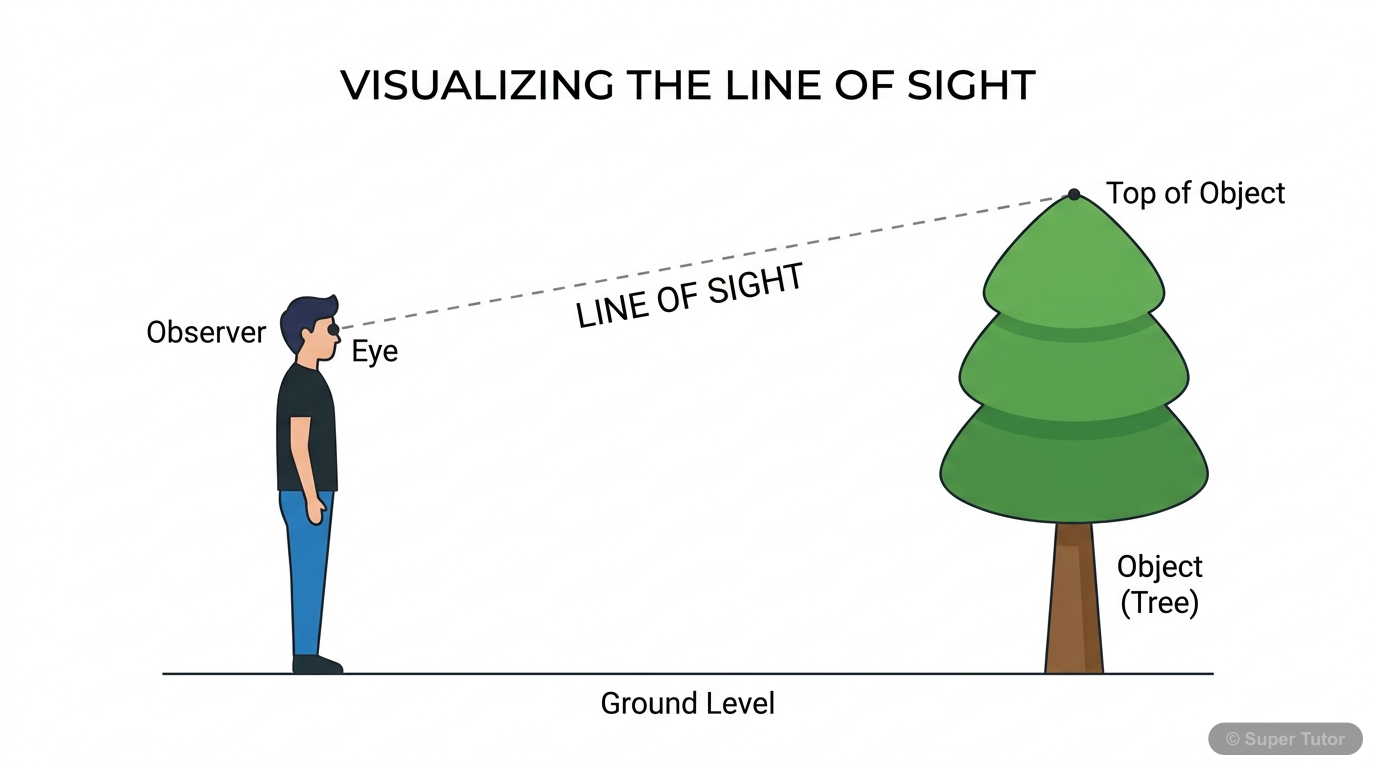
A diagram illustrating the concept of a line of sight, showing an observer's eye and an object, with a line connecting them.
Super Tutor

Learn better with visuals Super Tutor has hundreds of illustrations like this across every chapter — all free to try.

Get started
15 Questions Solved · 1 Section

Exercise 9.1

1A circus artist is climbing a 20 m long rope, which is tightly stretched and tied from the top of a vertical pole to the ground. Find the height of the pole, if the angle made by the rope with the ground level is 30°.Show solution
Given: Length of rope (hypotenuse) = 20 m, angle with ground = 30°.

Let the height of the pole = AB (perpendicular), and the rope AC is the hypotenuse.

Formula used: sinθ=PerpendicularHypotenuse\sin\theta = \dfrac{\text{Perpendicular}}{\text{Hypotenuse}}

Working:
sin30°=ABAC\sin 30° = \frac{AB}{AC}
12=AB20\frac{1}{2} = \frac{AB}{20}
AB=202=10 mAB = \frac{20}{2} = 10 \text{ m}

Answer: The height of the pole is 10 m.
2A tree breaks due to storm and the broken part bends so that the top of the tree touches the ground making an angle 30° with it. The distance between the foot of the tree to the point where the top touches the ground is 8 m. Find the height of the tree.Show solution
Given: The broken part makes an angle of 30° with the ground. The horizontal distance from the foot of the tree to the point where the top touches the ground = 8 m.

Let BC = standing part of the tree (perpendicular), AC = broken part (hypotenuse), AB = 8 m (base).

Step 1: Find BC using tan30°\tan 30°:
tan30°=BCAB\tan 30° = \frac{BC}{AB}
13=BC8\frac{1}{\sqrt{3}} = \frac{BC}{8}
BC=83=833 mBC = \frac{8}{\sqrt{3}} = \frac{8\sqrt{3}}{3} \text{ m}

Step 2: Find AC (broken part) using cos30°\cos 30°:
cos30°=ABAC\cos 30° = \frac{AB}{AC}
32=8AC\frac{\sqrt{3}}{2} = \frac{8}{AC}
AC=163=1633 mAC = \frac{16}{\sqrt{3}} = \frac{16\sqrt{3}}{3} \text{ m}

Step 3: Total height of the tree = BC + AC:
=833+1633=2433=83 m= \frac{8\sqrt{3}}{3} + \frac{16\sqrt{3}}{3} = \frac{24\sqrt{3}}{3} = 8\sqrt{3} \text{ m}

Answer: The height of the tree is 838\sqrt{3} m.
3A contractor plans to install two slides for the children to play in a park. For the children below the age of 5 years, she prefers to have a slide whose top is at a height of 1.5 m, and is inclined at an angle of 30° to the ground, whereas for elder children, she wants to have a steep slide at a height of 3 m, and inclined at an angle of 60° to the ground. What should be the length of the slide in each case?Show solution
Case 1 (Younger children):

Given: Height = 1.5 m, angle of inclination = 30°.

Let the length of the slide = l1l_1 (hypotenuse).

sin30°=1.5l1\sin 30° = \frac{1.5}{l_1}
12=1.5l1\frac{1}{2} = \frac{1.5}{l_1}
l1=1.5×2=3 ml_1 = 1.5 \times 2 = 3 \text{ m}

Case 2 (Elder children):

Given: Height = 3 m, angle of inclination = 60°.

Let the length of the slide = l2l_2 (hypotenuse).

sin60°=3l2\sin 60° = \frac{3}{l_2}
32=3l2\frac{\sqrt{3}}{2} = \frac{3}{l_2}
l2=3×23=63=23 ml_2 = \frac{3 \times 2}{\sqrt{3}} = \frac{6}{\sqrt{3}} = 2\sqrt{3} \text{ m}

Answer: The length of the slide for younger children is 3 m and for elder children is 232\sqrt{3} m.
4The angle of elevation of the top of a tower from a point on the ground, which is 30 m away from the foot of the tower, is 30°. Find the height of the tower.Show solution
Given: Distance from the point to the foot of the tower = 30 m, angle of elevation = 30°.

Let the height of the tower = hh m.

Formula used: tanθ=HeightBase\tan\theta = \dfrac{\text{Height}}{\text{Base}}

Working:
tan30°=h30\tan 30° = \frac{h}{30}
13=h30\frac{1}{\sqrt{3}} = \frac{h}{30}
h=303=3033=103 mh = \frac{30}{\sqrt{3}} = \frac{30\sqrt{3}}{3} = 10\sqrt{3} \text{ m}

Answer: The height of the tower is 10310\sqrt{3} m.
5A kite is flying at a height of 60 m above the ground. The string attached to the kite is temporarily tied to a point on the ground. The inclination of the string with the ground is 60°. Find the length of the string, assuming that there is no slack in the string.Show solution
Given: Height of kite = 60 m, angle of inclination of string with ground = 60°.

Let the length of the string = ll m (hypotenuse).

Working:
sin60°=60l\sin 60° = \frac{60}{l}
32=60l\frac{\sqrt{3}}{2} = \frac{60}{l}
l=60×23=1203=12033=403 ml = \frac{60 \times 2}{\sqrt{3}} = \frac{120}{\sqrt{3}} = \frac{120\sqrt{3}}{3} = 40\sqrt{3} \text{ m}

Answer: The length of the string is 40340\sqrt{3} m.
6A 1.5 m tall boy is standing at some distance from a 30 m tall building. The angle of elevation from his eyes to the top of the building increases from 30° to 60° as he walks towards the building. Find the distance he walked towards the building.Show solution
Given: Height of boy = 1.5 m, height of building = 30 m.

Effective height above the boy's eye level = 301.5=28.530 - 1.5 = 28.5 m.

Let the initial distance of the boy's eyes from the building = d1d_1, and the final distance = d2d_2.

Step 1: When angle of elevation = 30°:
tan30°=28.5d1\tan 30° = \frac{28.5}{d_1}
13=28.5d1\frac{1}{\sqrt{3}} = \frac{28.5}{d_1}
d1=28.53 md_1 = 28.5\sqrt{3} \text{ m}

Step 2: When angle of elevation = 60°:
tan60°=28.5d2\tan 60° = \frac{28.5}{d_2}
3=28.5d2\sqrt{3} = \frac{28.5}{d_2}
d2=28.53=28.533=9.53 md_2 = \frac{28.5}{\sqrt{3}} = \frac{28.5\sqrt{3}}{3} = 9.5\sqrt{3} \text{ m}

Step 3: Distance walked = d1d2d_1 - d_2:
=28.539.53=193 m= 28.5\sqrt{3} - 9.5\sqrt{3} = 19\sqrt{3} \text{ m}

Answer: The distance walked by the boy towards the building is 19319\sqrt{3} m.
7From a point on the ground, the angles of elevation of the bottom and the top of a transmission tower fixed at the top of a 20 m high building are 45° and 60° respectively. Find the height of the tower.Show solution
Given: Height of building = 20 m. Let height of transmission tower = hh m. Let the point on the ground be at distance dd from the foot of the building.

Step 1: Angle of elevation of the bottom of the tower (top of building) = 45°:
tan45°=20d\tan 45° = \frac{20}{d}
1=20d1 = \frac{20}{d}
d=20 md = 20 \text{ m}

Step 2: Angle of elevation of the top of the tower = 60°:
tan60°=20+hd\tan 60° = \frac{20 + h}{d}
3=20+h20\sqrt{3} = \frac{20 + h}{20}
20+h=20320 + h = 20\sqrt{3}
h=20320=20(31) mh = 20\sqrt{3} - 20 = 20(\sqrt{3} - 1) \text{ m}

Answer: The height of the transmission tower is 20(31)20(\sqrt{3}-1) m.
8A statue, 1.6 m tall, stands on the top of a pedestal. From a point on the ground, the angle of elevation of the top of the statue is 60° and from the same point the angle of elevation of the top of the pedestal is 45°. Find the height of the pedestal.Show solution
Given: Height of statue = 1.6 m. Let height of pedestal = hh m. Let the distance of the point from the base = dd m.

Step 1: Angle of elevation of top of pedestal = 45°:
tan45°=hd\tan 45° = \frac{h}{d}
1=hd1 = \frac{h}{d}
d=h(1)d = h \quad \cdots (1)

Step 2: Angle of elevation of top of statue = 60°:
tan60°=h+1.6d\tan 60° = \frac{h + 1.6}{d}
3=h+1.6h[using (1)]\sqrt{3} = \frac{h + 1.6}{h} \quad [\text{using (1)}]
3h=h+1.6\sqrt{3}\, h = h + 1.6
h(31)=1.6h(\sqrt{3} - 1) = 1.6
h=1.631=1.6(3+1)(31)(3+1)=1.6(3+1)2=0.8(3+1) mh = \frac{1.6}{\sqrt{3}-1} = \frac{1.6(\sqrt{3}+1)}{(\sqrt{3}-1)(\sqrt{3}+1)} = \frac{1.6(\sqrt{3}+1)}{2} = 0.8(\sqrt{3}+1) \text{ m}

Answer: The height of the pedestal is 0.8(3+1)0.8(\sqrt{3}+1) m.
9The angle of elevation of the top of a building from the foot of the tower is 30° and the angle of elevation of the top of the tower from the foot of the building is 60°. If the tower is 50 m high, find the height of the building.Show solution
Given: Height of tower = 50 m. Let height of building = hh m. Let the horizontal distance between them = dd m.

Step 1: Angle of elevation of top of tower from foot of building = 60°:
tan60°=50d\tan 60° = \frac{50}{d}
3=50d\sqrt{3} = \frac{50}{d}
d=503 md = \frac{50}{\sqrt{3}} \text{ m}

Step 2: Angle of elevation of top of building from foot of tower = 30°:
tan30°=hd\tan 30° = \frac{h}{d}
13=h503\frac{1}{\sqrt{3}} = \frac{h}{\dfrac{50}{\sqrt{3}}}
h=503×13=503 mh = \frac{50}{\sqrt{3}} \times \frac{1}{\sqrt{3}} = \frac{50}{3} \text{ m}

Answer: The height of the building is 503\dfrac{50}{3} m 16.67\approx 16.67 m.
10Two poles of equal heights are standing opposite each other on either side of the road, which is 80 m wide. From a point between them on the road, the angles of elevation of the top of the poles are 60° and 30°, respectively. Find the height of the poles and the distances of the point from the poles.Show solution
Given: Width of road = 80 m. Let height of each pole = hh m. Let the point P be at distance xx m from one pole (say pole AB) and (80x)(80 - x) m from the other pole (CD).

Step 1: Angle of elevation of pole AB = 60°:
tan60°=hx\tan 60° = \frac{h}{x}
3=hx\sqrt{3} = \frac{h}{x}
h=3x(1)h = \sqrt{3}\,x \quad \cdots (1)

Step 2: Angle of elevation of pole CD = 30°:
tan30°=h80x\tan 30° = \frac{h}{80 - x}
13=h80x\frac{1}{\sqrt{3}} = \frac{h}{80 - x}
h=80x3(2)h = \frac{80 - x}{\sqrt{3}} \quad \cdots (2)

Step 3: Equating (1) and (2):
3x=80x3\sqrt{3}\,x = \frac{80 - x}{\sqrt{3}}
3x=80x3x = 80 - x
4x=804x = 80
x=20 mx = 20 \text{ m}

Step 4: Height of poles:
h=3×20=203 mh = \sqrt{3} \times 20 = 20\sqrt{3} \text{ m}

Distance from the other pole = 8020=6080 - 20 = 60 m.

Answer: The height of each pole is 20320\sqrt{3} m. The point is 20 m from one pole and 60 m from the other pole.
11A TV tower stands vertically on a bank of a canal. From a point on the other bank directly opposite the tower, the angle of elevation of the top of the tower is 60°. From another point 20 m away from this point on the line going from this point to the foot of the tower, the angle of elevation of the top of the tower is 30°. Find the height of the tower and the width of the canal.Show solution
Given: Let the height of the tower = hh m and the width of the canal = dd m.

Let A be the point directly opposite the tower (angle of elevation = 60°), and B be the point 20 m further away (angle of elevation = 30°). So AB = 20 m.

Step 1: From point A:
tan60°=hd\tan 60° = \frac{h}{d}
3=hd\sqrt{3} = \frac{h}{d}
h=3d(1)h = \sqrt{3}\,d \quad \cdots (1)

Step 2: From point B (distance from tower = d+20d + 20):
tan30°=hd+20\tan 30° = \frac{h}{d + 20}
13=hd+20\frac{1}{\sqrt{3}} = \frac{h}{d + 20}
h=d+203(2)h = \frac{d + 20}{\sqrt{3}} \quad \cdots (2)

Step 3: Equating (1) and (2):
3d=d+203\sqrt{3}\,d = \frac{d + 20}{\sqrt{3}}
3d=d+203d = d + 20
2d=202d = 20
d=10 md = 10 \text{ m}

Step 4: Height of tower:
h=3×10=103 mh = \sqrt{3} \times 10 = 10\sqrt{3} \text{ m}

Answer: The height of the tower is 10310\sqrt{3} m and the width of the canal is 10 m.
12From the top of a 7 m high building, the angle of elevation of the top of a cable tower is 60° and the angle of depression of its foot is 45°. Determine the height of the tower.Show solution
Given: Height of building = 7 m. Let height of cable tower = HH m. Let horizontal distance between them = dd m.

Step 1: Angle of depression of the foot of the tower = 45°. The foot of the tower and the base of the building are at the same level.
tan45°=7d\tan 45° = \frac{7}{d}
1=7d1 = \frac{7}{d}
d=7 md = 7 \text{ m}

Step 2: The angle of elevation of the top of the tower from the top of the building = 60°. The height of the tower above the building level = H7H - 7.
tan60°=H7d\tan 60° = \frac{H - 7}{d}
3=H77\sqrt{3} = \frac{H - 7}{7}
H7=73H - 7 = 7\sqrt{3}
H=7+73=7(1+3) mH = 7 + 7\sqrt{3} = 7(1 + \sqrt{3}) \text{ m}

Answer: The height of the cable tower is 7(1+3)7(1+\sqrt{3}) m.
13As observed from the top of a 75 m high lighthouse from the sea-level, the angles of depression of two ships are 30° and 45°. If one ship is exactly behind the other on the same side of the lighthouse, find the distance between the two ships.Show solution
Given: Height of lighthouse = 75 m. Angles of depression of two ships = 45° and 30°.

Let A be the top of the lighthouse, B its base. Let C and D be the positions of the two ships (C is closer, D is farther).

Step 1: For the nearer ship C (angle of depression = 45°):
tan45°=75BC\tan 45° = \frac{75}{BC}
1=75BC1 = \frac{75}{BC}
BC=75 mBC = 75 \text{ m}

Step 2: For the farther ship D (angle of depression = 30°):
tan30°=75BD\tan 30° = \frac{75}{BD}
13=75BD\frac{1}{\sqrt{3}} = \frac{75}{BD}
BD=753 mBD = 75\sqrt{3} \text{ m}

Step 3: Distance between the two ships:
CD=BDBC=75375=75(31) mCD = BD - BC = 75\sqrt{3} - 75 = 75(\sqrt{3} - 1) \text{ m}

Answer: The distance between the two ships is 75(31)75(\sqrt{3}-1) m.
14A 1.2 m tall girl spots a balloon moving with the wind in a horizontal line at a height of 88.2 m from the ground. The angle of elevation of the balloon from the eyes of the girl at any instant is 60°. After some time, the angle of elevation reduces to 30°. Find the distance travelled by the balloon during the interval.Show solution
Given: Height of girl = 1.2 m. Height of balloon from ground = 88.2 m.

Height of balloon above the girl's eyes = 88.21.2=8788.2 - 1.2 = 87 m.

Let the girl's eye be at point E. Let A and B be the two positions of the balloon.

Step 1: When angle of elevation = 60°, horizontal distance = d1d_1:
tan60°=87d1\tan 60° = \frac{87}{d_1}
3=87d1\sqrt{3} = \frac{87}{d_1}
d1=873=8733=293 md_1 = \frac{87}{\sqrt{3}} = \frac{87\sqrt{3}}{3} = 29\sqrt{3} \text{ m}

Step 2: When angle of elevation = 30°, horizontal distance = d2d_2:
tan30°=87d2\tan 30° = \frac{87}{d_2}
13=87d2\frac{1}{\sqrt{3}} = \frac{87}{d_2}
d2=873 md_2 = 87\sqrt{3} \text{ m}

Step 3: Distance travelled by balloon:
=d2d1=873293=583 m= d_2 - d_1 = 87\sqrt{3} - 29\sqrt{3} = 58\sqrt{3} \text{ m}

Answer: The distance travelled by the balloon is 58358\sqrt{3} m.
15A straight highway leads to the foot of a tower. A man standing at the top of the tower observes a car at an angle of depression of 30°, which is approaching the foot of the tower with a uniform speed. Six seconds later, the angle of depression of the car is found to be 60°. Find the time taken by the car to reach the foot of the tower from this point.Show solution
Given: Let the height of the tower = hh m. The car moves from point A (angle of depression 30°) to point B (angle of depression 60°) in 6 seconds.

Step 1: Let the foot of the tower be O. From the top of the tower:

At position A:
tan30°=hOA    OA=h3\tan 30° = \frac{h}{OA} \implies OA = h\sqrt{3}

At position B:
tan60°=hOB    OB=h3\tan 60° = \frac{h}{OB} \implies OB = \frac{h}{\sqrt{3}}

Step 2: Distance covered in 6 seconds:
AB=OAOB=h3h3=h(313)=h313=2h3AB = OA - OB = h\sqrt{3} - \frac{h}{\sqrt{3}} = h\left(\sqrt{3} - \frac{1}{\sqrt{3}}\right) = h \cdot \frac{3-1}{\sqrt{3}} = \frac{2h}{\sqrt{3}}

Step 3: Speed of car:
Speed=AB6=2h63=h33\text{Speed} = \frac{AB}{6} = \frac{2h}{6\sqrt{3}} = \frac{h}{3\sqrt{3}}

Step 4: Time to travel from B to O (distance = OB=h3OB = \dfrac{h}{\sqrt{3}}):
Time=OBSpeed=h3h33=h3×33h=3 seconds\text{Time} = \frac{OB}{\text{Speed}} = \frac{\dfrac{h}{\sqrt{3}}}{\dfrac{h}{3\sqrt{3}}} = \frac{h}{\sqrt{3}} \times \frac{3\sqrt{3}}{h} = 3 \text{ seconds}

Answer: The car will reach the foot of the tower in 3 seconds from point B.

Stuck on a step?

Ask Super Tutor AI to explain any solution on this page in a simpler way — free, 24x7.

Ask a Doubt Free

Frequently Asked Questions

What are the important topics in Some Applications of Trigonometry for Madhya Pradesh Board Class 10 Mathematics?
Some Applications of Trigonometry covers several key topics that are frequently asked in Madhya Pradesh Board Class 10 board exams. Focus on the core concepts listed on this page and practise related questions to build confidence.
How to score full marks in Some Applications of Trigonometry — Madhya Pradesh Board Class 10 Mathematics?
Understand the core concepts first, then work through the 54 practice questions available for this chapter. Revise formulas and definitions regularly, and use flashcards for quick recall before the exam.
Where can I get free NCERT Solutions for Some Applications of Trigonometry Class 10 Mathematics?
This page has free step-by-step NCERT Solutions for every exercise question in Some Applications of Trigonometry (Madhya Pradesh Board Class 10 Mathematics) — written the way examiners award marks: given, formula, working, answer.

Sources & Official References

Content is aligned to the official syllabus. Refer to the board website for the latest curriculum.

For serious students

Get the full Some Applications of Trigonometry chapter — for free.

Quizzes, flashcards, AI doubt-solver and a step-by-step study plan for Madhya Pradesh Board Class 10 Mathematics.