Chapter 10 of 14
NCERT Solutions

Circles

Madhya Pradesh Board · Class 10 · Mathematics

NCERT Solutions for Circles — Madhya Pradesh Board Class 10 Mathematics.

67 questions24 flashcards5 concepts

Interactive on Super Tutor

Studying Circles? Get the full interactive chapter.

Quizzes, flashcards, AI doubt-solver and a step-by-step study plan — built for ncert solutions and more.

1,000+ Class 10 students started this chapter today

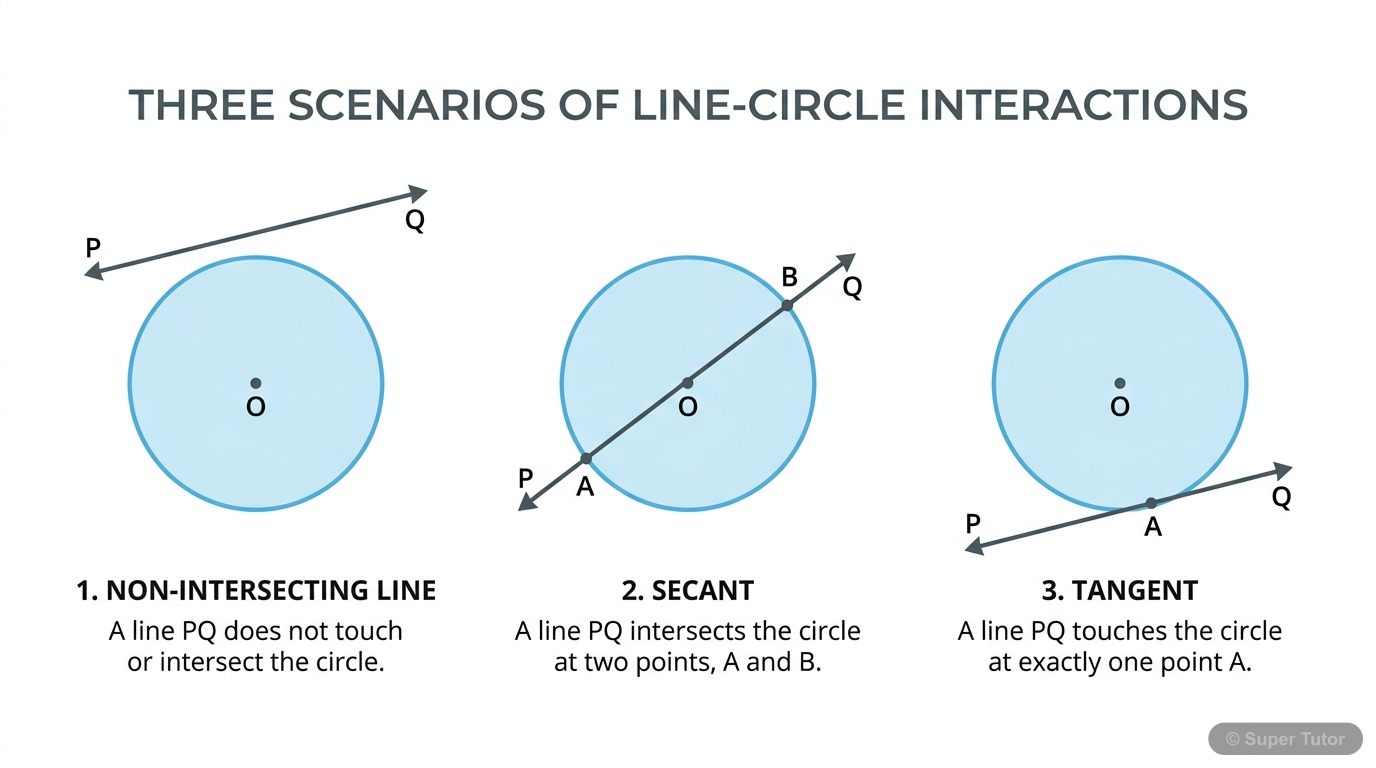
An illustration comparing the three possible positions of a line relative to a circle: non-intersecting, secant, and tangent.
Super Tutor

Super Tutor has 6+ illustrations like this for Circles alone — flashcards, concept maps, and step-by-step visuals.

See them all
17 Questions Solved · 2 Sections

EXERCISE 10.1

1How many tangents can a circle have?Show solution
A circle can have infinitely many tangents.

Reason: At every point on the circumference of a circle, a unique tangent can be drawn. Since a circle has infinitely many points on it, infinitely many tangents can be drawn to a circle.
2Fill in the blanks:
(i) A tangent to a circle intersects it in __________ point(s).
(ii) A line intersecting a circle in two points is called a __________.
(iii) A circle can have __________ parallel tangents at the most.
(iv) The common point of a tangent to a circle and the circle is called __________.
Show solution
(i) A tangent to a circle intersects it in one point.

Reason: By definition, a tangent touches the circle at exactly one point (the point of contact).

(ii) A line intersecting a circle in two points is called a secant.

Reason: A secant cuts the circle at two distinct points.

(iii) A circle can have two parallel tangents at the most.

Reason: Only two parallel tangents are possible — one at each end of a diameter (i.e., at diametrically opposite points).

(iv) The common point of a tangent to a circle and the circle is called the point of contact (or point of tangency).

Reason: The single point where the tangent meets the circle is defined as the point of contact.
3A tangent PQ at a point P of a circle of radius 5 cm meets a line through the centre O at a point Q so that OQ = 12 cm. Length PQ is:
(A) 12 cm (B) 13 cm (C) 8.5 cm (D) 119\sqrt{119} cm.
Show solution
Correct Option: (D) 119\sqrt{119} cm

Given:
- Radius OP=5OP = 5 cm
- OQ=12OQ = 12 cm
- PQ is a tangent at P

Concept used: The tangent at any point of a circle is perpendicular to the radius through the point of contact.

Therefore, OPPQOP \perp PQ, which means OPQ=90°\angle OPQ = 90°.

Applying Pythagoras Theorem in right OPQ\triangle OPQ:
OQ2=OP2+PQ2OQ^2 = OP^2 + PQ^2
122=52+PQ212^2 = 5^2 + PQ^2
144=25+PQ2144 = 25 + PQ^2
PQ2=14425=119PQ^2 = 144 - 25 = 119
PQ=119 cm\boxed{PQ = \sqrt{119} \text{ cm}}
4Draw a circle and two lines parallel to a given line such that one is a tangent and the other, a secant to the circle.Show solution
Construction Steps:

1. Draw a circle with centre O and any radius.
2. Draw a given line ll (for reference direction).
3. Draw a line mm parallel to ll such that it touches the circle at exactly one point — this is the tangent to the circle.
4. Draw another line nn parallel to ll (and to mm) such that it intersects the circle at two distinct points — this is the secant to the circle.

Observation:
- Line mm (tangent): touches the circle at one point only.
- Line nn (secant): intersects the circle at two points.
- Both mm and nn are parallel to the given line ll.

EXERCISE 10.2

1From a point Q, the length of the tangent to a circle is 24 cm and the distance of Q from the centre is 25 cm. The radius of the circle is
(A) 7 cm (B) 12 cm (C) 15 cm (D) 24.5 cm
Show solution
Correct Option: (A) 7 cm

Given:
- Length of tangent =QT=24= QT = 24 cm
- Distance from centre =OQ=25= OQ = 25 cm
- Let radius =OT=r= OT = r

Concept: The tangent is perpendicular to the radius at the point of contact, so OTQ=90°\angle OTQ = 90°.

Applying Pythagoras Theorem in right OTQ\triangle OTQ:
OQ2=OT2+QT2OQ^2 = OT^2 + QT^2
252=r2+24225^2 = r^2 + 24^2
625=r2+576625 = r^2 + 576
r2=625576=49r^2 = 625 - 576 = 49
r=7 cm\boxed{r = 7 \text{ cm}}
2In Fig. 10.11, if TP and TQ are the two tangents to a circle with centre O so that POQ=110°\angle POQ = 110°, then PTQ\angle PTQ is equal to
(A) 60° (B) 70° (C) 80° (D) 90°
Show solution
Correct Option: (B) 70°

Given:
- TP and TQ are tangents from external point T
- POQ=110°\angle POQ = 110°

Concept: The tangent is perpendicular to the radius at the point of contact.

Therefore:
OPT=90°andOQT=90°\angle OPT = 90° \quad \text{and} \quad \angle OQT = 90°

In quadrilateral OPTQ, the sum of all angles =360°= 360°:
PTQ+OPT+POQ+OQT=360°\angle PTQ + \angle OPT + \angle POQ + \angle OQT = 360°
PTQ+90°+110°+90°=360°\angle PTQ + 90° + 110° + 90° = 360°
PTQ+290°=360°\angle PTQ + 290° = 360°
PTQ=70°\boxed{\angle PTQ = 70°}
3If tangents PA and PB from a point P to a circle with centre O are inclined to each other at angle of 80°, then POA\angle POA is equal to
(A) 50° (B) 60° (C) 70° (D) 80°
Show solution
Correct Option: (A) 50°

Given:
- PA and PB are tangents from external point P
- APB=80°\angle APB = 80°

Concept: The tangent is perpendicular to the radius at the point of contact, so OAP=90°\angle OAP = 90°.

Also, by symmetry (tangents from an external point are equal), OP bisects APB\angle APB:
APO=APB2=80°2=40°\angle APO = \frac{\angle APB}{2} = \frac{80°}{2} = 40°

In right OAP\triangle OAP:
POA+OAP+APO=180°\angle POA + \angle OAP + \angle APO = 180°
POA+90°+40°=180°\angle POA + 90° + 40° = 180°
POA=180°130°\angle POA = 180° - 130°
POA=50°\boxed{\angle POA = 50°}
4Prove that the tangents drawn at the ends of a diameter of a circle are parallel.Show solution
Given: A circle with centre O and diameter AB. Tangents PQPQ and RSRS are drawn at points A and B respectively.

To Prove: PQRSPQ \parallel RS

Proof:

Since PQPQ is a tangent to the circle at point A, and OA is the radius:
OAPQ    OAP=90°...(1)OA \perp PQ \implies \angle OAP = 90° \quad \text{...(1)}

Since RSRS is a tangent to the circle at point B, and OB is the radius:
OBRS    OBR=90°...(2)OB \perp RS \implies \angle OBR = 90° \quad \text{...(2)}

From (1) and (2):
OAP=OBR=90°\angle OAP = \angle OBR = 90°

But OAP\angle OAP and OBR\angle OBR are alternate interior angles formed when the transversal AB cuts lines PQ and RS.

Since alternate interior angles are equal:
PQRS\boxed{PQ \parallel RS}

Hence proved.
5Prove that the perpendicular at the point of contact to the tangent to a circle passes through the centre.Show solution
Given: A circle with centre O. XY is a tangent to the circle at point P. A line ll is drawn perpendicular to XY at P.

To Prove: The line ll passes through the centre O.

Proof (by contradiction):

Assume that the perpendicular to XY at P does not pass through O.

Let the perpendicular at P meet some other point O′ (not the centre O).

Then OPXYO'P \perp XY.

But we know by the theorem that the tangent at any point of a circle is perpendicular to the radius through the point of contact.

Therefore, OPXYOP \perp XY.

This means both OPO'P and OPOP are perpendicular to XYXY at the same point P.

But through a given point, only one perpendicular can be drawn to a given line.

This is a contradiction.

Therefore, our assumption is wrong.

Hence, the perpendicular to the tangent XY at the point of contact P must pass through the centre O.

Hence proved.
6The length of a tangent from a point A at distance 5 cm from the centre of the circle is 4 cm. Find the radius of the circle.Show solution
Given:
- Distance of point A from centre O: OA=5OA = 5 cm
- Length of tangent from A: AB=4AB = 4 cm
- Let radius =OB=r= OB = r

Concept: The tangent is perpendicular to the radius at the point of contact.

So OBA=90°\angle OBA = 90°.

Applying Pythagoras Theorem in right OBA\triangle OBA:
OA2=OB2+AB2OA^2 = OB^2 + AB^2
52=r2+425^2 = r^2 + 4^2
25=r2+1625 = r^2 + 16
r2=2516=9r^2 = 25 - 16 = 9
r=3 cm\boxed{r = 3 \text{ cm}}

The radius of the circle is 3 cm.
7Two concentric circles are of radii 5 cm and 3 cm. Find the length of the chord of the larger circle which touches the smaller circle.Show solution
Given:
- Radius of larger circle =R=5= R = 5 cm
- Radius of smaller circle =r=3= r = 3 cm
- Let AB be a chord of the larger circle that is tangent to the smaller circle.

Let O be the common centre, and let the chord AB touch the smaller circle at point P.

Concept: The radius to the point of tangency is perpendicular to the tangent.

So OPABOP \perp AB, which means OPA=90°\angle OPA = 90°.

Also, since the perpendicular from the centre bisects the chord:
AP=PBAP = PB

In right OPA\triangle OPA:
OA2=OP2+AP2OA^2 = OP^2 + AP^2
52=32+AP25^2 = 3^2 + AP^2
25=9+AP225 = 9 + AP^2
AP2=16AP^2 = 16
AP=4 cmAP = 4 \text{ cm}

Length of chord:
AB=2×AP=2×4=8 cmAB = 2 \times AP = 2 \times 4 = \boxed{8 \text{ cm}}
8A quadrilateral ABCD is drawn to circumscribe a circle (see Fig. 10.12). Prove that AB+CD=AD+BCAB + CD = AD + BC.Show solution
Given: Quadrilateral ABCD circumscribes a circle. The circle touches sides AB, BC, CD and DA at points P, Q, R and S respectively.

To Prove: AB+CD=AD+BCAB + CD = AD + BC

Proof:

We know that tangent segments drawn from an external point to a circle are equal in length.

From vertex A: AP=ASAP = AS ...(1)

From vertex B: BP=BQBP = BQ ...(2)

From vertex C: CQ=CRCQ = CR ...(3)

From vertex D: DR=DSDR = DS ...(4)

Adding (1), (2), (3) and (4):
AP+BP+CQ+DR=AS+BQ+CR+DSAP + BP + CQ + DR = AS + BQ + CR + DS

(AP+BP)+(CQ+DR)=(AS+DS)+(BQ+CR)(AP + BP) + (CQ + DR) = (AS + DS) + (BQ + CR)

AB+CD=AD+BCAB + CD = AD + BC

Hence proved.
9In Fig. 10.13, XY and X′Y′ are two parallel tangents to a circle with centre O and another tangent AB with point of contact C intersecting XY at A and X′Y′ at B. Prove that AOB=90°\angle AOB = 90°.Show solution
Given:
- XY and X′Y′ are two parallel tangents to a circle with centre O, touching at P and Q respectively.
- AB is a third tangent touching the circle at C, meeting XY at A and X′Y′ at B.

To Prove: AOB=90°\angle AOB = 90°

Proof:

Join OA, OB, and OC.

In OAP\triangle OAP and OAC\triangle OAC:
- AP=ACAP = AC (tangents from external point A are equal)
- OA=OAOA = OA (common)
- OP=OCOP = OC (radii)

By SSS congruence: OAPOAC\triangle OAP \cong \triangle OAC

Therefore: POA=COA\angle POA = \angle COA

So OA bisects POC\angle POC:
POA=COA=12POC...(1)\angle POA = \angle COA = \frac{1}{2}\angle POC \quad \text{...(1)}

Similarly, in OBQ\triangle OBQ and OBC\triangle OBC:
- BQ=BCBQ = BC (tangents from external point B are equal)
- OB=OBOB = OB (common)
- OQ=OCOQ = OC (radii)

By SSS congruence: OBQOBC\triangle OBQ \cong \triangle OBC

Therefore: QOB=COB\angle QOB = \angle COB

So OB bisects QOC\angle QOC:
QOB=COB=12QOC...(2)\angle QOB = \angle COB = \frac{1}{2}\angle QOC \quad \text{...(2)}

Now, since XY \parallel X′Y′ and PQ is a transversal (a diameter):
POQ=180°(P and Q are ends of a diameter, as XY ∥ X’Y’)\angle POQ = 180° \quad \text{(P and Q are ends of a diameter, as XY ∥ X'Y')}

From (1) and (2):
AOB=COA+COB=12POC+12QOC\angle AOB = \angle COA + \angle COB = \frac{1}{2}\angle POC + \frac{1}{2}\angle QOC
=12(POC+QOC)=12×POQ=12×180°=90°= \frac{1}{2}(\angle POC + \angle QOC) = \frac{1}{2} \times \angle POQ = \frac{1}{2} \times 180° = 90°

AOB=90°\boxed{\angle AOB = 90°}

Hence proved.
10Prove that the angle between the two tangents drawn from an external point to a circle is supplementary to the angle subtended by the line-segment joining the points of contact at the centre.Show solution
Given: PA and PB are two tangents from external point P to a circle with centre O. A and B are the points of contact.

To Prove: APB+AOB=180°\angle APB + \angle AOB = 180°

Proof:

Since PA is a tangent at A:
OAPA    OAP=90°...(1)OA \perp PA \implies \angle OAP = 90° \quad \text{...(1)}

Since PB is a tangent at B:
OBPB    OBP=90°...(2)OB \perp PB \implies \angle OBP = 90° \quad \text{...(2)}

In quadrilateral OAPB, the sum of all angles =360°= 360°:
OAP+APB+OBP+AOB=360°\angle OAP + \angle APB + \angle OBP + \angle AOB = 360°

Substituting from (1) and (2):
90°+APB+90°+AOB=360°90° + \angle APB + 90° + \angle AOB = 360°
APB+AOB=360°180°\angle APB + \angle AOB = 360° - 180°
APB+AOB=180°\boxed{\angle APB + \angle AOB = 180°}

Hence, the angle between the two tangents is supplementary to the angle subtended by the line-segment joining the points of contact at the centre.

Hence proved.
11Prove that the parallelogram circumscribing a circle is a rhombus.Show solution
Given: A parallelogram ABCD circumscribes a circle with centre O. The circle touches sides AB, BC, CD and DA at points P, Q, R and S respectively.

To Prove: ABCD is a rhombus, i.e., AB=BC=CD=DAAB = BC = CD = DA.

Proof:

We know that tangent segments from an external point are equal.

From vertex A: AP=ASAP = AS ...(1)

From vertex B: BP=BQBP = BQ ...(2)

From vertex C: CQ=CRCQ = CR ...(3)

From vertex D: DR=DSDR = DS ...(4)

Adding all four:
(AP+BP)+(CQ+DR)=(AS+DS)+(BQ+CR)(AP + BP) + (CQ + DR) = (AS + DS) + (BQ + CR)
AB+CD=AD+BC...(5)AB + CD = AD + BC \quad \text{...(5)}

Since ABCD is a parallelogram:
AB=CDandAD=BC...(6)AB = CD \quad \text{and} \quad AD = BC \quad \text{...(6)}

Substituting (6) into (5):
AB+AB=AD+ADAB + AB = AD + AD
2AB=2AD2AB = 2AD
AB=ADAB = AD

Since AB=CDAB = CD and AD=BCAD = BC (opposite sides of parallelogram), and AB=ADAB = AD:
AB=BC=CD=DAAB = BC = CD = DA

Therefore, ABCD is a rhombus.

Hence proved.
12A triangle ABC is drawn to circumscribe a circle of radius 4 cm such that the segments BD and DC into which BC is divided by the point of contact D are of lengths 8 cm and 6 cm respectively (see Fig. 10.14). Find the sides AB and AC.Show solution
Given:
- Circle of radius 4 cm inscribed in ABC\triangle ABC
- BD=8BD = 8 cm, DC=6DC = 6 cm
- Let the circle touch AB at E and AC at F

Using the property that tangent segments from an external point are equal:

From B: BE=BD=8BE = BD = 8 cm ...(1)

From C: CF=CD=6CF = CD = 6 cm ...(2)

From A: AE=AF=xAE = AF = x (say) ...(3)

So the sides are:
BC=BD+DC=8+6=14 cmBC = BD + DC = 8 + 6 = 14 \text{ cm}
AB=AE+EB=x+8AB = AE + EB = x + 8
AC=AF+FC=x+6AC = AF + FC = x + 6

Finding x using the area method:

Let ss be the semi-perimeter:
s=AB+BC+CA2=(x+8)+14+(x+6)2=2x+282=x+14s = \frac{AB + BC + CA}{2} = \frac{(x+8) + 14 + (x+6)}{2} = \frac{2x + 28}{2} = x + 14

Area of ABC\triangle ABC using Heron's formula:
sAB=(x+14)(x+8)=6s - AB = (x+14) - (x+8) = 6
sBC=(x+14)14=xs - BC = (x+14) - 14 = x
sCA=(x+14)(x+6)=8s - CA = (x+14) - (x+6) = 8

Area=s(sa)(sb)(sc)=(x+14)(6)(x)(8)=48x(x+14)\text{Area} = \sqrt{s(s-a)(s-b)(s-c)} = \sqrt{(x+14)(6)(x)(8)} = \sqrt{48x(x+14)}

Also, Area == inradius ×\times semi-perimeter:
Area=r×s=4×(x+14)\text{Area} = r \times s = 4 \times (x+14)

Equating both expressions:
4(x+14)=48x(x+14)4(x+14) = \sqrt{48x(x+14)}

Squaring both sides:
16(x+14)2=48x(x+14)16(x+14)^2 = 48x(x+14)
16(x+14)=48x16(x+14) = 48x
x+14=3xx + 14 = 3x
14=2x14 = 2x
x=7 cmx = 7 \text{ cm}

Therefore:
AB=x+8=7+8=15 cmAB = x + 8 = 7 + 8 = \boxed{15 \text{ cm}}
AC=x+6=7+6=13 cmAC = x + 6 = 7 + 6 = \boxed{13 \text{ cm}}
13Prove that opposite sides of a quadrilateral circumscribing a circle subtend supplementary angles at the centre of the circle.Show solution
Given: A quadrilateral ABCD circumscribes a circle with centre O. The circle touches AB, BC, CD and DA at P, Q, R and S respectively.

To Prove:
AOB+COD=180°andAOD+BOC=180°\angle AOB + \angle COD = 180° \quad \text{and} \quad \angle AOD + \angle BOC = 180°

Proof:

Join OP, OQ, OR and OS.

In OAP\triangle OAP and OAS\triangle OAS:
- AP=ASAP = AS (tangents from A)
- OP=OSOP = OS (radii)
- OA=OAOA = OA (common)

By SSS: OAPOAS\triangle OAP \cong \triangle OAS

AOP=AOS=1 (say)\Rightarrow \angle AOP = \angle AOS = \angle 1 \text{ (say)}

Similarly:
- BOP=BOQ=2\angle BOP = \angle BOQ = \angle 2
- COQ=COR=3\angle COQ = \angle COR = \angle 3
- DOR=DOS=4\angle DOR = \angle DOS = \angle 4

Since the sum of all angles around O is 360°360°:
21+22+23+24=360°2\angle 1 + 2\angle 2 + 2\angle 3 + 2\angle 4 = 360°
1+2+3+4=180°...(i)\angle 1 + \angle 2 + \angle 3 + \angle 4 = 180° \quad \text{...(i)}

Now:
AOB+COD=(1+2)+(3+4)\angle AOB + \angle COD = (\angle 1 + \angle 2) + (\angle 3 + \angle 4)
=(1+2+3+4)=180°[from (i)]= (\angle 1 + \angle 2 + \angle 3 + \angle 4) = 180° \quad \text{[from (i)]}

Also:
AOD+BOC=(1+4)+(2+3)\angle AOD + \angle BOC = (\angle 1 + \angle 4) + (\angle 2 + \angle 3)
=(1+2+3+4)=180°[from (i)]= (\angle 1 + \angle 2 + \angle 3 + \angle 4) = 180° \quad \text{[from (i)]}

Hence, opposite sides of a quadrilateral circumscribing a circle subtend supplementary angles at the centre.

Hence proved.

Stuck on a step?

Ask Super Tutor AI to explain any solution on this page in a simpler way — free, 24x7.

Ask a Doubt Free

Frequently Asked Questions

What are the important topics in Circles for Madhya Pradesh Board Class 10 Mathematics?
Circles covers several key topics that are frequently asked in Madhya Pradesh Board Class 10 board exams. Focus on the core concepts listed on this page and practise related questions to build confidence.
How to score full marks in Circles — Madhya Pradesh Board Class 10 Mathematics?
Understand the core concepts first, then work through the 67 practice questions available for this chapter. Revise formulas and definitions regularly, and use flashcards for quick recall before the exam.
Where can I get free NCERT Solutions for Circles Class 10 Mathematics?
This page has free step-by-step NCERT Solutions for every exercise question in Circles (Madhya Pradesh Board Class 10 Mathematics) — written the way examiners award marks: given, formula, working, answer.

Sources & Official References

Content is aligned to the official syllabus. Refer to the board website for the latest curriculum.

For serious students

Get the full Circles chapter — for free.

Quizzes, flashcards, AI doubt-solver and a step-by-step study plan for Madhya Pradesh Board Class 10 Mathematics.