Triangles — NCERT Solutions
Madhya Pradesh Board · Class 10 · Mathematics
NCERT Solutions for Triangles, Madhya Pradesh Board Class 10 Mathematics: 29 textbook questions solved step by step.
Interactive on Super Tutor
Studying Triangles? Get the full interactive chapter.
Quizzes, flashcards, AI doubt-solver and a step-by-step study plan — built for NCERT solutions and more.
Free trial, no card needed.
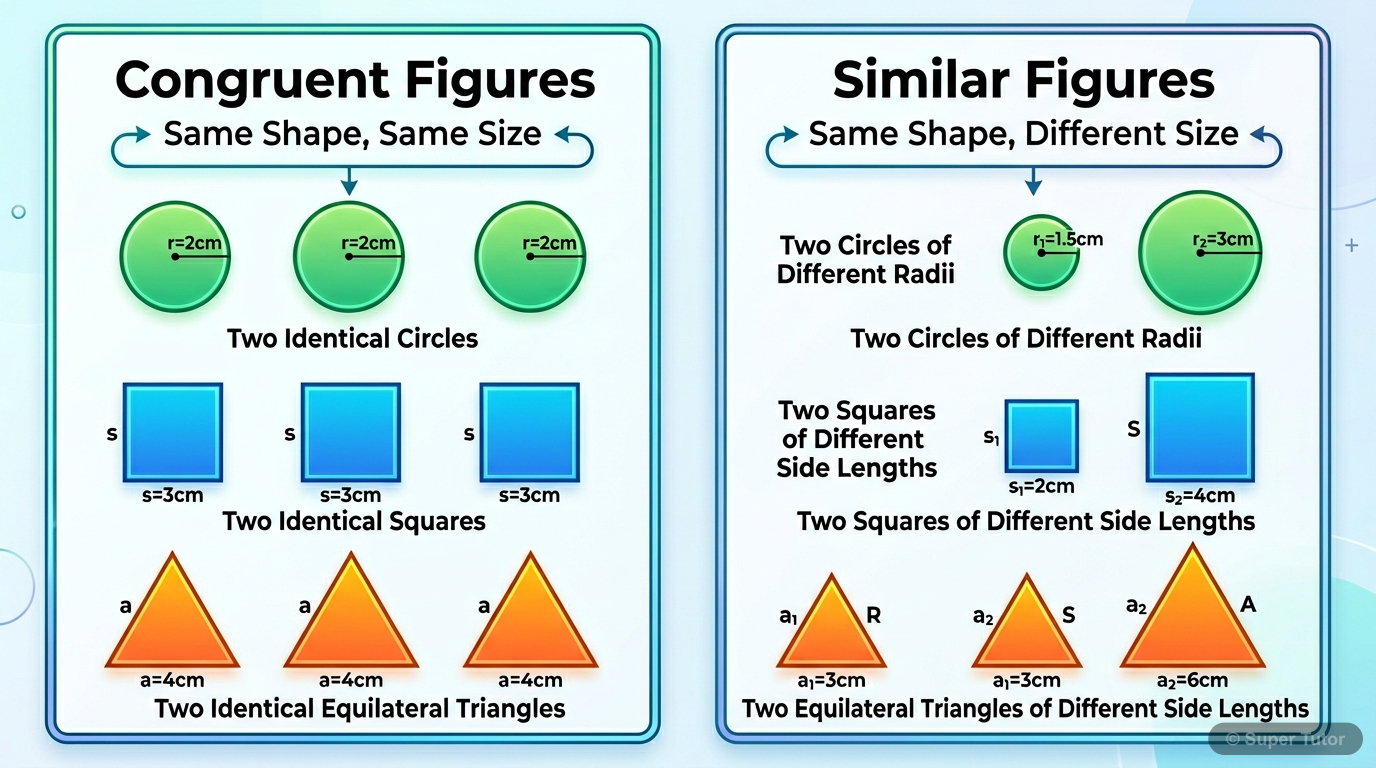
Learn better with visuals Super Tutor pairs illustrations like this with notes and quizzes for Triangles.
The first 15 solutions are open to read. The other 14 are free with a Super Tutor account.
Exercise 6.1
1Fill in the blanks using the correct word given in brackets:
(i) All circles are ______. (congruent, similar)
(ii) All squares are ______. (similar, congruent)
(iii) All ______ triangles are similar. (isosceles, equilateral)
(iv) Two polygons of the same number of sides are similar, if (a) their corresponding angles are ______ and (b) their corresponding sides are ______. (equal, proportional)Show solution
(i) All circles are similar.
Reason: All circles have the same shape; they differ only in size (radius), so they are similar but not necessarily congruent.
(ii) All squares are similar.
Reason: All squares have all angles equal to 90° and all sides in the same ratio (1:1 for any two squares scaled appropriately), so they are always similar.
(iii) All equilateral triangles are similar.
Reason: In every equilateral triangle each angle is 60°, so all equilateral triangles have equal corresponding angles and are therefore similar by AAA criterion.
(iv) Two polygons of the same number of sides are similar, if
(a) their corresponding angles are equal and
(b) their corresponding sides are proportional.
2Give two different examples of pair of
(i) similar figures.
(ii) non-similar figures.Show solution
(i) Examples of similar figures:
- Any two circles (e.g., a circle of radius 3 cm and a circle of radius 5 cm).
- Any two equilateral triangles (e.g., an equilateral triangle with side 4 cm and another with side 7 cm).
(ii) Examples of non-similar figures:
- A rectangle of dimensions 2 cm × 4 cm and a rectangle of dimensions 2 cm × 6 cm (corresponding sides are not proportional: ).
- A right-angled triangle and an equilateral triangle (corresponding angles are not equal).
3State whether the following quadrilaterals are similar or not (referring to Fig. 6.8 — a square and a rectangle/rhombus shown).Show solution
Given: Two quadrilaterals are shown in Fig. 6.8. From the figure, one appears to be a square and the other a rectangle (or a rhombus), with sides in different proportions.
Condition for similarity of polygons:
Two polygons are similar if and only if
(a) their corresponding angles are equal, AND
(b) their corresponding sides are proportional.
Analysis:
For the quadrilaterals in Fig. 6.8, although both may have all right angles (if one is a square and the other a rectangle), their corresponding sides are not proportional (a square has all sides equal while a rectangle has unequal adjacent sides). Alternatively, if one is a rhombus, the angles are not all equal to 90°.
Conclusion: The two quadrilaterals shown in Fig. 6.8 are not similar, because even though corresponding angles may be equal, their corresponding sides are not proportional (or vice versa). Both conditions must hold simultaneously for similarity.
Exercise 6.2
1In Fig. 6.17, (i) and (ii), DE ∥ BC. Find EC in (i) and AD in (ii).Show solution
Case (i): Given DE ∥ BC, AD = 1.5 cm, DB = 3 cm, AE = 1 cm. Find EC.
Concept used: Basic Proportionality Theorem (BPT / Thales' Theorem): If a line is drawn parallel to one side of a triangle, it divides the other two sides in the same ratio.
Case (ii): Given DE ∥ BC, DB = 7.2 cm, AE = 1.8 cm, EC = 5.4 cm. Find AD.
Using BPT:
2E and F are points on the sides PQ and PR respectively of a ΔPQR. For each of the following cases, state whether EF ∥ QR:
(i) PE = 3.9 cm, EQ = 3 cm, PF = 3.6 cm and FR = 2.4 cm
(ii) PE = 4 cm, QE = 4.5 cm, PF = 8 cm and RF = 9 cm
(iii) PQ = 1.28 cm, PR = 2.56 cm, PE = 0.18 cm and PF = 0.36 cmShow solution
Concept: By the converse of BPT, EF ∥ QR if and only if .
(i) PE = 3.9 cm, EQ = 3 cm, PF = 3.6 cm, FR = 2.4 cm
Since , EF is not parallel to QR.
(ii) PE = 4 cm, QE = 4.5 cm, PF = 8 cm, RF = 9 cm
Since , EF ∥ QR.
(iii) PQ = 1.28 cm, PR = 2.56 cm, PE = 0.18 cm, PF = 0.36 cm
First find EQ and FR:
Since , EF ∥ QR.
3In Fig. 6.18, if LM ∥ CB and LN ∥ CD, prove that .Show solution
Given: In the figure, LM ∥ CB and LN ∥ CD.
To prove:
Proof:
In , LM ∥ CB (given).
By Basic Proportionality Theorem:
This can be rewritten as:
In , LN ∥ CD (given).
By Basic Proportionality Theorem:
This can be rewritten as:
From (2) and (4):
Hence proved.
4In Fig. 6.19, DE ∥ AC and DF ∥ AE. Prove that .Show solution
Given: In , DE ∥ AC and DF ∥ AE.
To prove:
Proof:
Step 1: In , DE ∥ AC (given).
By Basic Proportionality Theorem:
Step 2: In , DF ∥ AE (given).
By Basic Proportionality Theorem:
Step 3: From (1) and (2):
Hence proved.
5In Fig. 6.20, DE ∥ OQ and DF ∥ OR. Show that EF ∥ QR.Show solution
Given: In the figure, DE ∥ OQ and DF ∥ OR (where E is on PQ and F is on PR, D is on PO).
To prove: EF ∥ QR
Proof:
Step 1: In , DE ∥ OQ (given).
By Basic Proportionality Theorem:
Step 2: In , DF ∥ OR (given).
By Basic Proportionality Theorem:
Step 3: From (1) and (2):
Step 4: In , E is on PQ and F is on PR such that .
By the Converse of Basic Proportionality Theorem:
Hence proved.
6In Fig. 6.21, A, B and C are points on OP, OQ and OR respectively such that AB ∥ PQ and AC ∥ PR. Show that BC ∥ QR.Show solution
Given: A is on OP, B is on OQ, C is on OR; AB ∥ PQ and AC ∥ PR.
To prove: BC ∥ QR
Proof:
Step 1: In , AB ∥ PQ (given).
By Basic Proportionality Theorem:
Step 2: In , AC ∥ PR (given).
By Basic Proportionality Theorem:
Step 3: From (1) and (2):
Step 4: In , B is on OQ and C is on OR such that .
By the Converse of Basic Proportionality Theorem:
Hence proved.
7Using Theorem 6.1, prove that a line drawn through the mid-point of one side of a triangle parallel to another side bisects the third side.Show solution
Given: In , D is the mid-point of AB and DE ∥ BC, where E is a point on AC.
To prove: E is the mid-point of AC, i.e., AE = EC.
Theorem 6.1 (BPT): If a line is drawn parallel to one side of a triangle to intersect the other two sides in distinct points, then the other two sides are divided in the same ratio.
Proof:
In , DE ∥ BC (given).
By Theorem 6.1 (BPT):
Since D is the mid-point of AB:
From (1) and (2):
Therefore, E is the mid-point of AC.
Hence proved.
8Using Theorem 6.2, prove that the line joining the mid-points of any two sides of a triangle is parallel to the third side.Show solution
Given: In , D and E are mid-points of AB and AC respectively.
To prove: DE ∥ BC.
Theorem 6.2 (Converse of BPT): If a line divides any two sides of a triangle in the same ratio, then the line is parallel to the third side.
Proof:
Since D is the mid-point of AB:
Since E is the mid-point of AC:
From (1) and (2):
By Theorem 6.2 (Converse of BPT), DE ∥ BC.
Hence proved.
9ABCD is a trapezium in which AB ∥ DC and its diagonals intersect each other at the point O. Show that .Show solution
Given: ABCD is a trapezium with AB ∥ DC. Diagonals AC and BD intersect at O.
To prove:
Construction: Draw EF through O parallel to AB (and DC), meeting AD at E and BC at F.
Proof:
In , EO ∥ AB (by construction).
By BPT:
In , OF ∥ AB (by construction).
By BPT:
Alternative direct approach:
In and :
- (vertically opposite angles)
- (alternate interior angles, since AB ∥ DC)
- (alternate interior angles, since AB ∥ DC)
Therefore, (by AAA similarity criterion).
Hence:
This gives:
Hence proved.
10The diagonals of a quadrilateral ABCD intersect each other at the point O such that . Show that ABCD is a trapezium.Show solution
Given: Diagonals AC and BD of quadrilateral ABCD intersect at O such that .
To prove: ABCD is a trapezium, i.e., AB ∥ DC.
Construction: Draw EO ∥ AB through O, meeting AD at E.
Proof:
Step 1: Given:
Step 2: In , EO ∥ AB (by construction).
By BPT:
Step 3: In , consider the line through O.
From (1): , i.e., .
In , EO ∥ AB gives .
Now in : (from given condition rearranged).
So .
By converse of BPT in , EO ∥ DC.
But EO ∥ AB (by construction).
Therefore AB ∥ DC.
Since AB ∥ DC, quadrilateral ABCD is a trapezium.
Hence proved.
Exercise 6.3
1State which pairs of triangles in Fig. 6.34 are similar. Write the similarity criterion used by you for answering the question and also write the pairs of similar triangles in the symbolic form.Show solution
Note: The figures show several pairs of triangles with given angles and/or sides. Based on the standard NCERT Fig. 6.34, the pairs are analysed as follows:
(i) In the two triangles, the angles given are 40°, 60°, 80° in one and 40°, 60°, 80° in the other.
Since all three corresponding angles are equal:
(ii) In the two triangles, sides are given as:
Triangle 1: sides 2, 2, 2 (or proportional sides)
Triangle 2: sides 4, 4, 4
(iii) In the two triangles, two sides are proportional and the included angle is equal.
(iv) In the two triangles, angles given are 70°, 80° in one and 70°, 30° in the other. The third angles are: and . So corresponding angles match.
(v) The sides given are not proportional and angles are not equal, so the triangles are not similar.
(vi) In the two triangles, angles given are 70°, 80° in one and 70°, 80° in the other (with the equal angles at corresponding vertices).
Summary:
- Pairs (i), (ii), (iii), (iv), (vi) are similar by AAA, SSS, SAS, AA, AA criteria respectively.
- Pair (v) is not similar.
2In Fig. 6.35, ΔODC ∼ ΔOBA, ∠BOC = 125° and ∠CDO = 70°. Find ∠DOC, ∠DCO and ∠OAB.Show solution
Given: , , .
Step 1: Find ∠DOC
and are supplementary (they form a linear pair on line DB):
Step 2: Find ∠DCO
In :
Step 3: Find ∠OAB
Since , corresponding angles are equal:
Therefore:
Answers:
Free with a Super Tutor account
Free with a Super Tutor account
Free with a Super Tutor account
Free with a Super Tutor account
(i) ΔAEP ∼ ΔCDP
(ii) ΔABD ∼ ΔCBE
(iii) ΔAEP ∼ ΔADB
(iv) ΔPDC ∼ ΔBEC
Free with a Super Tutor account
Free with a Super Tutor account
(i) ΔABC ∼ ΔAMP
(ii)
Free with a Super Tutor account
(i)
(ii) ΔDCB ∼ ΔHGE
(iii) ΔDCA ∼ ΔHGF
Free with a Super Tutor account
Free with a Super Tutor account
Free with a Super Tutor account
Free with a Super Tutor account
Free with a Super Tutor account
Free with a Super Tutor account
Free with a Super Tutor account
14 more solved questions in Triangles
They are free with a Super Tutor account, along with practice quizzes and flashcards for this chapter. Free to start, no card needed.
Frequently Asked Questions
What are the important topics in Triangles for Madhya Pradesh Board Class 10 Mathematics?
Are these NCERT Solutions for Triangles free?
How should I revise Triangles for the Madhya Pradesh Board Class 10 board exam?
Sources & Official References
Content is aligned to the official syllabus. Refer to the board website for the latest curriculum.
More resources for Triangles
Practice Quiz
Test yourself with a quick quiz
Important Questions
Exam-style questions with answers
Revision Notes
Key points for last-minute revision
Formula Sheet
The chapter's formulas in one place
Chapter Summary
Understand the chapter at a glance
Concept Maps
See how topics connect
Study Plan
Step-by-step plan for this chapter
Flashcards
Quick-fire cards for active recall
Syllabus
What topics to cover
For serious students
Get the full Triangles chapter — start free.
Quizzes, flashcards, an AI doubt solver and a study plan for Madhya Pradesh Board Class 10 Mathematics. Free to start, no card needed.