Introduction to Trigonometry — NCERT Solutions
Madhya Pradesh Board · Class 10 · Mathematics
NCERT Solutions for Introduction to Trigonometry, Madhya Pradesh Board Class 10 Mathematics: 28 textbook questions solved step by step.
Interactive on Super Tutor
Studying Introduction to Trigonometry? Get the full interactive chapter.
Quizzes, flashcards, AI doubt-solver and a step-by-step study plan — built for NCERT solutions and more.
Free trial, no card needed.
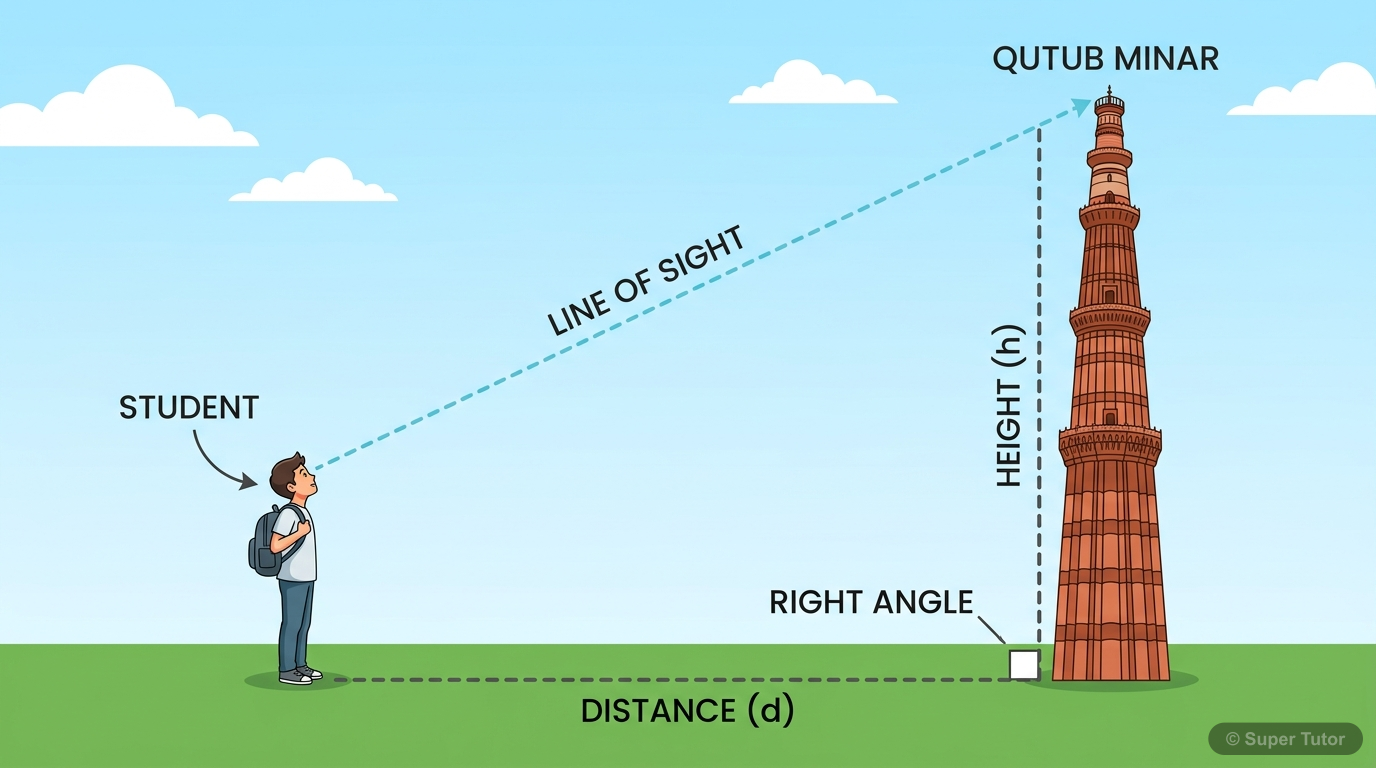
Learn better with visuals Super Tutor pairs illustrations like this with notes and quizzes for Introduction to Trigonometry.
The first 14 solutions are open to read. The other 14 are free with a Super Tutor account.
Exercise 8.1
1In △ABC, right-angled at B, AB = 24 cm, BC = 7 cm. Determine: (i) sin A, cos A (ii) sin C, cos CShow solution
Given: △ABC right-angled at B, AB = 24 cm, BC = 7 cm.
Step 1: Find the hypotenuse AC.
By Pythagoras theorem:
(i) For angle A:
- Side opposite to A = BC = 7 cm
- Side adjacent to A = AB = 24 cm
- Hypotenuse = AC = 25 cm
(ii) For angle C:
- Side opposite to C = AB = 24 cm
- Side adjacent to C = BC = 7 cm
- Hypotenuse = AC = 25 cm
2In Fig. 8.13, find tan P – cot R. (Figure shows △PQR right-angled at Q with PQ = 12 cm, PR = 13 cm.)Show solution
Note: From the figure, △PQR is right-angled at Q with PQ = 12 cm and PR = 13 cm.
Step 1: Find QR using Pythagoras theorem.
Step 2: Calculate tan P and cot R.
(For angle R: opposite = PQ = 12, adjacent = QR = 5, so and .)
Step 3:
3If , calculate cos A and tan A.Show solution
Given:
Step 1: Use the identity .
(Taking positive value since A is acute.)
Step 2: Calculate tan A.
Answer: ,
4Given 15 cot A = 8, find sin A and sec A.Show solution
Given:
Step 1: Construct a right triangle.
Let the side adjacent to A = 8k and side opposite to A = 15k.
Hypotenuse
Step 2: Find sin A and sec A.
Answer: ,
5Given , calculate all other trigonometric ratios.Show solution
Given: , so .
Step 1: Construct a right triangle.
Hypotenuse = 13k, adjacent side = 12k.
Opposite side
Step 2: Write all ratios.
6If ∠A and ∠B are acute angles such that cos A = cos B, then show that ∠A = ∠B.Show solution
Given: ∠A and ∠B are acute angles and .
To prove:
Proof:
Consider a right triangle. Let .
Suppose the triangles have the same hypotenuse (or we can use the ratio argument):
Let and for the same hypotenuse .
Since :
This means the adjacent sides are equal, so the triangles are congruent (by RHS), which gives .
Alternatively (using the fact that cosine is a one-to-one function for acute angles):
For acute angles, is a strictly decreasing function. Therefore, if and both A, B are acute, then:
7If , evaluate: (i) (ii) Show solution
Given:
Step 1: Find sin θ and cos θ.
Opposite = 8k, Adjacent = 7k, Hypotenuse
(i) Using the identity and :
(ii)
8If 3 cot A = 4, check whether or not.Show solution
Given:
Step 1: Find sin A and cos A.
Opposite = 3k, Adjacent = 4k, Hypotenuse = 5k.
Step 2: Calculate LHS.
Step 3: Calculate RHS.
Conclusion: LHS = RHS = . ✓ The equation holds true.
9In triangle ABC, right-angled at B, if , find the value of: (i) sin A cos C + cos A sin C (ii) cos A cos C – sin A sin CShow solution
Given: △ABC right-angled at B, .
Step 1: Find angle A.
Since ∠B = 90°, we have .
Step 2: Write the values.
(i)
(ii)
10In △PQR, right-angled at Q, PR + QR = 25 cm and PQ = 5 cm. Determine the values of sin P, cos P and tan P.Show solution
Given: △PQR right-angled at Q, PR + QR = 25 cm, PQ = 5 cm.
Step 1: Let QR = x, then PR = 25 – x.
By Pythagoras theorem:
So cm and cm.
Step 2: Calculate the ratios.
11State whether the following are true or false. Justify your answer. (i) The value of tan A is always less than 1. (ii) sec A = 12/5 for some value of angle A. (iii) cos A is the abbreviation used for the cosecant of angle A. (iv) cot A is the product of cot and A. (v) sin θ = 4/3 for some angle θ.Show solution
(i) False.
is the ratio of the opposite side to the adjacent side. For example, . So tan A can be greater than, equal to, or less than 1. The statement is False.
(ii) True.
for all acute angles. Since , it is possible for some angle A. The statement is True.
(iii) False.
is the abbreviation for cosine of angle A, not cosecant. Cosecant is abbreviated as (or ). The statement is False.
(iv) False.
is a single trigonometric ratio (cotangent of angle A). It is not the product of some quantity 'cot' and 'A'. The statement is False.
(v) False.
The value of always lies between –1 and 1 (i.e., ). Since , is not possible for any angle . The statement is False.
Exercise 8.2
1Evaluate the following: (i) sin 60° cos 30° + sin 30° cos 60° (ii) 2tan²45° + cos²30° – sin²60° (iii) cos45°/(sec30° + cosec30°) (iv) (sin30° + tan45° – cosec60°)/(sec30° + cos60° + cot45°) (v) (5cos²60° + 4sec²30° – tan²45°)/(sin²30° + cos²30°)Show solution
Standard values used:
(i)
(ii)
(iii)
(iv)
Numerator:
Denominator:
(v)
Denominator (Pythagorean identity)
Numerator
2Choose the correct option and justify your choice: (i) 2tan30°/(1+tan²30°) = ? (ii) (1–tan²45°)/(1+tan²45°) = ? (iii) sin2A = 2sinA is true when A = ? (iv) 2tan30°/(1–tan²30°) = ?Show solution
(i)
Correct option: (A)
(ii)
Correct option: (D) 0
(iii)
This holds when , i.e., .
Correct option: (A)
(iv)
Correct option: (C)
3If tan(A+B) = √3 and tan(A–B) = 1/√3; 0° < A+B ≤ 90°; A > B, find A and B.Show solution
Given: and
Step 1: From :
Step 2: From :
Step 3: Adding (1) and (2):
Step 4: Subtracting (2) from (1):
Answer: ,
Free with a Super Tutor account
Exercise 8.3
Free with a Super Tutor account
Free with a Super Tutor account
Free with a Super Tutor account
Free with a Super Tutor account
Free with a Super Tutor account
Free with a Super Tutor account
Free with a Super Tutor account
Free with a Super Tutor account
Free with a Super Tutor account
Free with a Super Tutor account
Free with a Super Tutor account
Free with a Super Tutor account
Free with a Super Tutor account
14 more solved questions in Introduction to Trigonometry
They are free with a Super Tutor account, along with practice quizzes and flashcards for this chapter. Free to start, no card needed.
Frequently Asked Questions
What are the important topics in Introduction to Trigonometry for Madhya Pradesh Board Class 10 Mathematics?
Are these NCERT Solutions for Introduction to Trigonometry free?
How should I revise Introduction to Trigonometry for the Madhya Pradesh Board Class 10 board exam?
Sources & Official References
Content is aligned to the official syllabus. Refer to the board website for the latest curriculum.
More resources for Introduction to Trigonometry
Practice Quiz
Test yourself with a quick quiz
Important Questions
Exam-style questions with answers
Revision Notes
Key points for last-minute revision
Formula Sheet
The chapter's formulas in one place
Chapter Summary
Understand the chapter at a glance
Concept Maps
See how topics connect
Study Plan
Step-by-step plan for this chapter
Flashcards
Quick-fire cards for active recall
Syllabus
What topics to cover
For serious students
Get the full Introduction to Trigonometry chapter — start free.
Quizzes, flashcards, an AI doubt solver and a study plan for Madhya Pradesh Board Class 10 Mathematics. Free to start, no card needed.