Chapter 9 of 13
NCERT Solutions

Light - Reflection and Refraction

Madhya Pradesh Board · Class 10 · Science

NCERT Solutions for Light - Reflection and Refraction — Madhya Pradesh Board Class 10 Science.

67 questions20 flashcards5 concepts

Interactive on Super Tutor

Studying Light - Reflection and Refraction? Get the full interactive chapter.

Quizzes, flashcards, AI doubt-solver and a step-by-step study plan — built for ncert solutions and more.

1,000+ Class 10 students started this chapter today

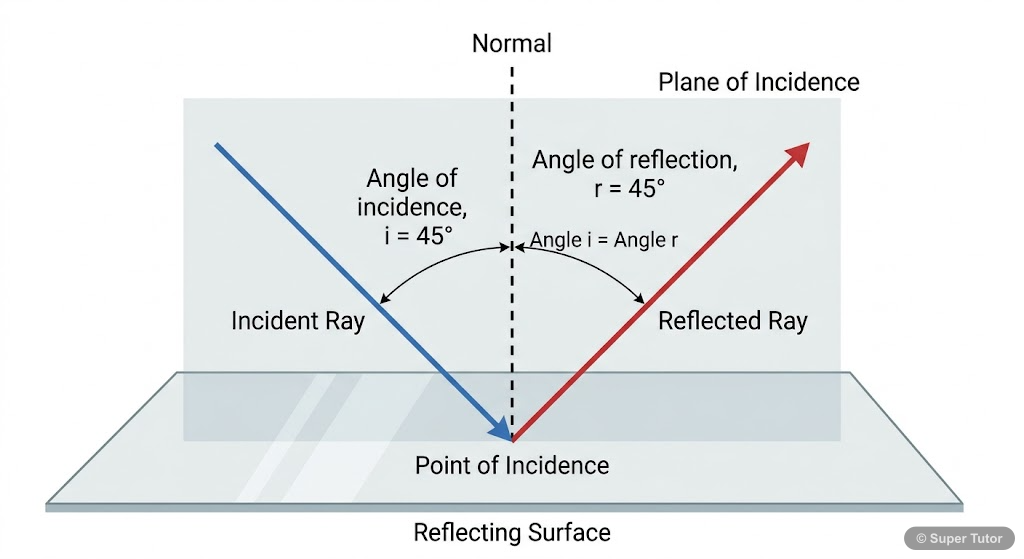
A labeled diagram illustrating the two laws of reflection: the angle of incidence equals the angle of reflection (∠i = ∠r), and the incident ray, reflected ray, and normal all lie in the same plane.
Super Tutor

Super Tutor has 35+ illustrations like this for Light - Reflection and Refraction alone — flashcards, concept maps, and step-by-step visuals.

See them all
20 Questions Solved · 2 Sections

Intext Questions (Before Exercises)

1Define 1 dioptre of power of a lens.Show solution
Definition: 1 dioptre is the power of a lens whose focal length is 1 metre.

Explanation:
The power of a lens is defined as the reciprocal of its focal length in metres:
P=1f(in metres)P = \frac{1}{f(\text{in metres})}

When f=1mf = 1\,\text{m},
P=11m=1DP = \frac{1}{1\,\text{m}} = 1\,\text{D}

Thus, 1 dioptre (1 D) is the power of a lens of focal length 1 metre. Its SI unit is m1\text{m}^{-1}.
2A convex lens forms a real and inverted image of a needle at a distance of 50 cm from it. Where is the needle placed in front of the convex lens if the image is equal to the size of the object? Also, find the power of the lens.Show solution
Given:
- Image distance, v=+50cmv = +50\,\text{cm} (real and inverted, so positive by sign convention)
- Image size = Object size, so magnification m=1m = -1 (real and inverted image of same size)

Step 1: Find object distance using magnification.
m=vum = \frac{v}{u}
1=+50u-1 = \frac{+50}{u}
u=50cmu = -50\,\text{cm}

So the needle is placed 50 cm in front of the lens (i.e., at the centre of curvature / at 2f2f).

Step 2: Find focal length using lens formula.
1v1u=1f\frac{1}{v} - \frac{1}{u} = \frac{1}{f}
1+50150=1f\frac{1}{+50} - \frac{1}{-50} = \frac{1}{f}
150+150=1f\frac{1}{50} + \frac{1}{50} = \frac{1}{f}
250=1f\frac{2}{50} = \frac{1}{f}
f=25cm=0.25mf = 25\,\text{cm} = 0.25\,\text{m}

Step 3: Find power of the lens.
P=1f=10.25m=+4DP = \frac{1}{f} = \frac{1}{0.25\,\text{m}} = +4\,\text{D}

Result: The needle is placed 50 cm in front of the convex lens (at twice the focal length), and the power of the lens is +4D\mathbf{+4\,D}.
3Find the power of a concave lens of focal length 2 m.Show solution
Given:
- Focal length of concave lens, f=2mf = -2\,\text{m} (negative for concave lens)

Formula:
P=1fP = \frac{1}{f}

Calculation:
P=12m=0.5DP = \frac{1}{-2\,\text{m}} = -0.5\,\text{D}

Result: The power of the concave lens is 0.5D\mathbf{-0.5\,D}.

EXERCISES

1Which one of the following materials cannot be used to make a lens?
(a) Water
(b) Glass
(c) Plastic
(d) Clay
Show solution
Correct Answer: (d) Clay

Justification: A lens works on the principle of refraction of light. For refraction to occur, the material must be transparent (light must pass through it). Clay is an opaque material — light cannot pass through it — so it cannot be used to make a lens. Water, glass, and plastic are all transparent and can be used to make lenses.
2The image formed by a concave mirror is observed to be virtual, erect and larger than the object. Where should be the position of the object?
(a) Between the principal focus and the centre of curvature
(b) At the centre of curvature
(c) Beyond the centre of curvature
(d) Between the pole of the mirror and its principal focus.
Show solution
Correct Answer: (d) Between the pole of the mirror and its principal focus.

Justification: A concave mirror produces a virtual, erect, and magnified image only when the object is placed between the pole (P) and the principal focus (F) of the mirror. In all other positions, a concave mirror forms a real and inverted image.
3Where should an object be placed in front of a convex lens to get a real image of the size of the object?
(a) At the principal focus of the lens
(b) At twice the focal length
(c) At infinity
(d) Between the optical centre of the lens and its principal focus.
Show solution
Correct Answer: (b) At twice the focal length.

Justification: When an object is placed at 2f2f (twice the focal length) in front of a convex lens, the image is formed at 2f2f on the other side. The image is real, inverted, and of the same size as the object (magnification =1= -1). This is the only position where image size equals object size for a convex lens.
4A spherical mirror and a thin spherical lens have each a focal length of −15 cm. The mirror and the lens are likely to be
(a) both concave.
(b) both convex.
(c) the mirror is concave and the lens is convex.
(d) the mirror is convex, but the lens is concave.
Show solution
Correct Answer: (a) both concave.

Justification: By the New Cartesian Sign Convention:
- A concave mirror has a negative focal length (focus is in front of the mirror, on the same side as the object).
- A concave lens (diverging lens) also has a negative focal length.

Since both have f=15cmf = -15\,\text{cm} (negative), both the mirror and the lens are concave.
5No matter how far you stand from a mirror, your image appears erect. The mirror is likely to be
(a) only plane.
(b) only concave.
(c) only convex.
(d) either plane or convex.
Show solution
Correct Answer: (d) either plane or convex.

Justification:
- A plane mirror always forms a virtual, erect image regardless of the distance of the object.
- A convex mirror always forms a virtual, erect (and diminished) image for any position of the object.
- A concave mirror forms an erect image only when the object is between the pole and focus; beyond that it forms inverted images.

Therefore, the mirror is either plane or convex.
6Which of the following lenses would you prefer to use while reading small letters found in a dictionary?
(a) A convex lens of focal length 50 cm.
(b) A concave lens of focal length 50 cm.
(c) A convex lens of focal length 5 cm.
(d) A concave lens of focal length 5 cm.
Show solution
Correct Answer: (c) A convex lens of focal length 5 cm.

Justification: To read small letters, we need a magnifying glass, which is a convex (converging) lens. A convex lens produces a magnified, virtual, and erect image when the object is within the focal length. A shorter focal length gives greater magnifying power (P=1/fP = 1/f, so smaller ff means larger PP). Hence, a convex lens of focal length 5 cm provides the greatest magnification among the given options.
7We wish to obtain an erect image of an object, using a concave mirror of focal length 15 cm. What should be the range of distance of the object from the mirror? What is the nature of the image? Is the image larger or smaller than the object? Draw a ray diagram to show the image formation in this case.Show solution
Given: Focal length of concave mirror, f=15cmf = 15\,\text{cm}

Condition for erect image with a concave mirror:
A concave mirror produces a virtual, erect, and magnified image only when the object is placed between the pole (P) and the principal focus (F).

Range of object distance:
0 < u < 15\,\text{cm}
(i.e., the object must be placed between the pole and the focus, less than 15 cm from the mirror)

Nature of the image:
- Virtual
- Erect
- Magnified (larger than the object)

Ray Diagram Description:
Place the object between P and F. Draw two rays from the top of the object:
1. A ray parallel to the principal axis — after reflection, it passes through (or appears to come from) the focus F.
2. A ray directed towards the centre of curvature C — it reflects back along the same path.

The reflected rays diverge and when extended behind the mirror, they meet to form a virtual, erect, and enlarged image behind the mirror.

Conclusion: The object should be placed at a distance less than 15 cm from the concave mirror. The image formed is virtual, erect, and larger than the object.
8Name the type of mirror used in the following situations.
(a) Headlights of a car.
(b) Side/rear-view mirror of a vehicle.
(c) Solar furnace.
Support your answer with reason.
Show solution
Answers:

(a) Headlights of a car — Concave Mirror

Reason: A concave mirror converges light rays. When a bulb (light source) is placed at the focus of a concave mirror, the reflected rays emerge as a powerful parallel beam of light. This provides a strong, focused beam of light for illuminating the road ahead.

(b) Side/rear-view mirror of a vehicle — Convex Mirror

Reason: A convex mirror always forms a virtual, erect, and diminished image. It has a wider field of view compared to a plane or concave mirror of the same size. This allows the driver to see a larger area of the traffic behind the vehicle, making it safer for driving.

(c) Solar furnace — Concave Mirror

Reason: A large concave mirror (parabolic reflector) converges all the incident parallel rays of sunlight at its focus. This concentrates a large amount of solar energy at one point (the focus), producing very high temperatures, which can be used to heat substances in a solar furnace.
9One-half of a convex lens is covered with a black paper. Will this lens produce a complete image of the object? Verify your answer experimentally. Explain your observations.Show solution
Answer: Yes, the lens will still produce a complete image of the object.

Explanation:
When half of a convex lens is covered with black paper, the uncovered half still refracts light rays coming from the object. Every part of a lens forms a complete image of the object. The covered half simply does not allow light to pass through it, but the remaining half still converges the light rays to form a complete image.

Observation:
- The image formed is complete (not half).
- However, the image is less bright (dimmer) compared to the image formed by the full lens, because only half the amount of light passes through the lens.

Experimental Verification:
Place a lighted candle in front of a convex lens and obtain its sharp image on a screen. Now cover the lower half of the lens with black paper. Observe that a complete image of the candle is still formed on the screen, but it is less bright than before.

Conclusion: Covering half the lens reduces the intensity (brightness) of the image but does not make the image incomplete. A complete image is still formed.
10An object 5 cm in length is held 25 cm away from a converging lens of focal length 10 cm. Draw the ray diagram and find the position, size and the nature of the image formed.Show solution
Given:
- Object height, ho=+5cmh_o = +5\,\text{cm}
- Object distance, u=25cmu = -25\,\text{cm} (object is on the left side)
- Focal length, f=+10cmf = +10\,\text{cm} (converging/convex lens)

Step 1: Apply the lens formula.
1v1u=1f\frac{1}{v} - \frac{1}{u} = \frac{1}{f}
1v125=110\frac{1}{v} - \frac{1}{-25} = \frac{1}{10}
1v+125=110\frac{1}{v} + \frac{1}{25} = \frac{1}{10}
1v=110125\frac{1}{v} = \frac{1}{10} - \frac{1}{25}
1v=5250=350\frac{1}{v} = \frac{5 - 2}{50} = \frac{3}{50}
v=+503+16.67cmv = +\frac{50}{3} \approx +16.67\,\text{cm}

Step 2: Find magnification.
m=vu=+50/325=503×(25)=23m = \frac{v}{u} = \frac{+50/3}{-25} = \frac{50}{3 \times (-25)} = -\frac{2}{3}

Step 3: Find image height.
hi=m×ho=23×5=1033.33cmh_i = m \times h_o = -\frac{2}{3} \times 5 = -\frac{10}{3} \approx -3.33\,\text{cm}

Results:
- Position of image: v+16.67cmv \approx +16.67\,\text{cm} on the other side of the lens.
- Size of image: hi3.33cm|h_i| \approx 3.33\,\text{cm} (smaller than the object)
- Nature of image: Real, inverted, and diminished.

Ray Diagram Description: The object is beyond ff but within 2f2f... actually u=25cmu = 25\,\text{cm} and 2f=20cm2f = 20\,\text{cm}, so the object is beyond 2f2f. The image forms between ff and 2f2f on the other side, real, inverted, and diminished.
11A concave lens of focal length 15 cm forms an image 10 cm from the lens. How far is the object placed from the lens? Draw the ray diagram.Show solution
Given:
- Focal length of concave lens, f=15cmf = -15\,\text{cm} (negative for concave lens)
- Image distance, v=10cmv = -10\,\text{cm} (image formed on the same side as the object for a concave lens — virtual image)

Step 1: Apply the lens formula.
1v1u=1f\frac{1}{v} - \frac{1}{u} = \frac{1}{f}
1101u=115\frac{1}{-10} - \frac{1}{u} = \frac{1}{-15}
1u=115110-\frac{1}{u} = \frac{1}{-15} - \frac{1}{-10}
1u=115+110-\frac{1}{u} = -\frac{1}{15} + \frac{1}{10}
1u=2+330=130-\frac{1}{u} = \frac{-2 + 3}{30} = \frac{1}{30}
1u=130\frac{1}{u} = -\frac{1}{30}
u=30cmu = -30\,\text{cm}

Result: The object is placed 30 cm in front of the concave lens (on the same side as the incoming light).

Ray Diagram Description: The object is placed 30 cm to the left of the concave lens. Two rays from the top of the object:
1. A ray parallel to the principal axis — after refraction, it appears to diverge from the focus F1F_1 on the same side as the object.
2. A ray directed towards the optical centre — passes straight through without bending.

The two refracted rays diverge; when extended backwards, they meet at v=10cmv = -10\,\text{cm} on the same side as the object, forming a virtual, erect, and diminished image.
12An object is placed at a distance of 10 cm from a convex mirror of focal length 15 cm. Find the position and nature of the image.Show solution
Given:
- Object distance, u=10cmu = -10\,\text{cm} (object in front of mirror)
- Focal length of convex mirror, f=+15cmf = +15\,\text{cm} (positive for convex mirror)

Step 1: Apply the mirror formula.
1v+1u=1f\frac{1}{v} + \frac{1}{u} = \frac{1}{f}
1v+110=1+15\frac{1}{v} + \frac{1}{-10} = \frac{1}{+15}
1v=115+110\frac{1}{v} = \frac{1}{15} + \frac{1}{10}
1v=2+330=530=16\frac{1}{v} = \frac{2 + 3}{30} = \frac{5}{30} = \frac{1}{6}
v=+6cmv = +6\,\text{cm}

Step 2: Find magnification.
m=vu=+610=+0.6m = -\frac{v}{u} = -\frac{+6}{-10} = +0.6

Results:
- Position: The image is formed 6 cm behind the convex mirror (behind the mirror, on the other side).
- Nature of image: Virtual, erect, and diminished (since m=+0.6m = +0.6, which is positive and less than 1).
13The magnification produced by a plane mirror is +1. What does this mean?Show solution
Meaning of magnification m=+1m = +1 for a plane mirror:

The formula for magnification is:
m=Height of imageHeight of object=hihom = \frac{\text{Height of image}}{\text{Height of object}} = \frac{h_i}{h_o}

m=+1m = +1 means:
1. Positive sign (+): The image is virtual and erect (same orientation as the object — not inverted).
2. Magnitude = 1: The size (height) of the image is equal to the size of the object — neither magnified nor diminished.

Conclusion: A plane mirror forms an image that is virtual, erect, and of the same size as the object. The image is formed as far behind the mirror as the object is in front of it.
14An object 5.0 cm in length is placed at a distance of 20 cm in front of a convex mirror of radius of curvature 30 cm. Find the position of the image, its nature and size.Show solution
Given:
- Object height, ho=+5.0cmh_o = +5.0\,\text{cm}
- Object distance, u=20cmu = -20\,\text{cm}
- Radius of curvature, R=+30cmR = +30\,\text{cm} (convex mirror, so positive)
- Focal length, f=R2=+302=+15cmf = \dfrac{R}{2} = \dfrac{+30}{2} = +15\,\text{cm}

Step 1: Apply the mirror formula.
1v+1u=1f\frac{1}{v} + \frac{1}{u} = \frac{1}{f}
1v+120=1+15\frac{1}{v} + \frac{1}{-20} = \frac{1}{+15}
1v=115+120\frac{1}{v} = \frac{1}{15} + \frac{1}{20}
1v=4+360=760\frac{1}{v} = \frac{4 + 3}{60} = \frac{7}{60}
v=+607+8.57cmv = +\frac{60}{7} \approx +8.57\,\text{cm}

Step 2: Find magnification.
m=vu=+60/720=607×20=60140=+37+0.43m = -\frac{v}{u} = -\frac{+60/7}{-20} = \frac{60}{7 \times 20} = \frac{60}{140} = +\frac{3}{7} \approx +0.43

Step 3: Find image height.
hi=m×ho=+37×5.0=+157+2.14cmh_i = m \times h_o = +\frac{3}{7} \times 5.0 = +\frac{15}{7} \approx +2.14\,\text{cm}

Results:
- Position: Image is formed 8.57cm\approx 8.57\,\text{cm} behind the convex mirror.
- Nature: Virtual, erect, and diminished.
- Size: 2.14cm\approx 2.14\,\text{cm} (smaller than the object).
15An object of size 7.0 cm is placed at 27 cm in front of a concave mirror of focal length 18 cm. At what distance from the mirror should a screen be placed, so that a sharp focussed image can be obtained? Find the size and the nature of the image.Show solution
Given:
- Object height, ho=+7.0cmh_o = +7.0\,\text{cm}
- Object distance, u=27cmu = -27\,\text{cm}
- Focal length of concave mirror, f=18cmf = -18\,\text{cm}

Step 1: Apply the mirror formula.
1v+1u=1f\frac{1}{v} + \frac{1}{u} = \frac{1}{f}
1v+127=118\frac{1}{v} + \frac{1}{-27} = \frac{1}{-18}
1v=118+127\frac{1}{v} = \frac{1}{-18} + \frac{1}{27}
1v=3+254=154\frac{1}{v} = \frac{-3 + 2}{54} = \frac{-1}{54}
v=54cmv = -54\,\text{cm}

Step 2: Find magnification.
m=vu=5427=5427=2m = -\frac{v}{u} = -\frac{-54}{-27} = -\frac{54}{27} = -2

Step 3: Find image height.
hi=m×ho=2×7.0=14cmh_i = m \times h_o = -2 \times 7.0 = -14\,\text{cm}

Results:
- Screen position: The screen should be placed 54 cm in front of the concave mirror (on the same side as the object).
- Size of image: hi=14cm|h_i| = 14\,\text{cm} (twice the size of the object)
- Nature of image: Real, inverted, and magnified (enlarged).
16Find the focal length of a lens of power – 2.0 D. What type of lens is this?Show solution
Given:
- Power of lens, P=2.0DP = -2.0\,\text{D}

Formula:
P=1f    f=1PP = \frac{1}{f} \implies f = \frac{1}{P}

Calculation:
f=12.0D=0.5mf = \frac{1}{-2.0\,\text{D}} = -0.5\,\text{m}

Result:
- Focal length: f=0.5mf = -0.5\,\text{m} (or 50cm-50\,\text{cm})
- Type of lens: Since the focal length is negative, this is a concave (diverging) lens.
17A doctor has prescribed a corrective lens of power +1.5 D. Find the focal length of the lens. Is the prescribed lens diverging or converging?Show solution
Given:
- Power of lens, P=+1.5DP = +1.5\,\text{D}

Formula:
f=1Pf = \frac{1}{P}

Calculation:
f=1+1.5=132=23m+0.67mf = \frac{1}{+1.5} = \frac{1}{\frac{3}{2}} = \frac{2}{3}\,\text{m} \approx +0.67\,\text{m}

Result:
- Focal length: f+0.67mf \approx +0.67\,\text{m} (or 66.7cm\approx 66.7\,\text{cm})
- Type of lens: Since the power is positive and the focal length is positive, the prescribed lens is a converging (convex) lens.

Stuck on a step?

Ask Super Tutor AI to explain any solution on this page in a simpler way — free, 24x7.

Ask a Doubt Free

Frequently Asked Questions

What are the important topics in Light - Reflection and Refraction for Madhya Pradesh Board Class 10 Science?
Key topics in Light - Reflection and Refraction include Light Reflection and Refraction Concept Map, Light - Reflection and Refraction Concept Map, Light - Reflection and Refraction Concept Map. These are the concepts Madhya Pradesh Board Class 10 examiners draw on most — study them first, then practise related questions.
How to score full marks in Light - Reflection and Refraction — Madhya Pradesh Board Class 10 Science?
Understand the core concepts first, then work through the 67 practice questions available for this chapter. Revise formulas and definitions regularly, and use flashcards for quick recall before the exam.
Where can I get free NCERT Solutions for Light - Reflection and Refraction Class 10 Science?
This page has free step-by-step NCERT Solutions for every exercise question in Light - Reflection and Refraction (Madhya Pradesh Board Class 10 Science) — written the way examiners award marks: given, formula, working, answer.

Sources & Official References

Content is aligned to the official syllabus. Refer to the board website for the latest curriculum.

For serious students

Get the full Light - Reflection and Refraction chapter — for free.

Quizzes, flashcards, AI doubt-solver and a step-by-step study plan for Madhya Pradesh Board Class 10 Science.