Our Environment — NCERT Solutions
Madhya Pradesh Board · Class 10 · Science
NCERT Solutions for Our Environment, Madhya Pradesh Board Class 10 Science: 13 textbook questions solved step by step.
Interactive on Super Tutor
Studying Our Environment? Get the full interactive chapter.
Quizzes, flashcards, AI doubt-solver and a step-by-step study plan — built for NCERT solutions and more.
Free trial, no card needed.
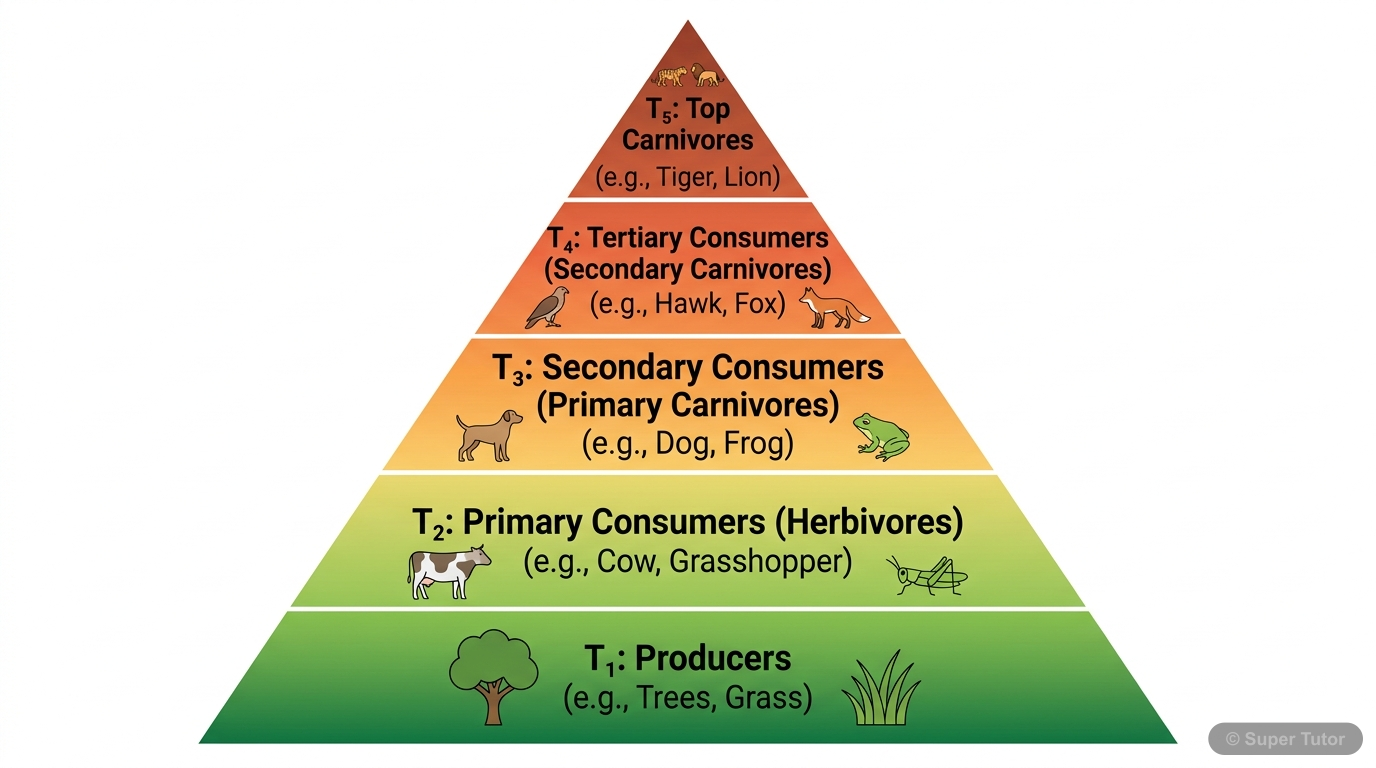
One of 10 illustrations for Our Environment in Super Tutor — alongside flashcards, concept maps and practice questions.
The first 7 solutions are open to read. The other 6 are free with a Super Tutor account.
Questions
1What are trophic levels? Give an example of a food chain and state the different trophic levels in it.Show solution
Trophic levels are the different steps or levels in a food chain, showing who eats whom.
Example of a food chain: grass → goat → human
- 1st trophic level: grass (producers)
- 2nd trophic level: goat (primary consumer)
- 3rd trophic level: human (secondary consumer)
So, each step in the food chain is a trophic level.
Questions
2Give any two ways in which biodegradable substances would affect the environment.Show solution
Any two ways biodegradable substances would affect the environment are:
- They are broken down by microorganisms and become part of the soil again.
- They help in the recycling of nutrients and natural replenishment of soil.
They may also cause pollution if dumped in large amounts before decomposing, but their main effect is that they do not persist for long.
Intext Questions (Page 216)
1What is ozone and how does it affect any ecosystem?Show solution
Given/Concept: Ozone is a molecule composed of three atoms of oxygen (O₃). It is found mainly in the upper atmosphere (stratosphere) forming the 'ozone layer'.
Formation:
Effect on the ecosystem:
- Protective role: The ozone layer acts as a shield and absorbs most of the harmful ultraviolet (UV) radiation coming from the Sun, preventing it from reaching the Earth's surface.
- If ozone is depleted: Increased UV radiation reaching the Earth can cause:
- Skin cancer and cataracts in humans and animals.
- Damage to phytoplankton and other producers in aquatic ecosystems, disrupting food chains.
- Reduced crop yields, affecting food availability.
- Mutations in organisms, disturbing biodiversity.
Conclusion: Ozone is essential for maintaining life on Earth; its depletion can severely damage every ecosystem.
2How can you help in reducing the problem of waste disposal? Give any two methods.Show solution
Two methods to reduce the problem of waste disposal:
Method 1 – Practice the 3R principle (Reduce, Reuse, Recycle):
- Reduce the amount of waste generated by avoiding unnecessary use of materials (e.g., carry cloth bags instead of plastic bags).
- Reuse items like glass bottles, paper, and containers instead of discarding them.
- Recycle materials such as paper, metal, and glass so they can be made into new products.
Method 2 – Segregate waste at source:
- Separate biodegradable waste (vegetable peels, food scraps) from non-biodegradable waste (plastic, glass, metal) at home.
- Biodegradable waste can be composted to make manure, reducing landfill burden.
- Non-biodegradable waste can be sent for proper recycling or disposal.
Conclusion: By adopting these practices individually, we can significantly reduce the pressure on waste disposal systems and protect the environment.
Exercises
1Which of the following groups contain only biodegradable items?
(a) Grass, flowers and leather
(b) Grass, wood and plastic
(c) Fruit-peels, cake and lime-juice
(d) Cake, wood and grassShow solution
Correct Answer: (c) Fruit-peels, cake and lime-juice
Justification:
- Biodegradable items are those that can be broken down by microorganisms (bacteria, fungi) into simpler substances.
- Fruit-peels, cake, and lime-juice are all organic materials of biological origin and are completely broken down by decomposers.
- Option (a) contains leather which decomposes very slowly and is often considered non-biodegradable in practical terms; however, the best and most clearly all-biodegradable group is (c).
- Option (b) contains plastic, which is non-biodegradable.
- Option (d): Cake, wood, and grass are all biodegradable — this is also a correct group.
Note: Both (c) and (d) are fully biodegradable. The most commonly accepted answer in NCERT is (d) Cake, wood and grass, as all three are clearly plant/organic-based biodegradable items. However, (c) is equally valid. The standard NCERT answer is (d).
2Which of the following constitute a food-chain?
(a) Grass, wheat and mango
(b) Grass, goat and human
(c) Goat, cow and elephant
(d) Grass, fish and goatShow solution
Correct Answer: (b) Grass, goat and human
Justification:
A food chain must show a feeding relationship where energy flows from producers to consumers.
- Grass (Producer) → Goat (Primary Consumer) → Human (Secondary Consumer). This is a valid food chain.
- Option (a): Grass, wheat, and mango are all producers — no feeding relationship.
- Option (c): Goat, cow, and elephant are all herbivores (primary consumers) — no sequential feeding.
- Option (d): Grass → Fish → Goat does not represent a natural feeding sequence (goats do not eat fish).
3Which of the following are environment-friendly practices?
(a) Carrying cloth-bags to put purchases in while shopping
(b) Switching off unnecessary lights and fans
(c) Walking to school instead of getting your mother to drop you on her scooter
(d) All of the aboveShow solution
Correct Answer: (d) All of the above
Justification:
- (a) Carrying cloth bags reduces the use of plastic bags, which are non-biodegradable and cause serious pollution.
- (b) Switching off unnecessary lights and fans conserves electrical energy, reducing the burning of fossil fuels and lowering carbon emissions.
- (c) Walking instead of using a motor vehicle reduces fuel consumption and decreases air pollution (no exhaust emissions).
All three practices reduce environmental damage, so (d) All of the above is correct.
Free with a Super Tutor account
Free with a Super Tutor account
Free with a Super Tutor account
Free with a Super Tutor account
Free with a Super Tutor account
Free with a Super Tutor account
6 more solved questions in Our Environment
They are free with a Super Tutor account, along with practice quizzes and flashcards for this chapter. Free to start, no card needed.
Frequently Asked Questions
What are the important topics in Our Environment for Madhya Pradesh Board Class 10 Science?
Are these NCERT Solutions for Our Environment free?
How should I revise Our Environment for the Madhya Pradesh Board Class 10 board exam?
Sources & Official References
Content is aligned to the official syllabus. Refer to the board website for the latest curriculum.
More resources for Our Environment
Practice Quiz
Test yourself with a quick quiz
Important Questions
Exam-style questions with answers
Revision Notes
Key points for last-minute revision
Chapter Summary
Understand the chapter at a glance
Concept Maps
See how topics connect
Study Plan
Step-by-step plan for this chapter
Flashcards
Quick-fire cards for active recall
Syllabus
What topics to cover
For serious students
Get the full Our Environment chapter — start free.
Quizzes, flashcards, an AI doubt solver and a study plan for Madhya Pradesh Board Class 10 Science. Free to start, no card needed.