Power-sharing — NCERT Solutions
Madhya Pradesh Board · Class 10 · Social Science
NCERT Solutions for Power-sharing, Madhya Pradesh Board Class 10 Social Science: 10 textbook questions solved step by step. Covers Exercise Questions.
Interactive on Super Tutor
Studying Power-sharing? Get the full interactive chapter.
Quizzes, flashcards, AI doubt-solver and a step-by-step study plan — built for NCERT solutions and more.
Free trial, no card needed.
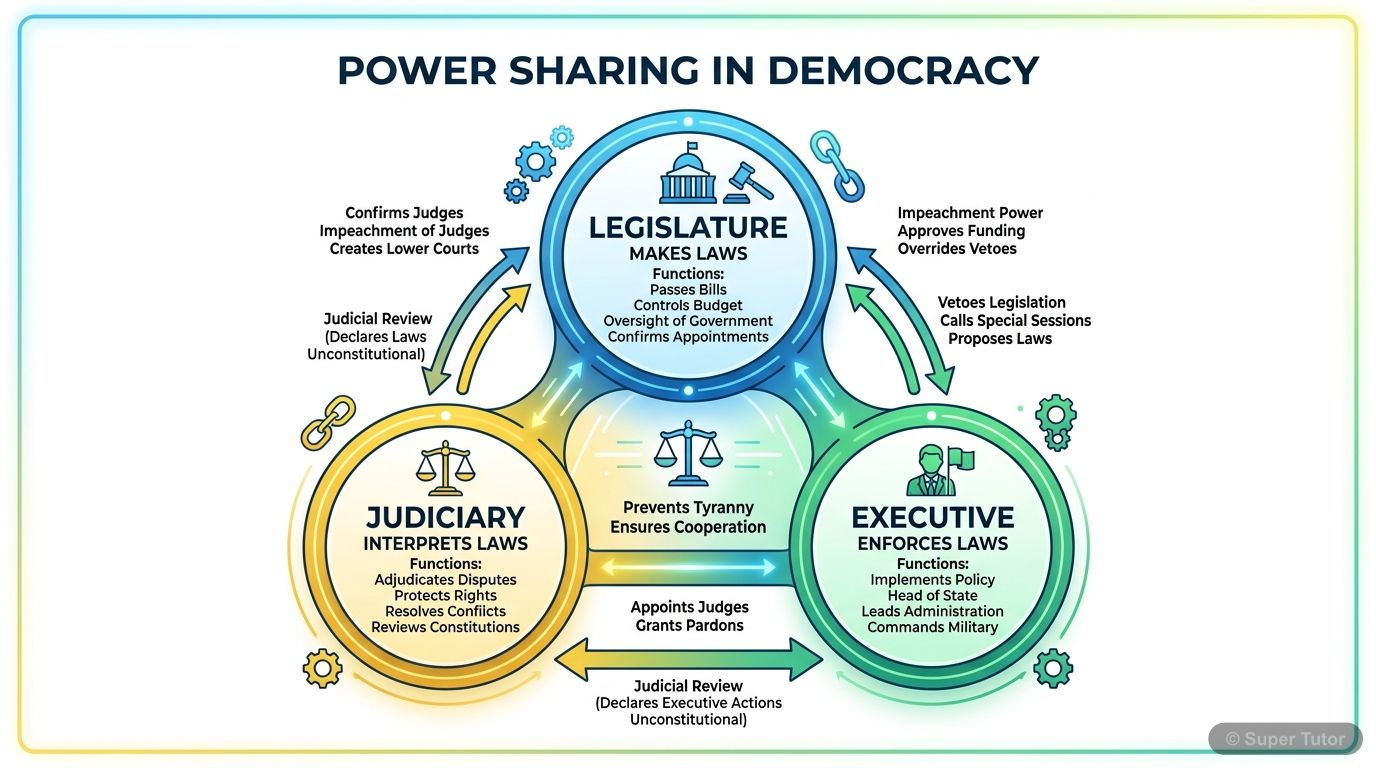
Learn better with visuals Super Tutor pairs illustrations like this with notes and quizzes for Power-sharing.
The first 5 solutions are open to read. The other 5 are free with a Super Tutor account.
Exercise Questions
Intext ActivityHere are some examples of power sharing. Which of the four types of power sharing do these represent? Who is sharing power with whom?
1. The Bombay High Court ordered the Maharashtra State Government to immediately take action and improve living conditions for the 2,000-odd children at seven children's homes in Mumbai.
2. The government of Ontario state in Canada has agreed to a land claim settlement with the aboriginal community.
3. Russia's two influential political parties, the Union of Right Forces and the Liberal Yabloko Movement, agreed to unite their organisations into a strong right-wing coalition.
4. The finance ministers of various states in Nigeria got together and demanded that the federal government declare its sources of income.Show solution
Example 1 — Bombay High Court vs. Maharashtra State Government:
- Type of power sharing: Power shared among different organs of government (Horizontal distribution of power).
- Who shares power with whom: The Judiciary (Bombay High Court) is exercising its power to check and direct the Executive (Maharashtra State Government). This is an example of the system of checks and balances where the judiciary checks the executive.
Example 2 — Ontario Government and Aboriginal Community (Canada):
- Type of power sharing: Power sharing among different social groups (Community/Social group power sharing).
- Who shares power with whom: The Ontario State Government is sharing power with the aboriginal (indigenous) community by recognising their land claims and working cooperatively with them.
Example 3 — Union of Right Forces and Liberal Yabloko Movement (Russia):
- Type of power sharing: Power sharing among political parties (forming a coalition).
- Who shares power with whom: Two political parties — the Union of Right Forces and the Liberal Yabloko Movement — are sharing power with each other by forming a coalition and presenting a common list of candidates.
Example 4 — Finance Ministers of Nigerian States vs. Federal Government:
- Type of power sharing: Power shared among governments at different levels (Vertical distribution / Federal power sharing).
- Who shares power with whom: The State Governments (represented by their finance ministers) are asserting their right to share power with the Federal (Central) Government of Nigeria by demanding transparency in revenue sources and distribution.
1What are the different forms of power sharing in modern democracies? Give an example of each of these.Show solution
Given/Concept: Power sharing is the very spirit of democracy. In modern democracies, power is shared in the following four main forms:
Form 1: Horizontal Distribution of Power (Among organs of government)
- Power is shared among the three organs of government — Legislature, Executive, and Judiciary.
- Each organ checks the others, creating a system of checks and balances.
- Example: In India, the Parliament (Legislature) makes laws, the Cabinet (Executive) implements them, and the Supreme Court (Judiciary) can strike down any law that violates the Constitution.
Form 2: Vertical Distribution of Power (Among governments at different levels)
- Power is shared among the Central (Federal) Government, State Governments, and Local Self-Government bodies.
- Example: In India, the Constitution divides powers between the Union Government and State Governments through the Union List, State List, and Concurrent List. Panchayati Raj institutions exercise power at the local level.
Form 3: Power Sharing Among Social Groups
- Power is shared among different social groups such as religious and linguistic minorities.
- Example: In India, the system of reserved constituencies in legislatures for Scheduled Castes and Scheduled Tribes ensures that these social groups have a share in political power.
Form 4: Power Sharing Among Political Parties, Pressure Groups, and Movements
- In a democracy, political parties compete for power, and sometimes form coalitions. Pressure groups and movements also influence decision-making.
- Example: The United Progressive Alliance (UPA) and the National Democratic Alliance (NDA) in India are examples of coalition governments where multiple parties share power.
Conclusion: These four forms ensure that power is not concentrated in one hand, making democracy more genuine and effective.
2State one prudential reason and one moral reason for power sharing with an example from the Indian context.Show solution
Concept: There are two broad categories of reasons for power sharing — Prudential (practical/result-oriented) and Moral (based on values and principles).
Prudential Reason for Power Sharing:
- Power sharing helps in reducing the possibility of conflict between different social groups, thereby ensuring the stability and unity of the country.
- If power is concentrated in one group, it may lead to resentment and conflict among those excluded.
- Indian Example: India is a diverse country with many religions, languages, and castes. By providing reservations for Scheduled Castes, Scheduled Tribes, and Other Backward Classes in legislatures and government jobs, power is shared with these groups. This reduces social tension and prevents conflict, thus maintaining social harmony and political stability.
Moral Reason for Power Sharing:
- Power sharing is intrinsically valuable. It is the very spirit of democracy. In a democracy, people have the right to be consulted on how they are governed. Power sharing gives every citizen a stake in governance.
- It upholds the values of self-governance, dignity, and equal participation.
- Indian Example: The 73rd and 74th Constitutional Amendments gave constitutional status to Panchayati Raj institutions and Urban Local Bodies. This ensures that ordinary citizens — including women (one-third reservation) — participate directly in governance. This is morally justified because it gives people control over their own lives and decisions, which is the essence of democracy.
Conclusion: Both prudential and moral reasons together make a strong case for power sharing in a democracy like India.
3After reading this chapter, three students drew different conclusions. Which of these do you agree with and why?
Thomman - Power sharing is necessary only in societies which have religious, linguistic or ethnic divisions.
Mathayi - Power sharing is suitable only for big countries that have regional divisions.
Ouseph - Every society needs some form of power sharing even if it is small or does not have social divisions.Show solution
I agree with Ouseph's conclusion.
Reasons:
- Power sharing is the spirit of democracy itself: Democracy means rule by the people. For this to be meaningful, power must be shared among all citizens and their representatives — not just concentrated in one person, group, or organ. This applies to every democratic society, regardless of its size or social composition.
- Checks and balances are universally needed: Even in a small, socially homogeneous country, power shared among the legislature, executive, and judiciary prevents authoritarianism and arbitrariness. Without this, even a small society can be misruled.
- Thomman is partially correct but incomplete: Social divisions do make power sharing more urgent, but they are not the only reason for it. Even without ethnic or religious divisions, power sharing is needed to ensure accountability and prevent the misuse of power.
- Mathayi is incorrect: Power sharing is not just about managing regional diversity. Small countries like Belgium (which is not very large) also need power sharing. The principle applies universally.
- Moral justification: Every citizen in every society has the right to participate in governance. This moral principle applies universally — to big and small countries alike.
Conclusion: Ouseph is correct. Power sharing is a fundamental requirement of any democratic society, irrespective of its size or the presence of social divisions.
4The Mayor of Merchtem, a town near Brussels in Belgium, has defended a ban on speaking French in the town's schools. He said that the ban would help all non-Dutch speakers integrate in this Flemish town. Do you think that this measure is in keeping with the spirit of Belgium's power sharing arrangements? Give your reasons in about 50 words.Show solution
Answer: No, this measure is NOT in keeping with the spirit of Belgium's power sharing arrangements.
Reasons:
- Belgium's power-sharing model was specifically designed to respect the linguistic and cultural rights of both the Dutch-speaking (Flemish) and French-speaking (Walloon) communities. The entire federal structure of Belgium is built on the principle of equal respect for both languages.
- Community Government: Belgium has a unique Community Government system where people of different linguistic communities have the power to legislate on cultural and educational matters. Banning French in schools directly violates the rights of the French-speaking community.
- Spirit of mutual respect: The Belgian model is based on mutual respect and accommodation, not on the dominance of one linguistic group over another. The Mayor's action imposes Dutch dominance, which is exactly the kind of majoritarian attitude that Belgium's power-sharing arrangements were designed to prevent.
- Forced integration vs. voluntary accommodation: True integration in a diverse society comes through accommodation and respect for differences, not by suppressing minority languages. Forcing non-Dutch speakers to give up French goes against the spirit of the Belgian Constitution.
Conclusion: The Mayor's ban is contrary to the spirit of Belgium's power-sharing arrangements, which are based on equal respect, accommodation of linguistic diversity, and protection of minority rights.
"We need to give more power to the panchayats to realise the dream of Mahatma Gandhi and the hopes of the makers of our Constitution. Panchayati Raj establishes true democracy. It restores power to the only place where power belongs in a democracy – in the hands of the people. Giving power to Panchayats is also a way to reduce corruption and increase administrative efficiency. When people participate in the planning and implementation of developmental schemes, they would naturally exercise greater control over these schemes. This would eliminate the corrupt middlemen. Thus, Panchayati Raj will strengthen the foundations of our democracy."
Free with a Super Tutor account
A. reduces conflict among different communities
B. decreases the possibility of arbitrariness
C. delays decision making process
D. accommodates diversities
E. increases instability and divisiveness
F. promotes people's participation in government
G. undermines the unity of a country
(a) A B D F
(b) A C E F
(c) A B D G
(d) B C D G
Free with a Super Tutor account
A. In Belgium, the Dutch-speaking majority people tried to impose their domination on the minority French-speaking community.
B. In Sri Lanka, the policies of the government sought to ensure the dominance of the Sinhala-speaking majority.
C. The Tamils in Sri Lanka demanded a federal arrangement of power sharing to protect their culture, language and equality of opportunity in education and jobs.
D. The transformation of Belgium from unitary government to a federal one prevented a possible division of the country on linguistic lines.
Which of the statements given above are correct?
(a) A, B, C and D
(b) A, B and D
(c) C and D
(d) B, C and D
Free with a Super Tutor account
List I:
1. Power shared among different organs of government
2. Power shared among governments at different levels
3. Power shared by different social groups
4. Power shared by two or more political parties
List II:
A. Community government
B. Separation of powers
C. Coalition government
D. Federal government
Free with a Super Tutor account
A. Power sharing is good for democracy.
B. It helps to reduce the possibility of conflict between social groups.
Which of these statements are true and false?
(a) A is true but B is false
(b) Both A and B are true
(c) Both A and B are false
(d) A is false but B is true
Free with a Super Tutor account
5 more solved questions in Power-sharing
They are free with a Super Tutor account, along with practice quizzes and flashcards for this chapter. Free to start, no card needed.
Frequently Asked Questions
What are the important topics in Power-sharing for Madhya Pradesh Board Class 10 Social Science?
Are these NCERT Solutions for Power-sharing free?
How should I revise Power-sharing for the Madhya Pradesh Board Class 10 board exam?
Sources & Official References
Content is aligned to the official syllabus. Refer to the board website for the latest curriculum.
More resources for Power-sharing
Practice Quiz
Test yourself with a quick quiz
Important Questions
Exam-style questions with answers
Revision Notes
Key points for last-minute revision
Chapter Summary
Understand the chapter at a glance
Concept Maps
See how topics connect
Study Plan
Step-by-step plan for this chapter
Flashcards
Quick-fire cards for active recall
Syllabus
What topics to cover
For serious students
Get the full Power-sharing chapter — start free.
Quizzes, flashcards, an AI doubt solver and a study plan for Madhya Pradesh Board Class 10 Social Science. Free to start, no card needed.