Transport and Communication (Part 2) — Chapter Summary
Madhya Pradesh Board · Class 12 · Geography
Summary of Transport and Communication (Part 2) for Madhya Pradesh Board Class 12 Geography. Part of the Madhya Pradesh Board Class 12 Geography syllabus.
Interactive on Super Tutor
Studying Transport and Communication? Get the full interactive chapter.
Quizzes, flashcards, AI doubt-solver and a step-by-step study plan — built for chapter summary and more.
Free trial, no card needed.
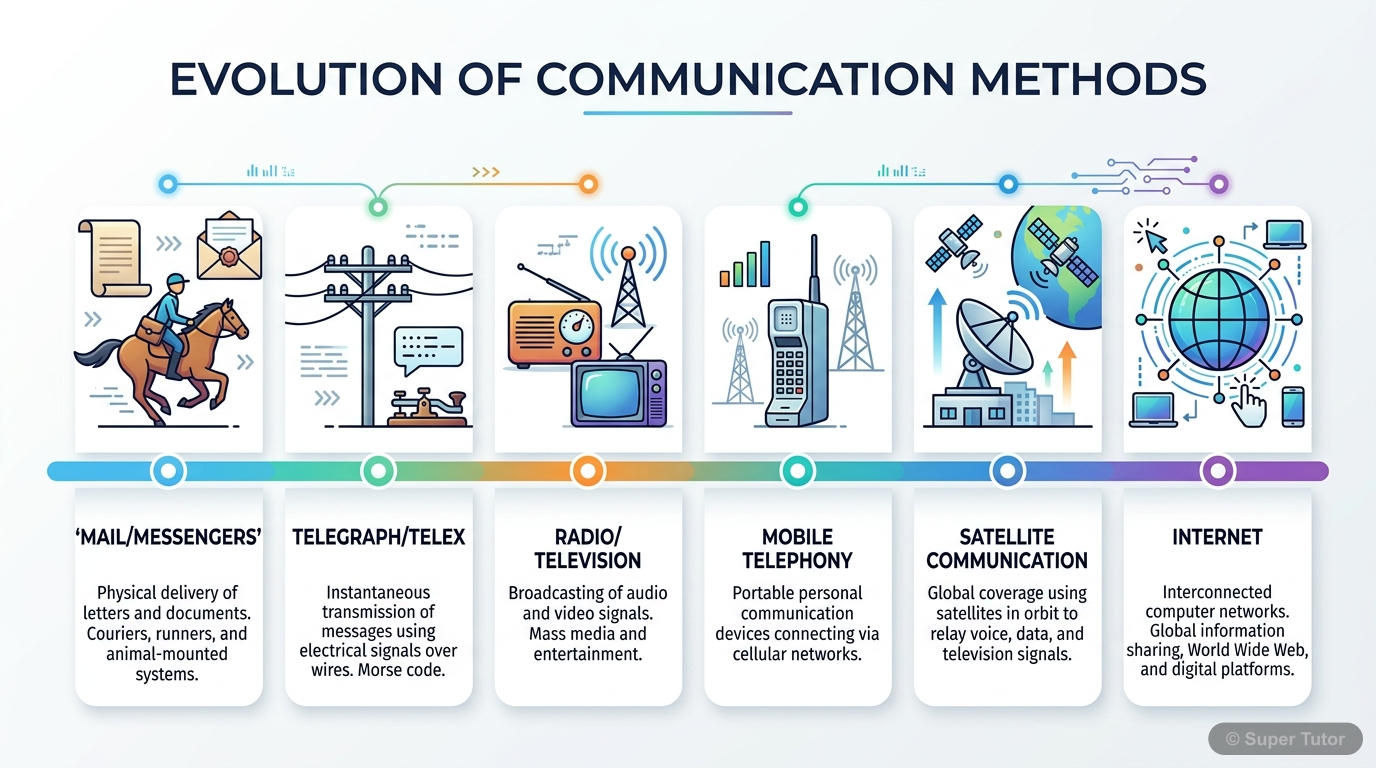
One of 17 illustrations for Transport and Communication in Super Tutor — alongside flashcards, concept maps and practice questions.
Overview
Transport and communication form the links that connect producing centres with consuming centres. They support trade, exchange, defence, cooperation, and unity across regions. Transport includes the movement of persons and goods by land, water, air, and pipelines, while communication creates the flo
Key Concepts
A transport network is formed by
A transport network is formed by several places joined together by a series of routes. The places act as nodes and the routes act as links.
Land transport includes roads and railways
Land transport includes roads and railways. It is the principal mode of world transportation and is important for both passengers and freight.
Before modern transport
Before modern transport, humans carried loads, and animals such as horses, dogs, reindeer, mules, camels, and bullocks were used according to local co
Roads are economical for short distances
Roads are economical for short distances and door-to-door service. Highways are metalled roads built for uninterrupted vehicular movement.
Railways are suited for bulky goods
Railways are suited for bulky goods and passengers over long distances. Rail gauges vary across countries, and rail density differs widely across regi
Learning Objectives
- Understand the meaning and role of transport and communication in human geography
- Identify the main modes of transport and their special uses
- Compare land, water, air, and pipeline transport
- Learn the main railway, road, sea, inland waterway, air, pipeline, and communication networks and examples
- Explain how modern communication systems have transformed global connectivity
Frequently Asked Questions
What are the important topics in Transport and Communication for Madhya Pradesh Board Class 12 Geography?
How should I revise Transport and Communication for the Madhya Pradesh Board Class 12 board exam?
Sources & Official References
Content is aligned to the official syllabus. Refer to the board website for the latest curriculum.
More resources for Transport and Communication
Practice Quiz
Test yourself with a quick quiz
Important Questions
Exam-style questions with answers
Revision Notes
Key points for last-minute revision
Concept Maps
See how topics connect
Study Plan
Step-by-step plan for this chapter
Flashcards
Quick-fire cards for active recall
Syllabus
What topics to cover
NCERT Solutions
Every textbook question solved step by step
For serious students
Get the full Transport and Communication chapter — start free.
Quizzes, flashcards, an AI doubt solver and a study plan for Madhya Pradesh Board Class 12 Geography. Free to start, no card needed.