Population : Distribution, Density, Growth and Composition — Chapter Summary
Madhya Pradesh Board · Class 12 · Geography
Summary of Population : Distribution, Density, Growth and Composition for Madhya Pradesh Board Class 12 Geography.
Interactive on Super Tutor
Studying Population : Distribution, Density, Growth and Composition? Get the full interactive chapter.
Quizzes, flashcards, AI doubt-solver and a step-by-step study plan — built for chapter summary and more.
Free trial, no card needed.
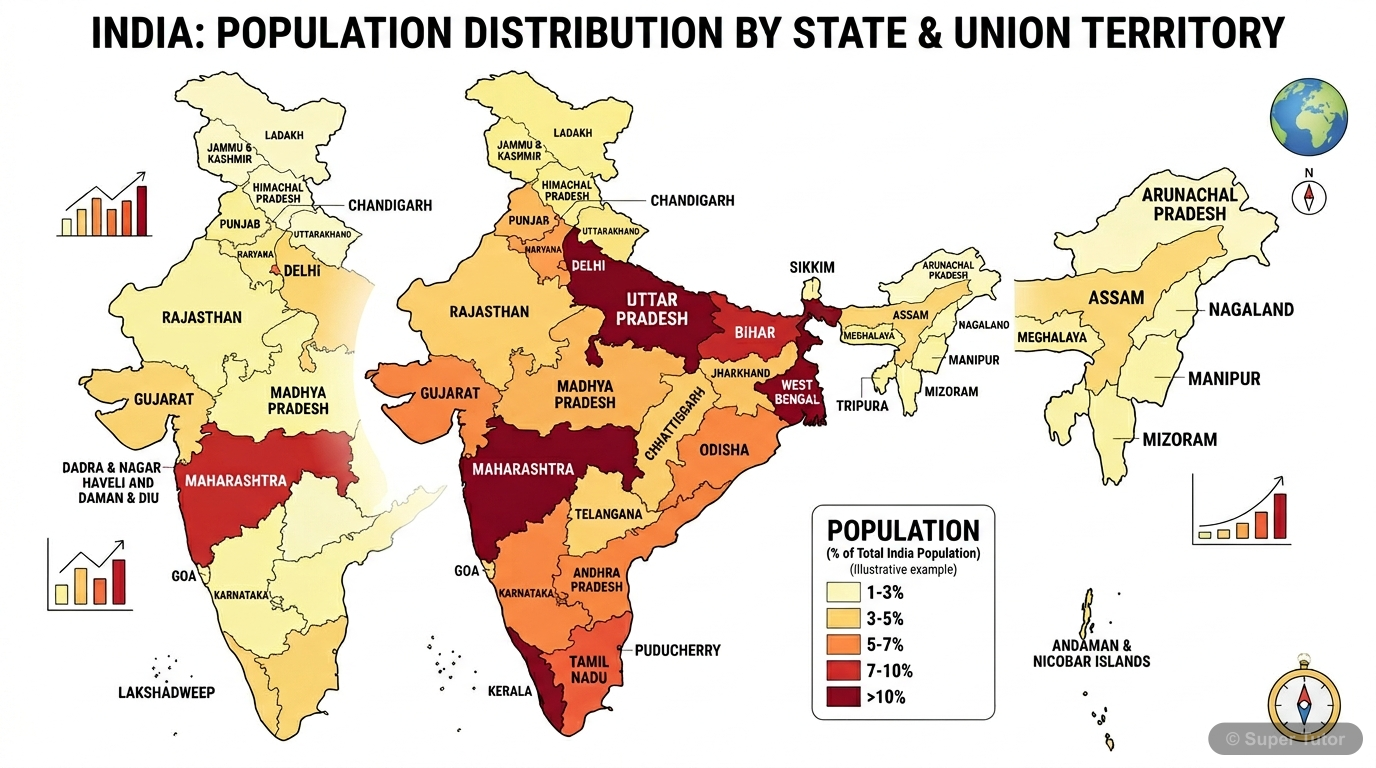
One of 8 illustrations for Population : Distribution, Density, Growth and Composition in Super Tutor — alongside flashcards, concept maps and practice questions.
Overview
India has a very large and unevenly distributed population. Population distribution, density, growth and composition together explain how people are spread across the country, how fast the population changes, and how the population is socially and economically structured. The chapter shows that popu
Key Concepts
Population distribution means the way people
Population distribution means the way people are spread across different regions. India shows a highly uneven pattern. Uttar Pradesh has the highest p
Population concentration is influenced by climate
Population concentration is influenced by climate, terrain, water availability, settled agriculture, transport, industrialisation and urbanisation. No
Density of population is the number
Density of population is the number of persons per unit area. India’s density was 382 persons per sq km in 2011, rising from 117 persons per sq km in
Physiological density = total population /
Physiological density = total population / net cultivated area. It measures pressure of population on cultivated land and is more refined than crude d
Agricultural density = total agricultural population
Agricultural density = total agricultural population / net cultivable area. Agricultural population includes cultivators, agricultural labourers and t
Learning Objectives
- Understand the meaning of population distribution, density, growth and composition
- Identify the causes of uneven population distribution in India
- Explain population density and distinguish crude density from physiological and agricultural density
- Describe the phases of population growth in India and their causes
- Recognise regional variations in growth, rural-urban pattern, language, religion and occupational structure
Frequently Asked Questions
What are the important topics in Population : Distribution, Density, Growth and Composition for Madhya Pradesh Board Class 12 Geography?
How should I revise Population : Distribution, Density, Growth and Composition for the Madhya Pradesh Board Class 12 board exam?
Sources & Official References
Content is aligned to the official syllabus. Refer to the board website for the latest curriculum.
More resources for Population : Distribution, Density, Growth and Composition
Practice Quiz
Test yourself with a quick quiz
Important Questions
Exam-style questions with answers
Revision Notes
Key points for last-minute revision
Formula Sheet
The chapter's formulas in one place
Concept Maps
See how topics connect
Study Plan
Step-by-step plan for this chapter
Flashcards
Quick-fire cards for active recall
Syllabus
What topics to cover
NCERT Solutions
Every textbook question solved step by step
For serious students
Get the full Population : Distribution, Density, Growth and Composition chapter — start free.
Quizzes, flashcards, an AI doubt solver and a study plan for Madhya Pradesh Board Class 12 Geography. Free to start, no card needed.