Transport and Communication — Chapter Summary
Madhya Pradesh Board · Class 12 · Geography
Summary of Transport and Communication for Madhya Pradesh Board Class 12 Geography. Part of the Madhya Pradesh Board Class 12 Geography syllabus.
Interactive on Super Tutor
Studying Transport and Communication? Get the full interactive chapter.
Quizzes, flashcards, AI doubt-solver and a step-by-step study plan — built for chapter summary and more.
Free trial, no card needed.
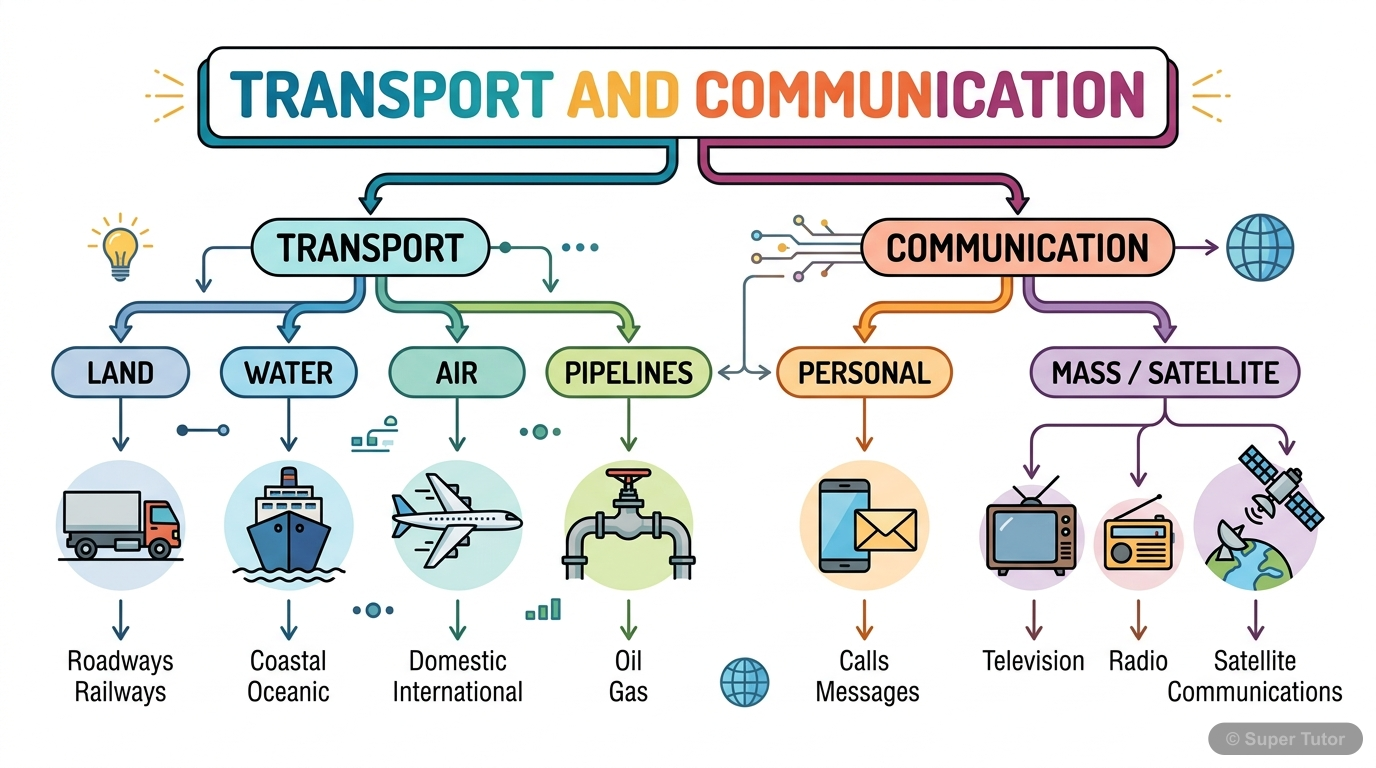
One of 9 illustrations for Transport and Communication in Super Tutor — alongside flashcards, concept maps and practice questions.
Overview
Transport and communication form the backbone of economic and social life. Transport moves goods, people, and raw materials from one place to another, while communication carries ideas, messages, and information. In India, these systems link production with markets, connect remote regions with citie
Key Concepts
India has about 62
India has about 62.16 lakh km of road length, one of the second largest road networks in the world. Roads carry about 85% of passenger traffic and 70%
Roads are classified for construction
Roads are classified for construction and maintenance purposes into National Highways, State Highways, Major District Roads, and Rural Roads. Other ro
National Highways are constructed and maintained
National Highways are constructed and maintained by the Central Government. They are meant for inter-state transport and defence movement, and they co
The first serious attempt at road
The first serious attempt at road planning was the Nagpur Plan of 1943. The twenty-year road plan was introduced in 1961. Major road projects include
The Border Road Organisation was established
The Border Road Organisation was established in May 1960 for economic development and defence preparedness along the northern and north-eastern bounda
Learning Objectives
- Understand the major means of transport in India and their role in economic development
- Identify the main categories of roads, railways, waterways, air transport, pipelines, and communication systems
- Explain the growth, distribution, and importance of transport networks in India
- Recognise the role of modern communication systems in linking people, markets, and institutions
- Relate transport and communication to regional development, trade, defence, and national integration
Frequently Asked Questions
What are the important topics in Transport and Communication for Madhya Pradesh Board Class 12 Geography?
How should I revise Transport and Communication for the Madhya Pradesh Board Class 12 board exam?
Sources & Official References
Content is aligned to the official syllabus. Refer to the board website for the latest curriculum.
More resources for Transport and Communication
Practice Quiz
Test yourself with a quick quiz
Important Questions
Exam-style questions with answers
Revision Notes
Key points for last-minute revision
Concept Maps
See how topics connect
Study Plan
Step-by-step plan for this chapter
Flashcards
Quick-fire cards for active recall
Syllabus
What topics to cover
NCERT Solutions
Every textbook question solved step by step
For serious students
Get the full Transport and Communication chapter — start free.
Quizzes, flashcards, an AI doubt solver and a study plan for Madhya Pradesh Board Class 12 Geography. Free to start, no card needed.