Planning and Sustainable Development in Indian Context — Chapter Summary
Madhya Pradesh Board · Class 12 · Geography
Summary of Planning and Sustainable Development in Indian Context for Madhya Pradesh Board Class 12 Geography.
Interactive on Super Tutor
Studying Planning and Sustainable Development in Indian Context? Get the full interactive chapter.
Quizzes, flashcards, AI doubt-solver and a step-by-step study plan — built for chapter summary and more.
Free trial, no card needed.
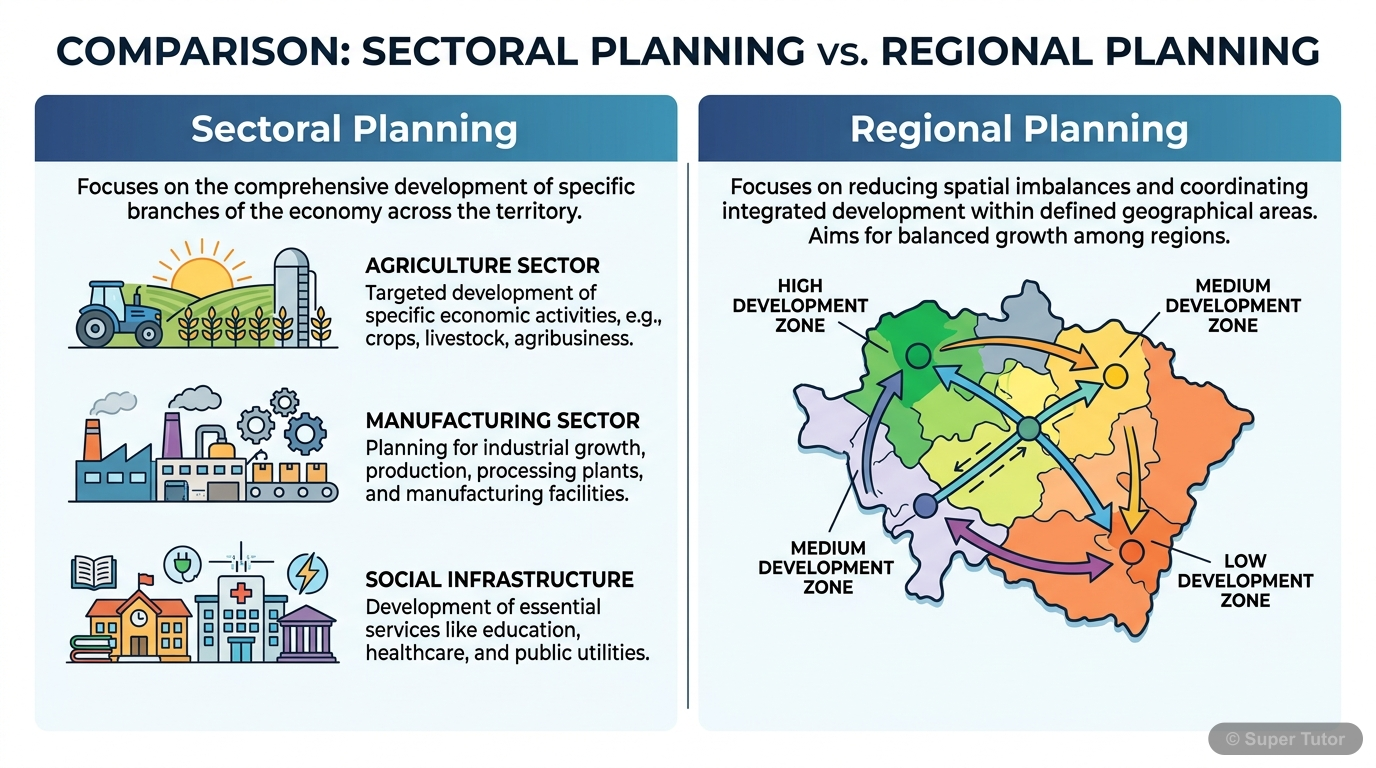
One of 10 illustrations for Planning and Sustainable Development in Indian Context in Super Tutor — alongside flashcards, concept maps and practice questions.
Overview
Planning in India moved from a centralised system after Independence to a decentralised multi-level system with NITI Aayog replacing the Planning Commission on 1 January 2015. The chapter explains two major approaches to planning, the need for target area and target group programmes, and the idea of
Key Concepts
Planning is the process of thinking
Planning is the process of thinking, formulating a scheme or programme, and implementing actions to achieve a goal. In economic development, it helps
NITI Aayog was formed on 1
NITI Aayog was formed on 1 January 2015, replacing the Planning Commission. It involves states in economic policy making and provides strategic and te
Sectoral planning means formulation and implementation
Sectoral planning means formulation and implementation of schemes or programmes aimed at developing different sectors of the economy such as agricultu
Regional planning is planning that addresses
Regional planning is planning that addresses uneven development across space and aims to reduce regional imbalance.
This approach focuses on backward areas
This approach focuses on backward areas that need special attention because regional imbalances have become more pronounced.
Learning Objectives
- Understand the meaning of planning in economic development
- Differentiate between sectoral planning and regional planning
- Explain target area and target group approaches to planning
- Describe special area programmes for hill, drought-prone, tribal and backward regions
- Understand the concept and evolution of sustainable development
Frequently Asked Questions
What are the important topics in Planning and Sustainable Development in Indian Context for Madhya Pradesh Board Class 12 Geography?
How should I revise Planning and Sustainable Development in Indian Context for the Madhya Pradesh Board Class 12 board exam?
Sources & Official References
Content is aligned to the official syllabus. Refer to the board website for the latest curriculum.
More resources for Planning and Sustainable Development in Indian Context
Practice Quiz
Test yourself with a quick quiz
Important Questions
Exam-style questions with answers
Revision Notes
Key points for last-minute revision
Concept Maps
See how topics connect
Study Plan
Step-by-step plan for this chapter
Flashcards
Quick-fire cards for active recall
Syllabus
What topics to cover
NCERT Solutions
Every textbook question solved step by step
For serious students
Get the full Planning and Sustainable Development in Indian Context chapter — start free.
Quizzes, flashcards, an AI doubt solver and a study plan for Madhya Pradesh Board Class 12 Geography. Free to start, no card needed.