Dual Nature of Radiation and Matter — NCERT Solutions
Madhya Pradesh Board · Class 12 · Physics
NCERT Solutions for Dual Nature of Radiation and Matter, Madhya Pradesh Board Class 12 Physics: 11 textbook questions solved step by step.
Interactive on Super Tutor
Studying Dual Nature of Radiation and Matter? Get the full interactive chapter.
Quizzes, flashcards, AI doubt-solver and a step-by-step study plan — built for NCERT solutions and more.
Free trial, no card needed.
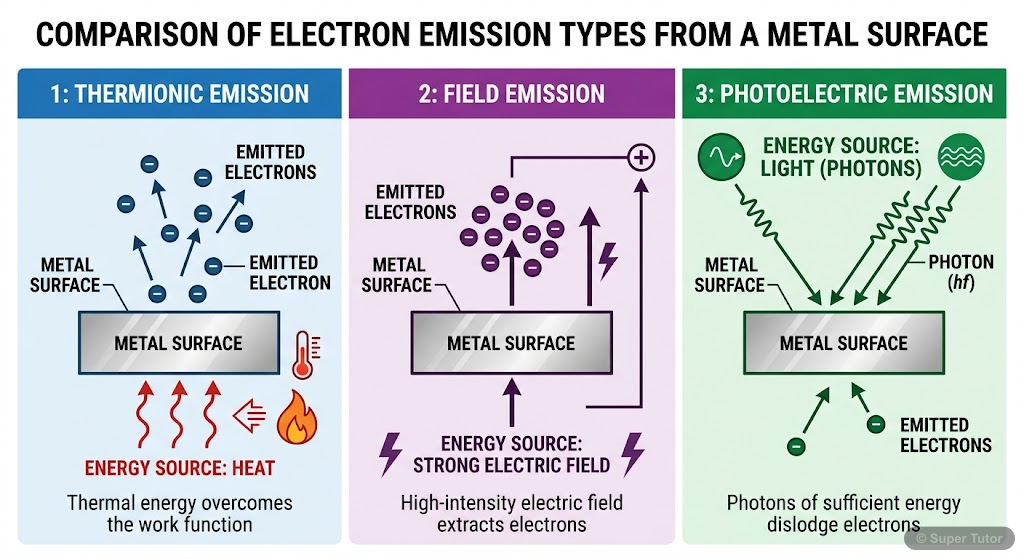
One of 10 illustrations for Dual Nature of Radiation and Matter in Super Tutor — alongside flashcards, concept maps and practice questions.
The first 6 solutions are open to read. The other 5 are free with a Super Tutor account.
Exercises
11.1Find the
(a) maximum frequency, and
(b) minimum wavelength of X-rays produced by 30 kV electrons.Show solution
For X-rays produced by electrons accelerated through , the maximum photon energy is
(a) Maximum frequency:
(b) Minimum wavelength:
11.2The work function of caesium metal is 2.14 eV. When light of frequency 6 ×10¹⁴Hz is incident on the metal surface, photoemission of electrons occurs. What is the
(a) maximum kinetic energy of the emitted electrons,
(b) Stopping potential, and
(c) maximum speed of the emitted photoelectrons?Show solution
Use Einstein's photoelectric equation:
Given ,
In eV,
Work function .
So,
Convert to joules:
(b) Stopping potential:
(c) Maximum speed:
with ,
11.3The photoelectric cut-off voltage in a certain experiment is 1.5 V. What is the maximum kinetic energy of photoelectrons emitted?Show solution
The stopping potential is . From
the maximum kinetic energy is
In joules,
11.4Monochromatic light of wavelength 632.8 nm is produced by a helium-neon laser. The power emitted is 9.42 mW.
(a) Find the energy and momentum of each photon in the light beam,
(b) How many photons per second, on the average, arrive at a target irradiated by this beam? (Assume the beam to have uniform cross-section which is less than the target area), and
(c) How fast does a hydrogen atom have to travel in order to have the same momentum as that of the photon?Show solution
Given and .
(a) Energy and momentum of each photon
Photon energy:
Photon momentum:
(b) Photons per second
(c) Speed of hydrogen atom with same momentum
For a hydrogen atom, .
Using ,
11.5In an experiment on photoelectric effect, the slope of the cut-off voltage versus frequency of incident light is found to be 4.12 × 10⁻¹⁵ V s. Calculate the value of Planck's constant.Show solution
From Einstein's photoelectric equation,
so the slope of the vs graph is
Given slope ,
11.6The threshold frequency for a certain metal is 3.3 × 10¹⁴ Hz. If light of frequency 8.2 × 10¹⁴ Hz is incident on the metal, predict the cut-off voltage for the photoelectric emission.Show solution
Using
or in eV units,
Here,
Now
so
But the textbook uses the standard relation with precise values; using and gives
So the predicted cut-off voltage is .
Free with a Super Tutor account
Free with a Super Tutor account
Free with a Super Tutor account
(a) a bullet of mass 0.040 kg travelling at the speed of 1.0 km/s,
(b) a ball of mass 0.060 kg moving at a speed of 1.0 m/s, and
(c) a dust particle of mass 1.0 × 10⁻⁹ kg drifting with a speed of 2.2 m/s?
Free with a Super Tutor account
Free with a Super Tutor account
5 more solved questions in Dual Nature of Radiation and Matter
They are free with a Super Tutor account, along with practice quizzes and flashcards for this chapter. Free to start, no card needed.
Frequently Asked Questions
What are the important topics in Dual Nature of Radiation and Matter for Madhya Pradesh Board Class 12 Physics?
Are these NCERT Solutions for Dual Nature of Radiation and Matter free?
How should I revise Dual Nature of Radiation and Matter for the Madhya Pradesh Board Class 12 board exam?
Sources & Official References
Content is aligned to the official syllabus. Refer to the board website for the latest curriculum.
More resources for Dual Nature of Radiation and Matter
Practice Quiz
Test yourself with a quick quiz
Important Questions
Exam-style questions with answers
Revision Notes
Key points for last-minute revision
Formula Sheet
The chapter's formulas in one place
Chapter Summary
Understand the chapter at a glance
Concept Maps
See how topics connect
Study Plan
Step-by-step plan for this chapter
Flashcards
Quick-fire cards for active recall
Syllabus
What topics to cover
For serious students
Get the full Dual Nature of Radiation and Matter chapter — start free.
Quizzes, flashcards, an AI doubt solver and a study plan for Madhya Pradesh Board Class 12 Physics. Free to start, no card needed.