Moving Charges and Magnetism — NCERT Solutions
Madhya Pradesh Board · Class 12 · Physics
NCERT Solutions for Moving Charges and Magnetism, Madhya Pradesh Board Class 12 Physics: 13 textbook questions solved step by step.
Interactive on Super Tutor
Studying Moving Charges and Magnetism? Get the full interactive chapter.
Quizzes, flashcards, AI doubt-solver and a step-by-step study plan — built for NCERT solutions and more.
Free trial, no card needed.
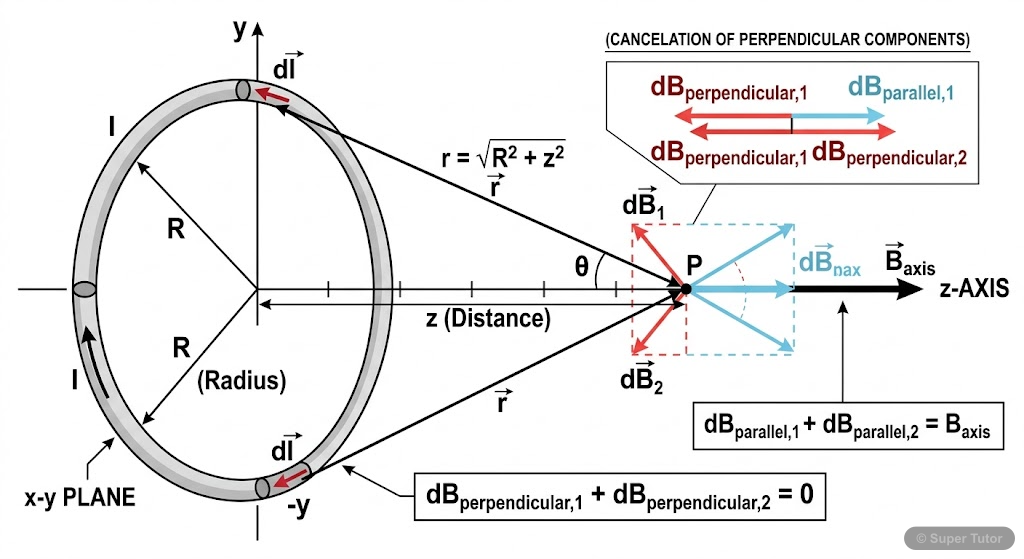
One of 16 illustrations for Moving Charges and Magnetism in Super Tutor — alongside flashcards, concept maps and practice questions.
The first 7 solutions are open to read. The other 6 are free with a Super Tutor account.
EXERCISES — Moving Charges and Magnetism
4.1A circular coil of wire consisting of 100 turns, each of radius 8.0 cm carries a current of 0.40 A. What is the magnitude of the magnetic field B at the centre of the coil?Show solution
Given:
- Number of turns,
- Radius of coil,
- Current,
Formula used:
The magnetic field at the centre of a circular coil of turns is:
Calculation:
Answer: The magnitude of the magnetic field at the centre of the coil is .
4.2A long straight wire carries a current of 35 A. What is the magnitude of the field B at a point 20 cm from the wire?Show solution
Given:
- Current,
- Distance from wire,
Formula used:
The magnetic field at a perpendicular distance from a long straight wire is:
Calculation:
Answer: The magnitude of the magnetic field at a point 20 cm from the wire is .
4.3A long straight wire in the horizontal plane carries a current of 50 A in north to south direction. Give the magnitude and direction of B at a point 2.5 m east of the wire.Show solution
Given:
- Current, (flowing from North to South)
- Distance from wire, (point is to the East)
Formula used:
Calculation:
Direction:
Using the right-hand thumb rule: Point the thumb of the right hand in the direction of current (North to South, i.e., direction). The fingers curl from East (where the point is) in the downward direction.
Alternatively, using : The current is in the (South) direction, the point is in the (East) direction. The field direction is ...
More carefully: , i.e., vertically upward.
Answer: The magnitude of the magnetic field is and it is directed vertically upward (out of the horizontal plane).
4.4A horizontal overhead power line carries a current of 90 A in east to west direction. What is the magnitude and direction of the magnetic field due to the current 1.5 m below the line?Show solution
Given:
- Current, (flowing East to West)
- Distance below the line,
Formula used:
Calculation:
Direction:
The current flows from East to West (i.e., in the direction). The point is 1.5 m below the wire (i.e., in the direction).
Using the right-hand thumb rule: Point the thumb in the direction of current (East to West). The field lines form circles around the wire. At a point directly below the wire, the field is directed towards the South (i.e., direction).
Verification: (South). ✓
Answer: The magnitude of the magnetic field is and it is directed towards the South.
4.5What is the magnitude of magnetic force per unit length on a wire carrying a current of 8 A and making an angle of 30° with the direction of a uniform magnetic field of 0.15 T?Show solution
Given:
- Current,
- Angle between wire and magnetic field,
- Magnetic field,
Formula used:
The force on a current-carrying conductor is .
Therefore, force per unit length is:
Calculation:
Answer: The magnitude of the magnetic force per unit length on the wire is .
4.6A 3.0 cm wire carrying a current of 10 A is placed inside a solenoid perpendicular to its axis. The magnetic field inside the solenoid is given to be 0.27 T. What is the magnetic force on the wire?Show solution
Given:
- Length of wire,
- Current,
- Magnetic field inside solenoid,
- Angle between wire and field, (wire is perpendicular to the axis, and the field is along the axis)
Formula used:
Calculation:
Answer: The magnetic force on the wire is .
4.7Two long and parallel straight wires A and B carrying currents of 8.0 A and 5.0 A in the same direction are separated by a distance of 4.0 cm. Estimate the force on a 10 cm section of wire A.Show solution
Given:
- Current in wire A,
- Current in wire B,
- Separation between wires,
- Length of section considered,
Formula used:
The force per unit length between two parallel current-carrying wires is:
So the force on a length of wire A is:
Calculation:
Nature of force: Since the currents are in the same direction, the force is attractive.
Answer: The force on a 10 cm section of wire A is , and it is attractive (directed towards wire B).
Free with a Super Tutor account
Free with a Super Tutor account
(The spring constants are identical for the two meters.)
Determine the ratio of (a) current sensitivity and (b) voltage sensitivity of M₂ and M₁.
Free with a Super Tutor account
Free with a Super Tutor account
Free with a Super Tutor account
(b) Would your answer change, if the circular coil in (a) were replaced by a planar coil of some irregular shape that encloses the same area? (All other particulars are also unaltered.)
Free with a Super Tutor account
6 more solved questions in Moving Charges and Magnetism
They are free with a Super Tutor account, along with practice quizzes and flashcards for this chapter. Free to start, no card needed.
Frequently Asked Questions
What are the important topics in Moving Charges and Magnetism for Madhya Pradesh Board Class 12 Physics?
Are these NCERT Solutions for Moving Charges and Magnetism free?
How should I revise Moving Charges and Magnetism for the Madhya Pradesh Board Class 12 board exam?
Sources & Official References
Content is aligned to the official syllabus. Refer to the board website for the latest curriculum.
More resources for Moving Charges and Magnetism
Practice Quiz
Test yourself with a quick quiz
Important Questions
Exam-style questions with answers
Revision Notes
Key points for last-minute revision
Formula Sheet
The chapter's formulas in one place
Chapter Summary
Understand the chapter at a glance
Concept Maps
See how topics connect
Study Plan
Step-by-step plan for this chapter
Flashcards
Quick-fire cards for active recall
Syllabus
What topics to cover
For serious students
Get the full Moving Charges and Magnetism chapter — start free.
Quizzes, flashcards, an AI doubt solver and a study plan for Madhya Pradesh Board Class 12 Physics. Free to start, no card needed.